Mahaweni Niken M, Ehlers Femke A I, Sarkar Subhashis, Janssen Johanna W H, Tilanus Marcel G J, Bos Gerard M J, Wieten Lotte
Division of Hematology, Department of Internal Medicine, Maastricht University Medical Center+, Maastricht, Netherlands.
GROW School for Oncology and Developmental Biology, Maastricht University, Maastricht, Netherlands.
Front Immunol. 2018 Jun 22;9:1415. doi: 10.3389/fimmu.2018.01415. eCollection 2018.
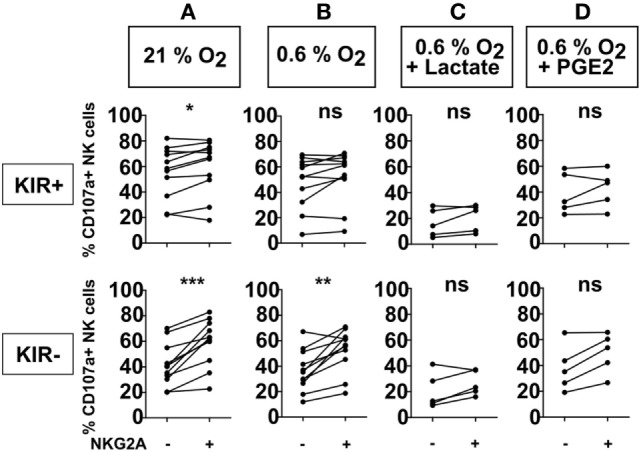
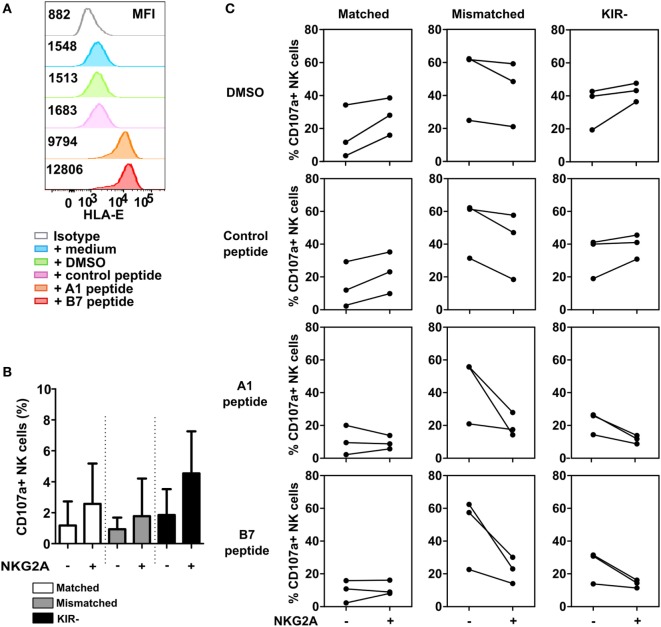
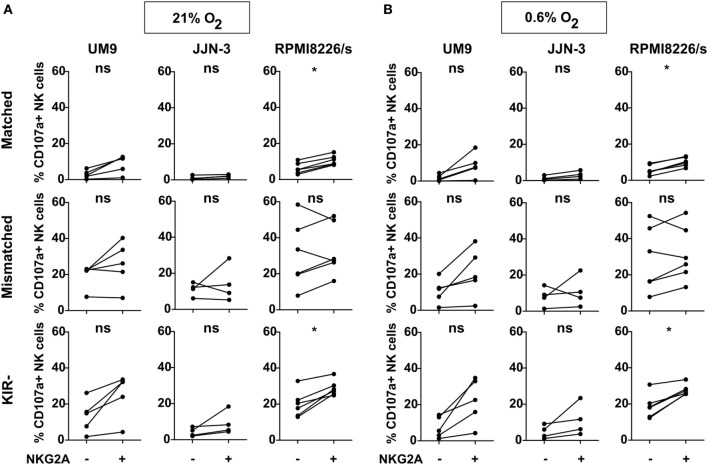
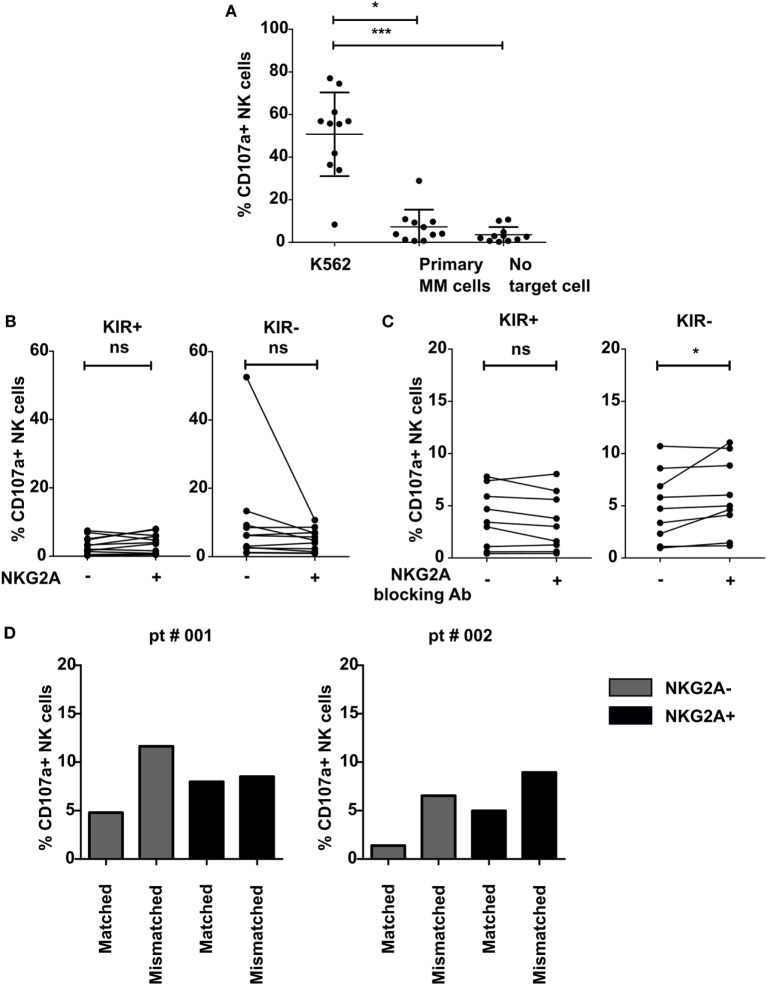
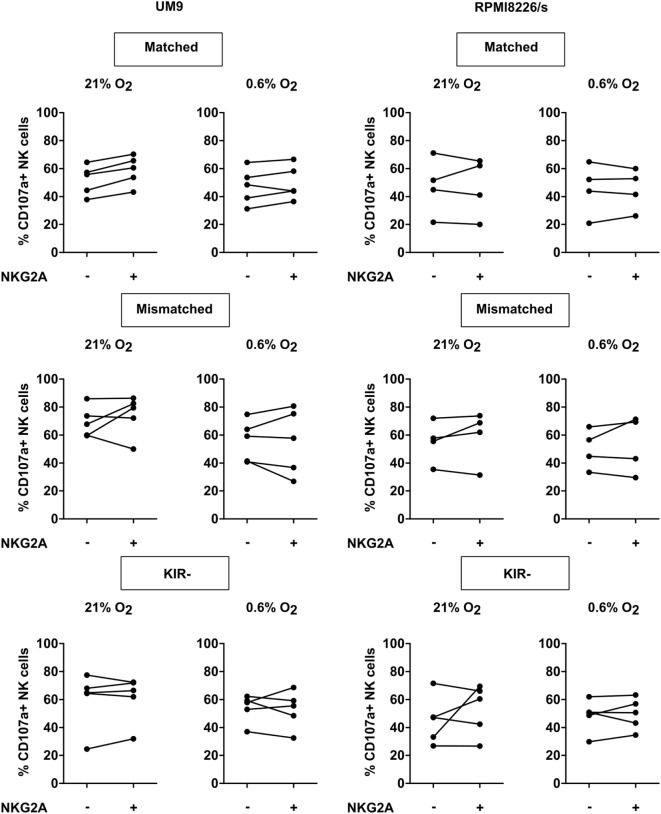
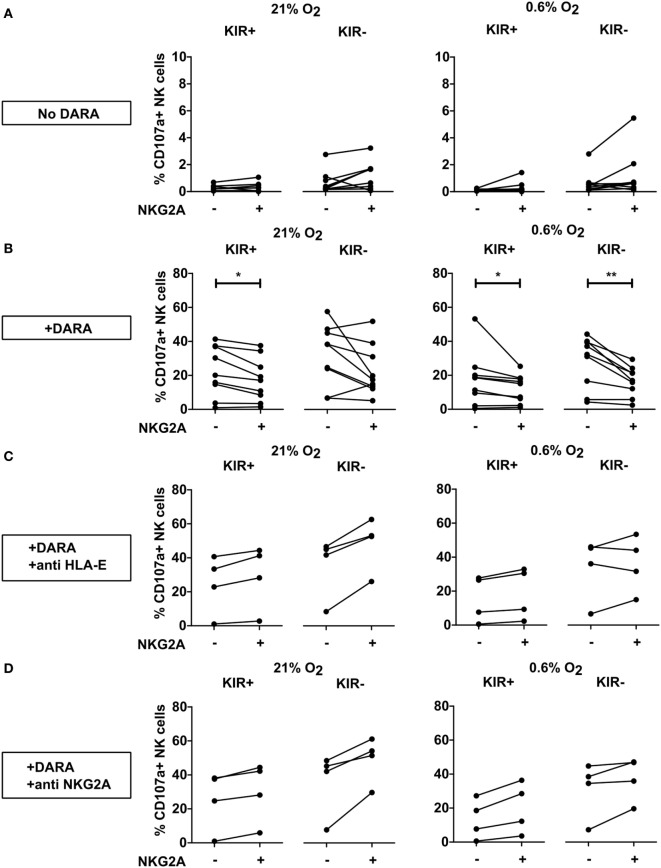
Natural killer (NK) cell-based immunotherapy is a promising therapy for cancer patients. Inhibitory killer immunoglobulin-like receptors (KIRs) and NKG2A are required for NK cell licensing, but can also inhibit NK cell effector function. Upon reconstitution in a stem cell transplantation setting or after NK expansion with IL-2, NKG2A is expressed on a large percentage of NK cells. Since the functional consequences of NKG2A co-expression for activated NK cells are not well known, we compared NKG2A+ vs NKG2A- NK cell subsets in response to K562 cells, multiple myeloma (MM) cell lines and primary MM cells. NK cells were isolated from healthy donors (HLA-C1+C2+Bw4+) and activated overnight with 1,000 U/ml IL-2. NK cell degranulation in subsets expressing KIRs and/or NKG2A was assessed at 21 or 0.6% O. Activated NKG2A+ NK cell subsets degranulated more vigorously than NKG2A- subsets both at 21 and 0.6% O. This was irrespective of the presence of KIR and occurred in response to HLA-deficient K562 cells as well as HLA competent, lowly expressing HLA-E MM cell lines. In response to primary MM cells, no inhibitory effects of NKG2A were observed, and NKG2A blockade did not enhance degranulation of NKG2A+ subsets. KIR- NK cells expressing NKG2A degranulated less than their NKG2A- counterparts in response to MM cells having high levels of peptide-induced membrane HLA-E, suggesting that high surface HLA-E levels are required for NKG2A to inhibit activated NK cells. Addition of daratumumab, an anti-CD38 to trigger antibody-dependent cell-mediated cytotoxicity, improved the anti-MM response for all subsets and degranulation of the KIR-NKG2A- "unlicensed" subset was comparable to KIR+ or NKG2A+ licensed subsets. This demonstrates that with potent activation, all subsets can contribute to tumor clearance. Additionally, subsets expressing KIRs mismatched with the HLA ligands on the target cell had the highest level of activation in response to MM cell lines as well as against primary MM. Our current study demonstrated that if NK cells are sufficiently activated, e.g., cytokine or antibody activation, the (co-)expression of NKG2A receptor may not necessarily be a disadvantage for NK cell-based therapy.
基于自然杀伤(NK)细胞的免疫疗法是一种很有前景的癌症治疗方法。抑制性杀伤细胞免疫球蛋白样受体(KIR)和NKG2A是NK细胞获得许可所必需的,但也会抑制NK细胞的效应功能。在干细胞移植环境中重建后或用白细胞介素-2(IL-2)扩增NK细胞后,很大比例的NK细胞会表达NKG2A。由于NKG2A共表达对活化NK细胞的功能影响尚不清楚,我们比较了NKG2A+和NKG2A- NK细胞亚群对K562细胞、多发性骨髓瘤(MM)细胞系和原发性MM细胞的反应。从健康供体(HLA-C1+C2+Bw4+)中分离出NK细胞,并用1000 U/ml的IL-2过夜激活。在21%或0.6%氧气浓度下评估表达KIR和/或NKG2A的亚群中的NK细胞脱颗粒情况。在21%和0.6%氧气浓度下,活化的NKG2A+ NK细胞亚群的脱颗粒比NKG2A-亚群更强烈。这与KIR的存在无关,并且在对缺乏HLA的K562细胞以及具有HLA能力、低表达HLA-E的MM细胞系的反应中都会发生。在对原发性MM细胞的反应中,未观察到NKG2A的抑制作用,并且NKG2A阻断并未增强NKG2A+亚群的脱颗粒。表达NKG2A的KIR- NK细胞在对具有高水平肽诱导膜HLA-E的MM细胞的反应中,其脱颗粒比其NKG2A-对应细胞少,这表明NKG2A抑制活化NK细胞需要高水平的表面HLA-E。添加达雷妥尤单抗(一种抗CD38抗体,用于触发抗体依赖性细胞介导的细胞毒性)可改善所有亚群的抗MM反应,并且KIR-NKG2A-“未获得许可”亚群的脱颗粒与KIR+或NKG2A+获得许可的亚群相当。这表明在有效激活的情况下,所有亚群都可以促进肿瘤清除。此外,表达与靶细胞上HLA配体不匹配的KIR的亚群在对MM细胞系以及原发性MM的反应中具有最高水平的激活。我们目前的研究表明,如果NK细胞被充分激活,例如通过细胞因子或抗体激活,NKG2A受体的(共)表达不一定对基于NK细胞的治疗不利。