Division of Hematology, Department of Internal Medicine, Maastricht University Medical Center+, Maastricht, Netherlands.
GROW School for Oncology and Developmental Biology, Maastricht University, Maastricht, Netherlands.
Front Immunol. 2018 Dec 4;9:2848. doi: 10.3389/fimmu.2018.02848. eCollection 2018.
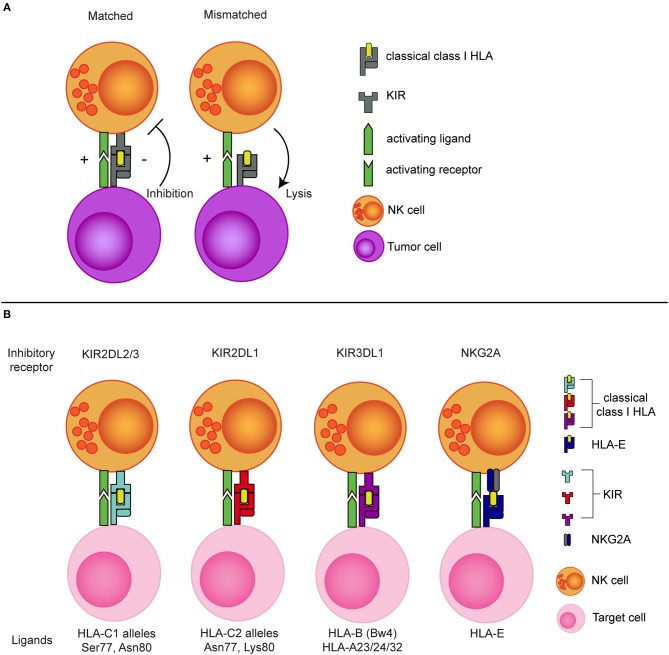
Natural killer (NK) cells are attractive candidates for allogeneic cell-based immunotherapy due to their potent antitumor effector function and good safety profile. NK cells express killer immunoglobulin-like receptors (KIRs) and the NKG2A receptor important for NK cells education as well as providing inhibitory signals upon encountering HLA-expressing target cells. Multiple myeloma (MM) is an example of a tumor expressing relatively high levels of HLA molecules. In this review, we discuss the functional relevance of inhibitory KIRs and NKG2A for NK cells anti-MM response and strategies to lower these inhibitory signaling to enhance clinical efficacy of allogeneic NK cells in MM.
自然杀伤 (NK) 细胞因其强大的抗肿瘤效应功能和良好的安全性而成为异体细胞为基础的免疫治疗的理想候选者。NK 细胞表达杀伤免疫球蛋白样受体 (KIRs) 和 NKG2A 受体,这些受体对于 NK 细胞的教育以及在遇到表达 HLA 的靶细胞时提供抑制信号很重要。多发性骨髓瘤 (MM) 是一种表达相对高水平 HLA 分子的肿瘤的例子。在这篇综述中,我们讨论了抑制性 KIRs 和 NKG2A 对 NK 细胞抗 MM 反应的功能相关性,以及降低这些抑制性信号的策略,以增强异体 NK 细胞在 MM 中的临床疗效。