Chao Hann-Hsiang, Valdes Gilmer, Luna Jose M, Heskel Marina, Berman Abigail T, Solberg Timothy D, Simone Charles B
Department of Radiation Oncology, University of Pennsylvania, Philadelphia, PA, USA.
Department of Radiation Oncology, University of California - San Francisco, San Francisco, CA, USA.
J Appl Clin Med Phys. 2018 Sep;19(5):539-546. doi: 10.1002/acm2.12415. Epub 2018 Jul 10.
Chest wall toxicity is observed after stereotactic body radiation therapy (SBRT) for peripherally located lung tumors. We utilize machine learning algorithms to identify toxicity predictors to develop dose-volume constraints.
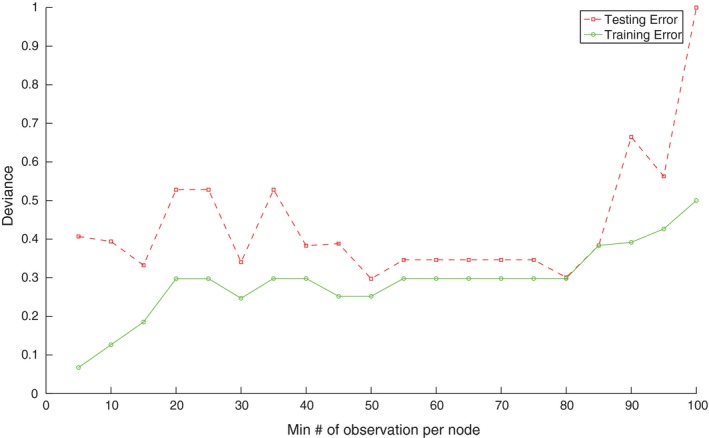
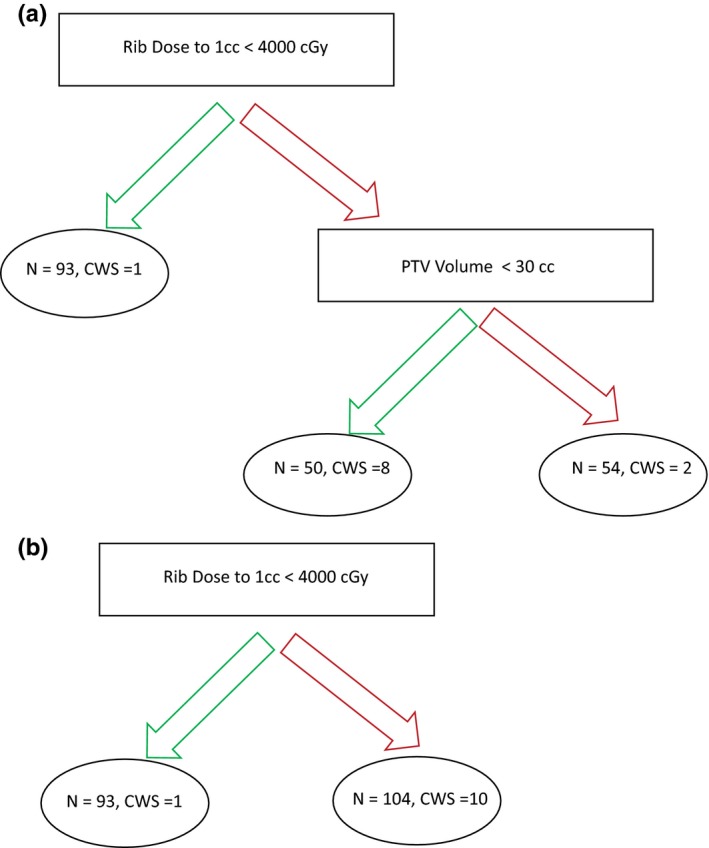
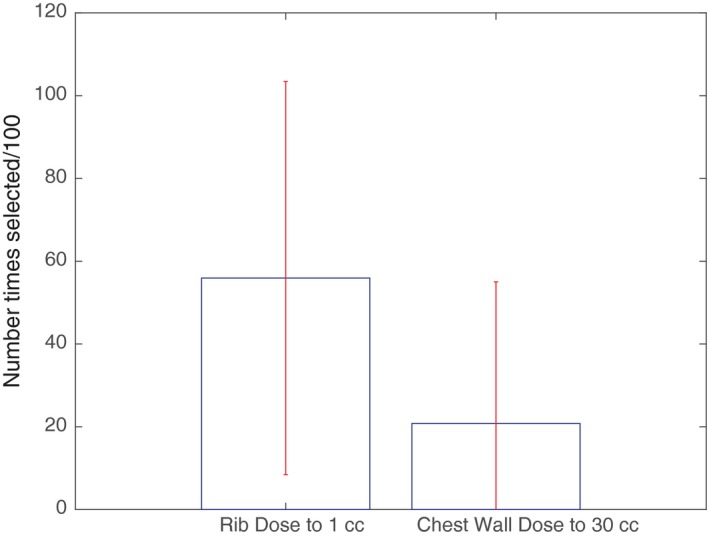
Twenty-five patient, tumor, and dosimetric features were recorded for 197 consecutive patients with Stage I NSCLC treated with SBRT, 11 of whom (5.6%) developed CTCAEv4 grade ≥2 chest wall pain. Decision tree modeling was used to determine chest wall syndrome (CWS) thresholds for individual features. Significant features were determined using independent multivariate methods. These methods incorporate out-of-bag estimation using Random forests (RF) and bootstrapping (100 iterations) using decision trees.
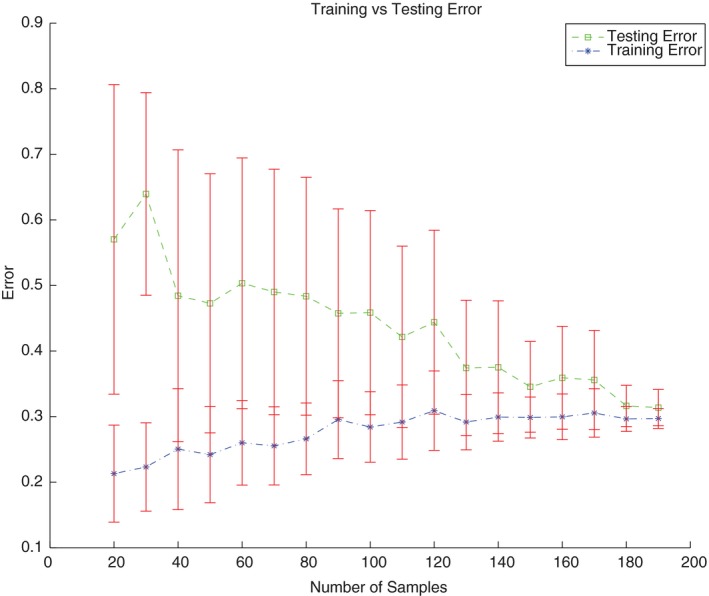
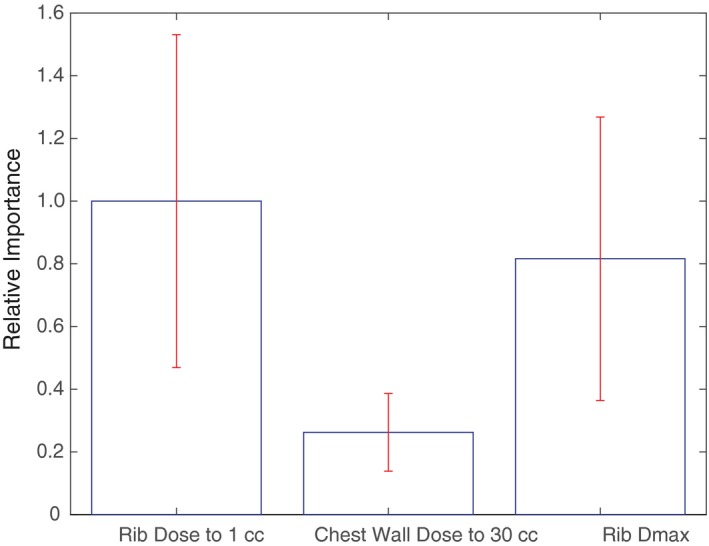
Univariate analysis identified rib dose to 1 cc < 4000 cGy (P = 0.01), chest wall dose to 30 cc < 1900 cGy (P = 0.035), rib Dmax < 5100 cGy (P = 0.05) and lung dose to 1000 cc < 70 cGy (P = 0.039) to be statistically significant thresholds for avoiding CWS. Subsequent multivariate analysis confirmed the importance of rib dose to 1 cc, chest wall dose to 30 cc, and rib Dmax. Using learning-curve experiments, the dataset proved to be self-consistent and provides a realistic model for CWS analysis.
Using machine learning algorithms in this first of its kind study, we identify robust features and cutoffs predictive for the rare clinical event of CWS. Additional data in planned subsequent multicenter studies will help increase the accuracy of multivariate analysis.
立体定向体部放射治疗(SBRT)用于治疗外周型肺肿瘤后会出现胸壁毒性反应。我们利用机器学习算法识别毒性预测因子,以制定剂量体积限制。
记录了197例接受SBRT治疗的I期非小细胞肺癌(NSCLC)患者的25项患者、肿瘤和剂量学特征,其中11例(5.6%)出现CTCAE v4级≥2的胸壁疼痛。采用决策树建模确定个体特征的胸壁综合征(CWS)阈值。使用独立多变量方法确定显著特征。这些方法包括使用随机森林(RF)的袋外估计和使用决策树的自抽样法(100次迭代)。
单变量分析确定,1 cc肋骨剂量<4000 cGy(P = 0.01)、30 cc胸壁剂量<1900 cGy(P = 0.035)、肋骨Dmax<5100 cGy(P = 0.05)以及1000 cc肺剂量<70 cGy(P = 0.039)是避免CWS的统计学显著阈值。随后的多变量分析证实了1 cc肋骨剂量、30 cc胸壁剂量和肋骨Dmax的重要性。通过学习曲线实验,该数据集被证明是自洽的,并为CWS分析提供了一个现实的模型。
在这项同类研究中使用机器学习算法,我们识别出了对CWS这一罕见临床事件具有预测性的强大特征和临界值。计划开展的后续多中心研究中的更多数据将有助于提高多变量分析的准确性。