IEEE Trans Biomed Eng. 2018 Dec;65(12):2692-2703. doi: 10.1109/TBME.2018.2813759. Epub 2018 Mar 8.
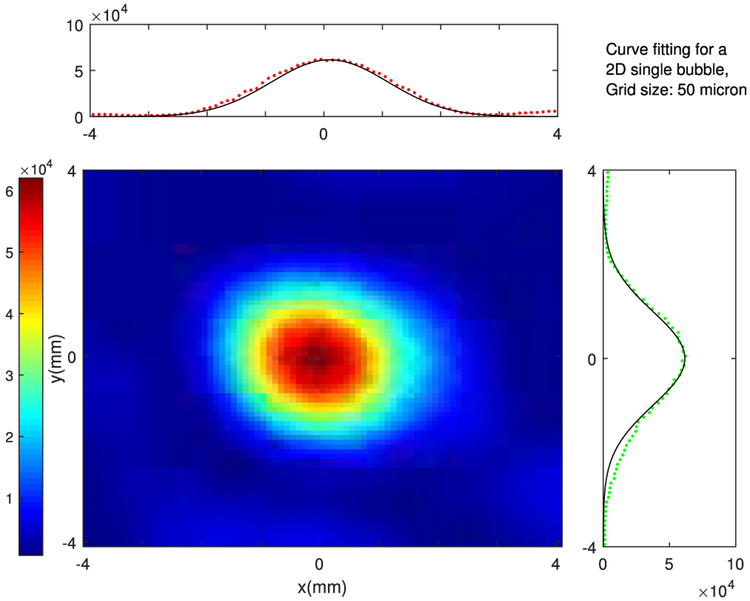
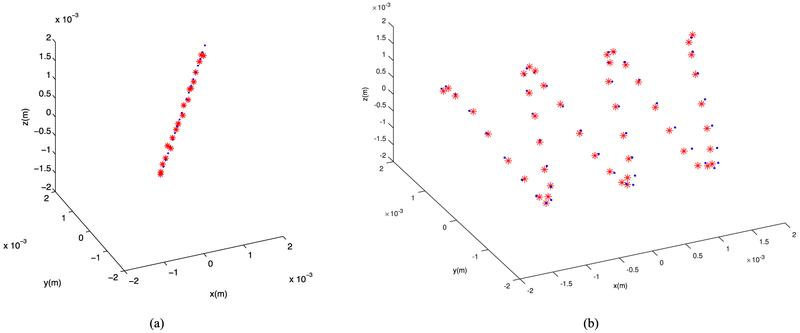
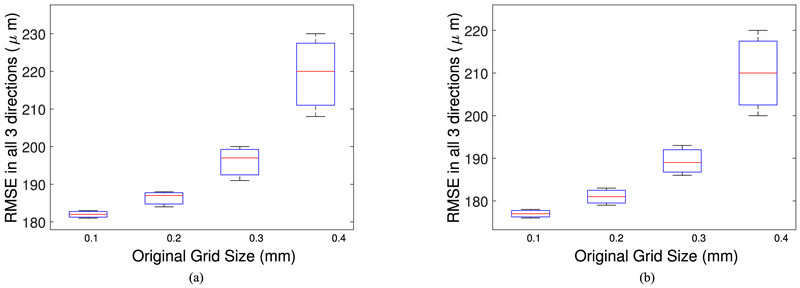
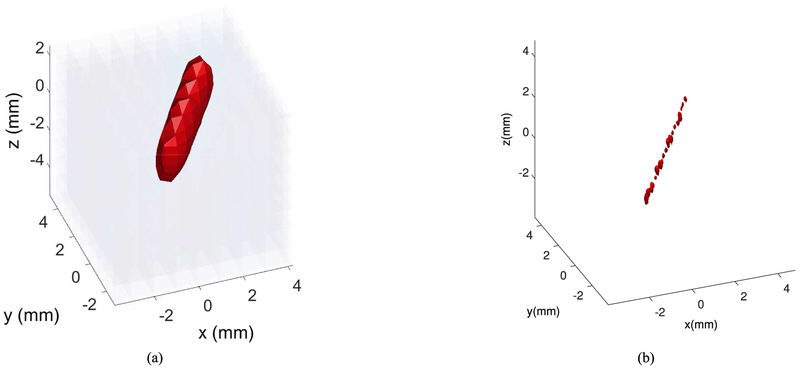
Superresolution algorithms in ultrasound imaging are attracting the interest of researchers recently due to the ability of these methods to enable enhanced vascular imaging. In this study, two superresolution imaging methods are compared for postprocessing images of microbubbles generated using passive acoustic mapping (PAM) methods with a potential application of three-dimensional (3-D) brain vascular imaging. The first method is based on fitting single bubble images one at a time with a 3-D Gaussian profile to localize the microbubbles and a superresolution image is then formed using the uncertainty of the localization as the standard deviation of the Gaussian profile. The second superresolution method is based on image deconvolution that processes multiframe resolution-limited images iteratively and estimates the intensity at each pixel of the superresolution image without the need for localizing each microbubble. The point spread function is approximated by a Gaussian curve which is similar to the beam response of the hemispherical transducer array used in our experimental setup. The Cramér-Rao Bounds of the two estimation techniques are derived analytically and the performance of these techniques is compared through numerical simulations based on experimental PAM images. For linear and sinusoidal traces, the localization errors between the estimated peaks by the fitting-based method and the actual source locations were 220 10 m and 210 5 m, respectively, as compared to 74 10 m and 59 8 m with the deconvolution-based method. However, in terms of the running time and the computational costs, the curve fitting technique outperforms the deconvolution-based approach.
超声成像中的超分辨率算法最近引起了研究人员的兴趣,因为这些方法能够增强血管成像。在这项研究中,比较了两种超分辨率成像方法,用于处理使用被动声学映射 (PAM) 方法生成的微泡的后处理图像,潜在应用于三维 (3-D) 脑血管成像。第一种方法基于逐个拟合单个气泡图像的 3-D 高斯分布来定位微泡,然后使用定位的不确定性作为高斯分布的标准差来形成超分辨率图像。第二种超分辨率方法基于图像反卷积,它迭代地处理多帧分辨率受限的图像,并在不需要定位每个微泡的情况下估计超分辨率图像中每个像素的强度。点扩散函数通过高斯曲线近似,该曲线类似于我们实验设置中使用的半球形换能器阵列的波束响应。两种估计技术的克拉美罗界 (Cramér-Rao Bounds) 从理论上推导出来,并通过基于实验 PAM 图像的数值模拟比较了这些技术的性能。对于线性和正弦迹线,基于拟合的方法估计的峰值与实际源位置之间的定位误差分别为 220 10 m 和 210 5 m,而基于反卷积的方法分别为 74 10 m 和 59 8 m。然而,就运行时间和计算成本而言,曲线拟合技术优于基于反卷积的方法。