National Cancer Center Hospital East, 6-5-1 Kashiwanoha, Kashiwa-shi, Chiba-ken, 277-8577, Japan.
Kanagawa Cancer Center, Yokohama, Japan.
Invest New Drugs. 2019 Feb;37(1):118-126. doi: 10.1007/s10637-018-0636-3. Epub 2018 Jul 11.
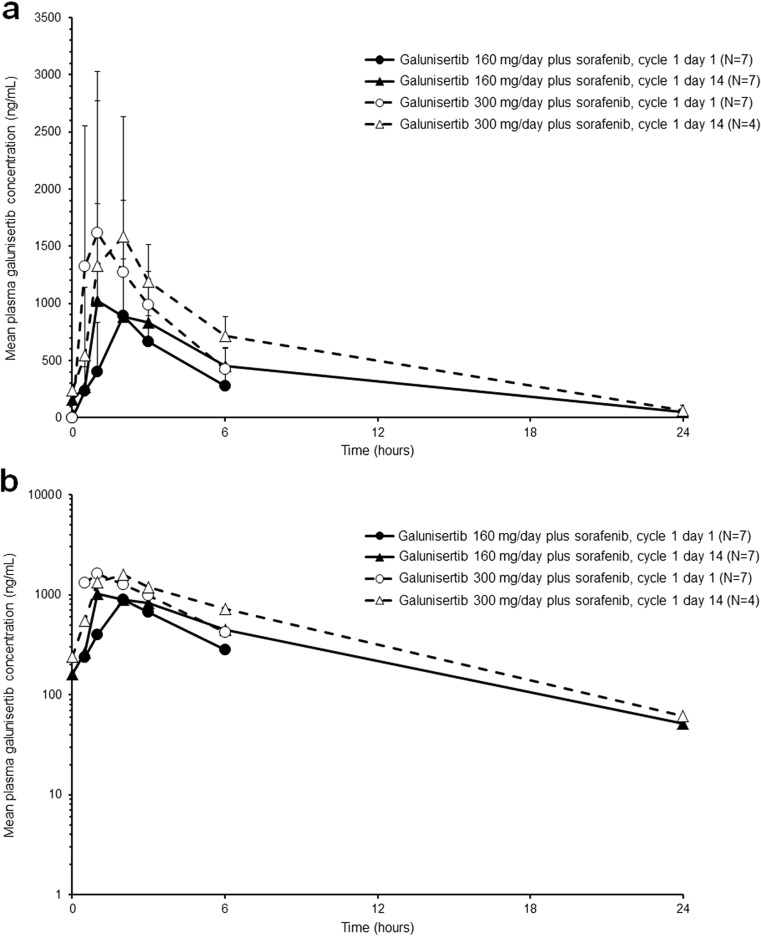
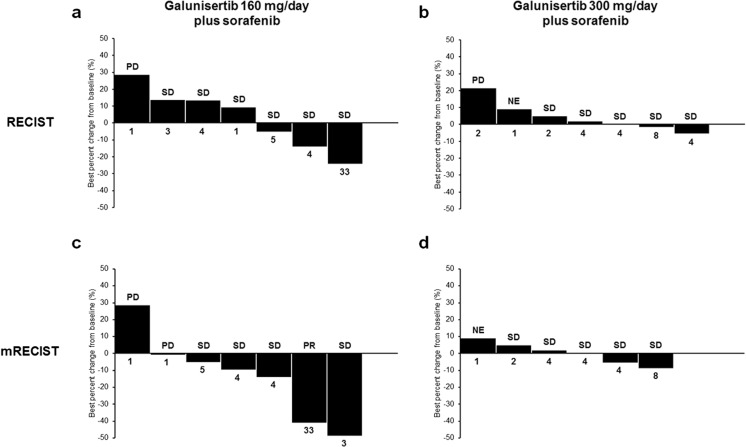
Background Galunisertib inhibits type I transforming growth factor-beta receptor serine/threonine kinase. The primary objective of this study was to evaluate the safety and tolerability of galunisertib in combination with sorafenib in Japanese patients with unresectable hepatocellular carcinoma. Patients and methods This open-label, dose-escalation, multicenter, nonrandomized phase 1b study consisted of two dose levels of galunisertib, 160 or 300 mg/day, in combination with sorafenib 800 mg/day. Galunisertib 80 mg or 150 mg was administered orally twice daily for 14 days followed by 14 days of rest plus sorafenib 400 mg administered orally twice daily for 28 days. The dose-limiting toxicity evaluation was 28 days after the first dose. Safety measures, pharmacokinetics, and antitumor activity were assessed. Results Fourteen patients, 7 at each galunisertib dose, were enrolled and treated. Three dose-limiting toxicities were reported for 2 patients. The most common treatment-emergent adverse events (TEAEs) were hypophosphatemia (14 patients [100%]), palmar-plantar erythrodysesthesia syndrome (12 patients [85.7%]), and decreased platelet count (10 patients [71.4%]). The most common grade ≥ 3 TEAEs were hypophosphatemia (10 patients [71.4%]) and palmar-plantar erythrodysesthesia syndrome (7 patients [50.0%]). No grade 5 TEAEs were reported. The pharmacokinetic profile of galunisertib in combination with sorafenib was similar to that previously reported for galunisertib. Eleven patients had a best overall response of stable disease, and 1 patient achieved a partial response by hepatocellular carcinoma-specific modified RECIST. Conclusions These data are consistent with the known safety profile for galunisertib and sorafenib and confirm tolerability of the recommended dose of galunisertib (150 mg twice daily for 14 days) in combination with sorafenib in Japanese patients with unresectable hepatocellular carcinoma.
背景 加鲁钠替布抑制 I 型转化生长因子-β受体丝氨酸/苏氨酸激酶。本研究的主要目的是评估 galunisertib 联合索拉非尼在不可切除的肝细胞癌日本患者中的安全性和耐受性。
患者和方法 这是一项开放标签、剂量递增、多中心、非随机的 1b 期研究,包括 galunisertib 的两个剂量水平,每天 160 或 300mg,联合索拉非尼每天 800mg。galunisertib 80mg 或 150mg 每天口服两次,连用 14 天,然后休息 14 天,同时每天口服索拉非尼 400mg,连用 28 天。首次给药后 28 天评估剂量限制性毒性。评估安全性措施、药代动力学和抗肿瘤活性。
结果 14 名患者(每个 galunisertib 剂量 7 名)入组并接受治疗。2 名患者报告了 3 例剂量限制性毒性。最常见的治疗相关不良事件(TEAEs)是低磷血症(14 例[100%])、掌跖红斑感觉异常综合征(12 例[85.7%])和血小板计数降低(10 例[71.4%])。最常见的 3 级以上 TEAEs 是低磷血症(10 例[71.4%])和掌跖红斑感觉异常综合征(7 例[50.0%])。无 5 级 TEAEs 报告。galunisertib 联合索拉非尼的药代动力学特征与之前报道的 galunisertib 相似。11 名患者的总体最佳反应为疾病稳定,1 名患者通过肝细胞癌特异性改良 RECIST 达到部分缓解。
结论 这些数据与 galunisertib 和 sorafenib 的已知安全性特征一致,并证实了不可切除的肝细胞癌日本患者联合使用 galunisertib(每天两次 150mg,连用 14 天)的推荐剂量与 sorafenib 联合使用的耐受性。