Health Economics and Financing Research Group, Universal health Coverage, Health Systems and Population Studies Division, icddr,b, Dhaka, Bangladesh.
Health Economics and Policy Research Group, Department of Learning, Informatics, Management and Ethics (LIME), Karolinska Institutet, Stockholm, Sweden.
PLoS One. 2018 Jul 11;13(7):e0200265. doi: 10.1371/journal.pone.0200265. eCollection 2018.
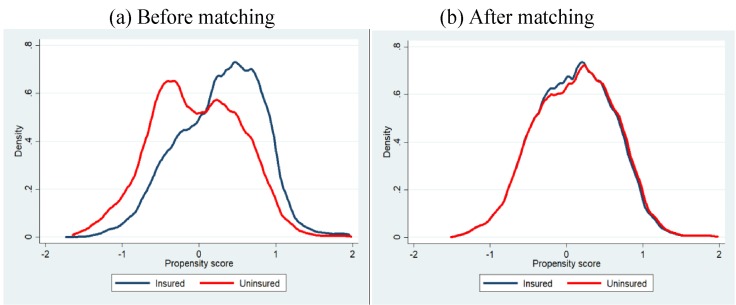
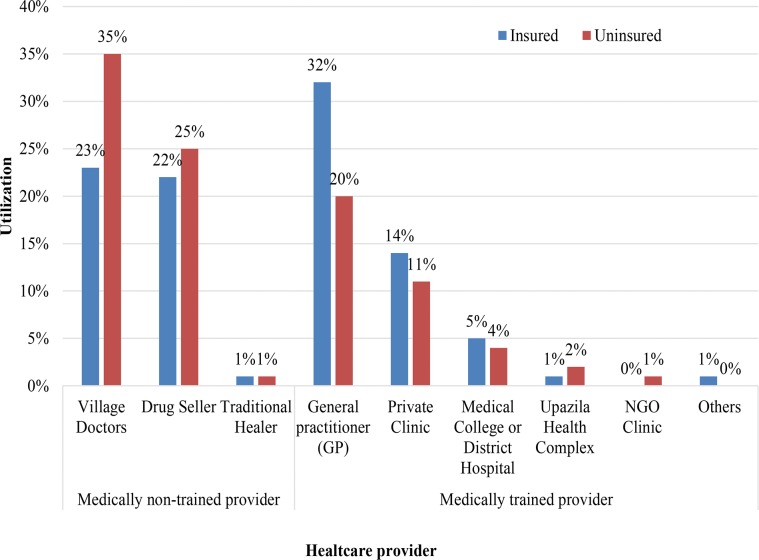
We aimed to estimate the impact of a Community-Based Health Insurance (CBHI) scheme on utilization of healthcare from medically trained providers (MTP) by informal workers. A quasi-experimental study was conducted where insured households were included in the intervention group and uninsured households in comparison group. In total 1,292 (646 insured and 646 uninsured) households were surveyed from Chandpur district comprising urban and rural areas after 1 year period of CBHI introduction. Matching of the characteristics of insured and uninsured groups was performed using a propensity score matching approach to minimize the observed baseline differences among the groups. Multilevel logistic regression model, with adjustment for individual and household characteristics was used for estimating association between healthcare utilization from the MTP and insurance enrolment. The utilization of healthcare from MTP was significantly higher in the insured group (50.7%) compared to the uninsured group (39.4%). The regression analysis demonstrated that the CBHI beneficiaries were 2.111 (95% CI: 1.458-3.079) times more likely to utilize healthcare from MTP.CBHI scheme increases the utilization of MTP among informal workers. Ensuring such healthcare for these workers and their dependents is a challenge in many low and middle income countries. The implementation and scale-up of CBHI schemes have the potential to address this challenge of universal health coverage.
我们旨在评估社区医疗保险(CBHI)计划对非正规工人利用医疗培训提供者(MTP)提供的医疗服务的影响。本研究采用准实验设计,将参保家庭纳入干预组,未参保家庭作为对照组。在 CBHI 实施一年后,从包括城乡地区在内的恰尔布尔县共调查了 1292 户(646 户参保和 646 户未参保)家庭。采用倾向评分匹配方法对参保和未参保组的特征进行匹配,以最小化组间观察到的基线差异。采用多水平逻辑回归模型,根据个体和家庭特征进行调整,估计从 MTP 获得医疗服务的利用情况与参保之间的关联。与未参保组(39.4%)相比,参保组(50.7%)从 MTP 获得医疗服务的利用率明显更高。回归分析表明,CBHI 受益人的 MTP 利用率是未参保组的 2.111 倍(95%CI:1.458-3.079)。CBHI 计划增加了非正规工人对 MTP 的利用。确保这些工人及其家属获得此类医疗保健是许多低收入和中等收入国家面临的挑战。CBHI 计划的实施和扩大有可能解决全民健康覆盖的这一挑战。