School of Medicine, University of Adelaide, Adelaide, South Australia, Australia.
Freemasons Foundation Centre for Men's Health, University of Adelaide, Adelaide, South Australia, Australia.
PLoS One. 2018 Jul 11;13(7):e0200078. doi: 10.1371/journal.pone.0200078. eCollection 2018.
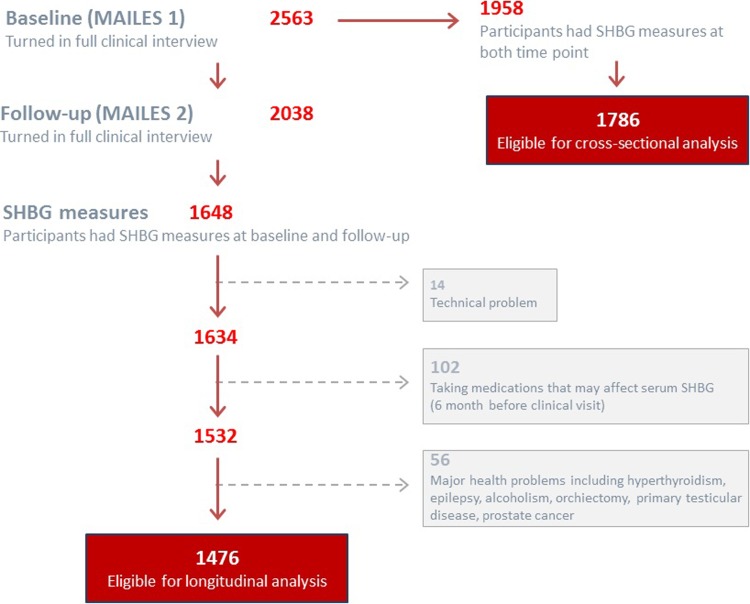
Despite its widespread clinical use, there is little data available from population-based studies on the determinants of serum sex hormone binding globulin (SHBG). We aimed to examine multifactorial determinants of circulating SHBG levels in community-dwelling men. Study participants comprised randomly selected 35-80 y.o. men (n = 2563) prospectively-followed for 5 years (n = 2038) in the Men Androgen Inflammation Lifestyle Environment and Stress (MAILES) study. After excluding men with illness or medications known to affect SHBG (n = 172), data from 1786 men were available at baseline, and 1476 at follow-up. The relationship between baseline body composition (DXA), serum glucose, insulin, triglycerides, thyroxine (fT4), sex steroids (total testosterone (TT), oestradiol (E2)), and pro-inflammatory cytokines and serum SHBG level at both baseline & follow-up was determined by linear and penalized logistic regression models adjusting for age, lifestyle & demographic, body composition, metabolic, and hormonal factors. Restricted cubic spline analyses was also conducted to capture possible non-linear relationships. At baseline there were positive cross-sectional associations between age (β = 0.409, p<0.001), TT (β = 0.560, p<0.001), fT4 (β = 0.067, p = 0.019) and SHBG, and negative associations between triglycerides (β = -0.112, p<0.001), abdominal fat mass (β = -0.068, p = 0.032) and E2 (β = -0.058, p = 0.050) and SHBG. In longitudinal analysis the positive determinants of SHBG at 4.9 years were age (β = 0.406, p = <0.001), TT (β = 0.461, p = <0.001), and fT4 (β = 0.040, p = 0.034) and negative determinants were triglycerides (β = -0.065, p = 0.027) and abdominal fat mass (β = -0.078, p = 0.032). Taken together these data suggest low SHBG is a marker of abdominal obesity and increased serum triglycerides, conditions which are known to have been associated with low testosterone and low T4.
尽管其在临床上得到了广泛应用,但关于影响血清性激素结合球蛋白(SHBG)的决定因素,基于人群的研究数据却很少。我们旨在研究社区居住男性中循环 SHBG 水平的多因素决定因素。研究参与者包括前瞻性随访 5 年的随机选择的 35-80 岁男性(n=2563)(n=2038),该研究名为男性雄激素炎症生活方式环境和压力(MAILES)研究。排除已知影响 SHBG 的疾病或药物的男性(n=172)后,1786 名男性在基线时和 1476 名男性在随访时有数据。通过线性和惩罚逻辑回归模型,在调整年龄、生活方式和人口统计学、身体成分、代谢和激素因素后,确定基线时(DXA)身体成分、血清葡萄糖、胰岛素、甘油三酯、甲状腺素(fT4)、性激素(总睾酮(TT)、雌二醇(E2))和促炎细胞因子与基线和随访时血清 SHBG 水平之间的关系。还进行了限制立方样条分析以捕获可能的非线性关系。在基线时,年龄(β=0.409,p<0.001)、TT(β=0.560,p<0.001)和 fT4(β=0.067,p=0.019)与 SHBG 呈正相关,而甘油三酯(β=-0.112,p<0.001)、腹部脂肪量(β=-0.068,p=0.032)和 E2(β=-0.058,p=0.050)与 SHBG 呈负相关。在 4.9 年的纵向分析中,SHBG 的阳性决定因素是年龄(β=0.406,p<0.001)、TT(β=0.461,p<0.001)和 fT4(β=0.040,p=0.034),负决定因素是甘油三酯(β=-0.065,p=0.027)和腹部脂肪量(β=-0.078,p=0.032)。综上所述,这些数据表明低 SHBG 是腹部肥胖和血清甘油三酯升高的标志物,这些情况已知与低睾酮和低 T4 有关。