Lamar John M, Motilal Nehru Vijeyaluxmy, Weinberg Guy
Department of Molecular and Cellular Physiology, Albany Medical College, Albany, NY 12208, USA.
Department of Oncology, University of Illinois College of Medicine, Chicago, IL 60612, USA.
Cancers (Basel). 2018 Jul 10;10(7):229. doi: 10.3390/cancers10070229.
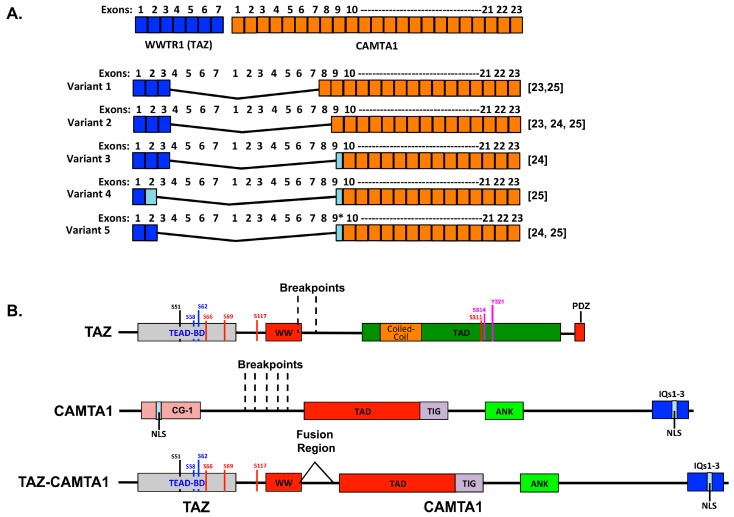
Epithelioid hemangioendothelioma (EHE) is a rare soft-tissue sarcoma involving cells with histologic markers that suggest an endothelial origin. Around 90% of EHEs are caused by the fusion of Transcriptional Co-activator with a PDZ-motif (TAZ) with Calmodulin Binding Transcription Activator 1 (CAMTA1), a central nervous system-specific transcription activator. The 10% of EHEs that lack the TAZ⁻CAMTA1 fusion instead have a fusion of Yes-associated Protein (YAP) and Transcription Factor E3 (TFE3) genes (YAP-TFE3). YAP and TAZ are well-defined downstream effectors in the Hippo pathway that promote cell growth when translocated to the nucleus. The TAZ⁻CAMTA1 fusion transcript is insensitive to the Hippo inhibitory signals that normally prevent this process and thus constitutively activates the TAZ transcriptome. In EHE, this causes tumors to form in a variety of organs and tissue types, most commonly the liver, lung, and bone. Its clinical course is unpredictable and highly variable. TAZ activation is known to contribute to key aspects of the cancer phenotype, including metastasis and fibrosis, and increased expression of TAZ is thought to be causally related to the progression of many cancers, including breast, lung, and liver. Therefore, understanding TAZ biology and the molecular mechanisms by which it promotes unregulated cell proliferation will yield insights and possibly improved treatments for both EHE as well as much more common cancers.
上皮样血管内皮瘤(EHE)是一种罕见的软组织肉瘤,其细胞具有提示内皮起源的组织学标志物。约90%的EHE是由具有PDZ基序的转录共激活因子(TAZ)与钙调蛋白结合转录激活因子1(CAMTA1,一种中枢神经系统特异性转录激活因子)融合所致。另外10%缺乏TAZ⁻CAMTA1融合的EHE则具有Yes相关蛋白(YAP)和转录因子E3(TFE3)基因的融合(YAP-TFE3)。YAP和TAZ是Hippo信号通路中明确的下游效应因子,当易位至细胞核时可促进细胞生长。TAZ⁻CAMTA1融合转录本对通常阻止这一过程的Hippo抑制信号不敏感,因此可组成性激活TAZ转录组。在EHE中,这会导致肿瘤在多种器官和组织类型中形成,最常见于肝脏、肺和骨骼。其临床病程不可预测且高度多变。已知TAZ激活有助于癌症表型的关键方面,包括转移和纤维化,并且TAZ表达增加被认为与包括乳腺癌、肺癌和肝癌在内的许多癌症的进展存在因果关系。因此,了解TAZ生物学及其促进不受调控的细胞增殖的分子机制,将为EHE以及更为常见的癌症带来见解并可能改善治疗方法。