Graduate Institute of Basic Medical Science, China Medical University, Taichung 40402, Taiwan.
Department of Orthopedic Surgery, China Medical University Hospital, Taichung 40447, Taiwan.
Int J Mol Sci. 2018 Jul 10;19(7):2012. doi: 10.3390/ijms19072012.
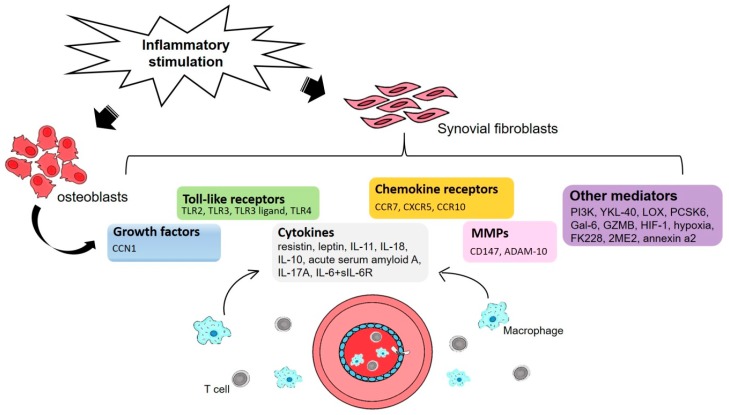
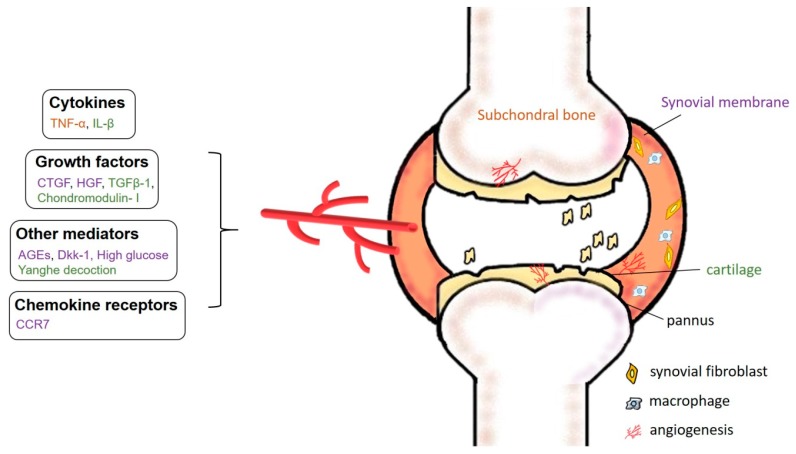
Angiogenesis, the growth of new blood vessels, is essential in the pathogenesis of joint inflammatory disorders such as rheumatoid arthritis (RA) and osteoarthritis (OA), facilitating the invasion of inflammatory cells and increase in local pain receptors that contribute to structural damage and pain. The angiogenic process is perpetuated by various mediators such as growth factors, primarily vascular endothelial growth factor (VEGF) and hypoxia-inducible factors (HIFs), as well as proinflammatory cytokines, various chemokines, matrix components, cell adhesion molecules, proteases, and others. Despite the development of potent, well-tolerated nonbiologic (conventional) and biologic disease-modifying agents that have greatly improved outcomes for patients with RA, many remain resistant to these therapies, are only partial responders, or cannot tolerate biologics. The only approved therapies for OA include symptom-modifying agents, such as analgesics, non-steroidal anti-inflammatory drugs (NSAIDs), steroids, and hyaluronic acid. None of the available treatments slow the disease progression, restore the original structure or enable a return to function of the damaged joint. Moreover, a number of safety concerns surround current therapies for RA and OA. New treatments are needed that not only target inflamed joints and control articular inflammation in RA and OA, but also selectively inhibit synovial angiogenesis, while preventing healthy tissue damage. This narrative review of the literature in PubMed focuses on the evidence illustrating the therapeutic benefits of modulating angiogenic activity in experimental RA and OA. This evidence points to new treatment targets in these diseases.
血管生成,即新血管的生长,在类风湿关节炎 (RA) 和骨关节炎 (OA) 等关节炎症性疾病的发病机制中至关重要,它促进了炎症细胞的浸润和局部疼痛感受器的增加,进而导致结构损伤和疼痛。血管生成过程由各种介质如生长因子(主要是血管内皮生长因子 [VEGF] 和缺氧诱导因子 [HIFs])、促炎细胞因子、各种趋化因子、基质成分、细胞黏附分子、蛋白酶等维持。尽管已经开发出了有效的、耐受性良好的非生物(常规)和生物疾病修饰药物,这些药物极大地改善了 RA 患者的预后,但许多患者仍然对这些治疗方法有抗性,或者只能部分缓解,或者无法耐受生物制剂。OA 的唯一批准的治疗方法包括症状缓解药物,如镇痛药、非甾体抗炎药(NSAIDs)、类固醇和透明质酸。现有的治疗方法都不能减缓疾病进展、恢复受损关节的原始结构或使其恢复功能。此外,目前针对 RA 和 OA 的治疗方法还存在许多安全问题。需要新的治疗方法,不仅要针对发炎的关节,控制 RA 和 OA 中的关节炎症,还要选择性抑制滑膜血管生成,同时防止健康组织损伤。本文对 PubMed 中的文献进行了综述,重点介绍了在实验性 RA 和 OA 中调节血管生成活性的治疗益处的证据。这些证据为这些疾病的新治疗靶点指明了方向。