Department of Psychology, Harvard University, Cambridge, MA 02138;
Department of Psychology, Harvard University, Cambridge, MA 02138.
Proc Natl Acad Sci U S A. 2018 Jul 24;115(30):7801-7806. doi: 10.1073/pnas.1803926115. Epub 2018 Jul 11.
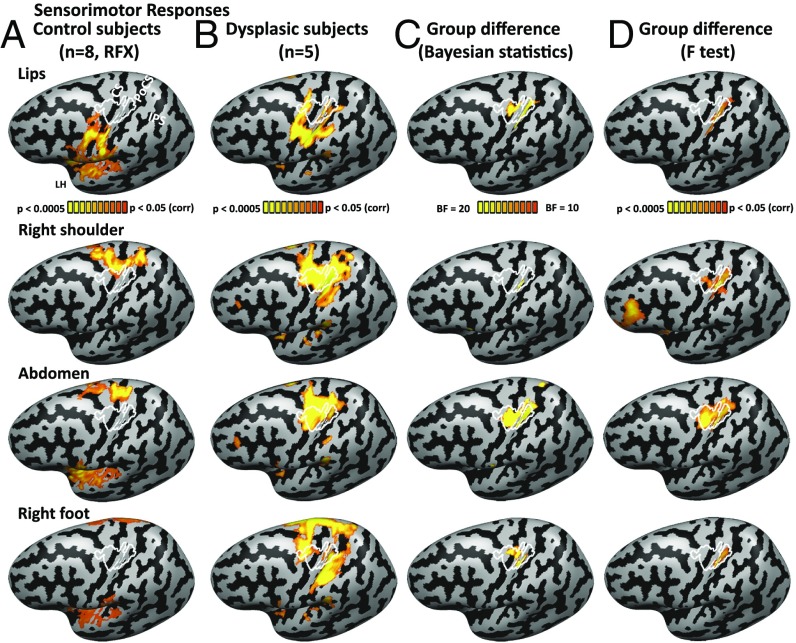
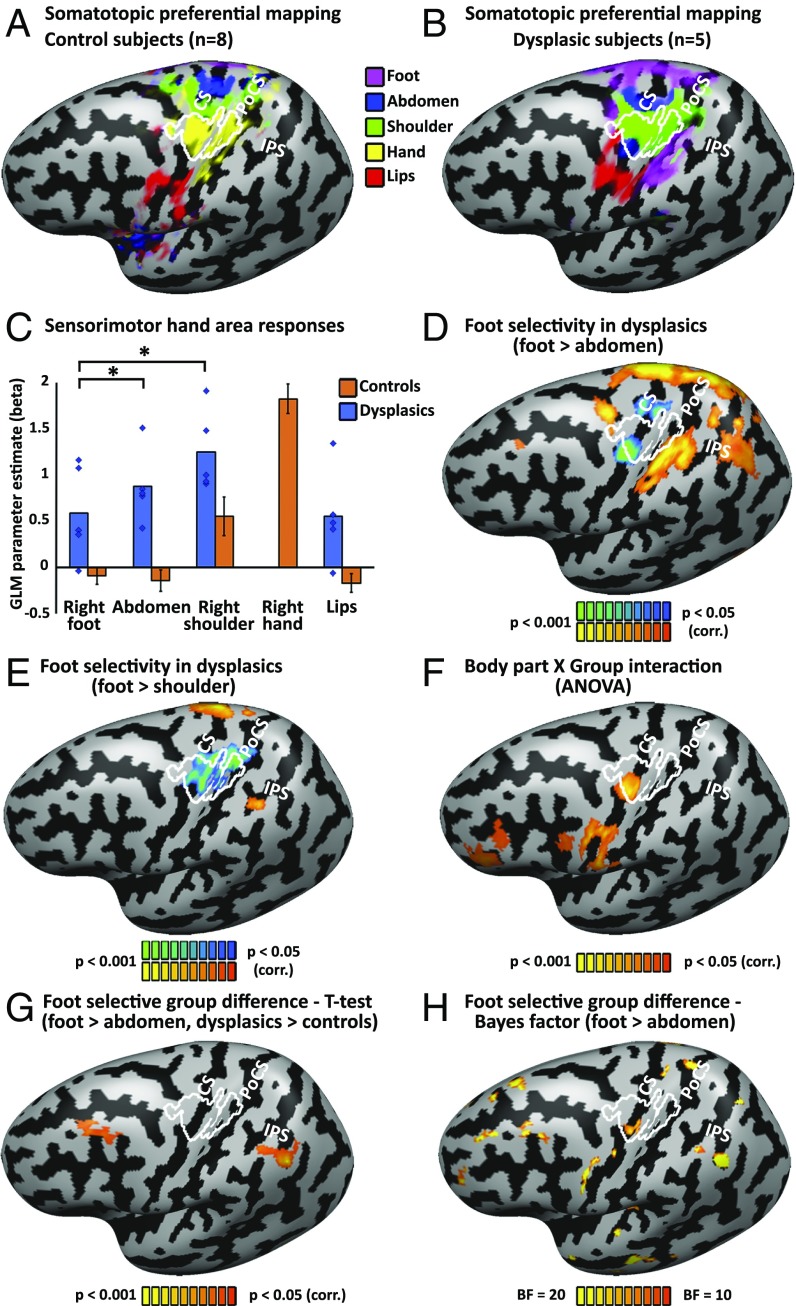
What forces direct brain organization and its plasticity? When brain regions are deprived of their input, which regions reorganize based on compensation for the disability and experience, and which regions show topographically constrained plasticity? People born without hands activate their primary sensorimotor hand region while moving body parts used to compensate for this disability (e.g., their feet). This was taken to suggest a neural organization based on functions, such as performing manual-like dexterous actions, rather than on body parts, in primary sensorimotor cortex. We tested the selectivity for the compensatory body parts in the primary and association sensorimotor cortex of people born without hands (dysplasic individuals). Despite clear compensatory foot use, the primary sensorimotor hand area in the dysplasic subjects showed preference for adjacent body parts that are not compensatorily used as effectors. This suggests that function-based organization, proposed for congenital blindness and deafness, does not apply to the primary sensorimotor cortex deprivation in dysplasia. These findings stress the roles of neuroanatomical constraints like topographical proximity and connectivity in determining the functional development of primary cortex even in extreme, congenital deprivation. In contrast, increased and selective foot movement preference was found in dysplasics' association cortex in the inferior parietal lobule. This suggests that the typical motor selectivity of this region for manual actions may correspond to high-level action representations that are effector-invariant. These findings reveal limitations to compensatory plasticity and experience in modifying brain organization of early topographical cortex compared with association cortices driven by function-based organization.
是什么力量指导了大脑的组织和可塑性?当大脑区域失去输入时,哪些区域会根据代偿残疾和经验进行重组,哪些区域会表现出受到地形限制的可塑性?天生没有手的人在使用身体其他部位(例如脚)来代偿这种残疾时,会激活初级感觉运动手区。这表明初级感觉运动皮层中的神经组织是基于功能的,例如执行类似手动的灵巧动作,而不是基于身体部位。我们在没有手的人(畸形个体)的初级和联合感觉运动皮层中测试了对代偿身体部位的选择性。尽管明显有代偿性的脚部使用,但畸形受试者的初级感觉运动手区仍然偏向于相邻的、不被代偿性用作效应器的身体部位。这表明,基于功能的组织,如先天性失明和失聪,不适用于畸形中的初级感觉运动皮层剥夺。这些发现强调了神经解剖学限制(如地形接近和连通性)在决定初级皮层的功能发展中的作用,即使在极端的先天性剥夺情况下也是如此。相比之下,在畸形者的下顶叶联合皮层中发现了增加的、选择性的脚部运动偏好。这表明,该区域对手动动作的典型运动选择性可能对应于不受效应器影响的高级动作表示。这些发现揭示了与基于功能的组织驱动的联合皮层相比,早期地形皮层的补偿性可塑性和经验在改变大脑组织方面的局限性。