Garbarino Sergio, Scoditti Egeria, Lanteri Paola, Conte Luana, Magnavita Nicola, Toraldo Domenico M
Department of Neuroscience, Rehabilitation, Ophthalmology, Genetics and Maternal/Child Sciences, University of Genoa, Genoa, Italy.
Department of Health Sciences, University of Genoa, Genoa, Italy.
Front Neurol. 2018 Jun 27;9:505. doi: 10.3389/fneur.2018.00505. eCollection 2018.
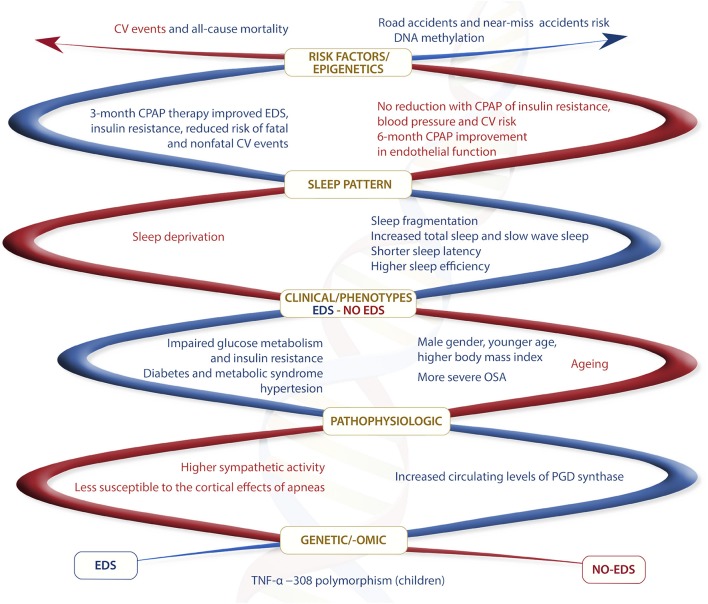
Obstructive sleep apnea (OSA) is a serious and prevalent medical condition with major consequences for health and safety. Excessive daytime sleepiness (EDS) is a common-but not universal-accompanying symptom. The purpose of this literature analysis is to understand whether the presence/absence of EDS is associated with different physiopathologic, prognostic, and therapeutic outcomes in OSA patients. Articles in English published in PubMed, Medline, and EMBASE between January 2000 and June 2017, focusing on no-EDS OSA patients, were critically reviewed. A relevant percentage of OSA patients do not complain of EDS. EDS is a significant and independent predictor of incident cardiovascular disease (CVD) and is associated with all-cause mortality and an increased risk of metabolic syndrome and diabetes. Male gender, younger age, high body mass index, are predictors of EDS. The positive effects of nasal continuous positive airway pressure (CPAP) therapy on blood pressure, insulin resistance, fatal and non-fatal CVD, and endothelial dysfunction risk factors have been demonstrated in EDS-OSA patients, but results are inconsistent in no-EDS patients. The most sustainable cause of EDS is nocturnal hypoxemia and alterations of sleep architecture, including sleep fragmentation. These changes are less evident in no-EDS patients that seem less susceptible to the cortical effects of apneas. There is no consensus if we should consider OSA as a single disease with different phenotypes with or without EDS, or if there are different diseases with different genetic/epigenetic determinants, pathogenic mechanisms, prognosis, and treatment.The small number of studies focused on this issue indicates the need for further research in this area. Clinicians must carefully assess the presence or absence of EDS and decide accordingly the treatment. This approach could improve combination therapy targeted to a patient's specific pathology to enhance both efficacy and long-term adherence to OSA treatment and significantly reduce the social, economic, and health negative impact of OSA.
阻塞性睡眠呼吸暂停(OSA)是一种严重且普遍存在的医学病症,对健康和安全有重大影响。白天过度嗜睡(EDS)是一种常见但并非普遍存在的伴随症状。本文献分析的目的是了解EDS的有无是否与OSA患者不同的生理病理、预后和治疗结果相关。对2000年1月至2017年6月期间发表在PubMed、Medline和EMBASE上的英文文章进行了严格审查,这些文章聚焦于无EDS的OSA患者。相当比例的OSA患者没有主诉EDS。EDS是心血管疾病(CVD)发病的重要且独立的预测因素,与全因死亡率以及代谢综合征和糖尿病风险增加相关。男性、年轻、高体重指数是EDS的预测因素。鼻持续气道正压通气(CPAP)治疗对EDS-OSA患者的血压、胰岛素抵抗、致命和非致命性CVD以及内皮功能障碍危险因素有积极作用,但在无EDS患者中的结果并不一致。EDS最可持续的原因是夜间低氧血症和睡眠结构改变,包括睡眠片段化。这些变化在无EDS患者中不太明显,他们似乎对呼吸暂停的皮质效应不太敏感。对于我们是否应将OSA视为一种具有或不具有EDS的不同表型的单一疾病,或者是否存在具有不同遗传/表观遗传决定因素、致病机制、预后和治疗的不同疾病,尚无共识。针对该问题的研究数量较少,表明该领域需要进一步研究。临床医生必须仔细评估EDS的有无,并据此决定治疗方案。这种方法可以改进针对患者特定病理的联合治疗,以提高疗效和OSA治疗的长期依从性,并显著降低OSA的社会、经济和健康负面影响。