Misiuk-Hojlo Marta, Pomorska Maria, Mulak Malgorzata, Rekas Marek, Wierzbowska Joanna, Prost Marek, Wasyluk Jaromir, Lubinski Wojciech, Podboraczynska-Jodko Karolina, Romaniuk Wanda, Kinasz Renata, Ortyl-Markiewicz Renata, Mocko Lucyna, Zaleska-Zmijewska Anna, Rokicki Dariusz, Baudouin Christophe
1 Department of Ophthalmology, Wroclaw Medical University, Wroclaw, Poland.
2 Department of Ophthalmology, Military Institute of Medicine, Warsaw, Poland.
Eur J Ophthalmol. 2019 Mar;29(2):210-215. doi: 10.1177/1120672118785280. Epub 2018 Jul 12.
: To assess tolerability and efficacy following a switch from benzalkonium chloride-latanoprost to preservative-free latanoprost in patients with glaucoma or ocular hypertension.
: A total of 140 patients with glaucoma or ocular hypertension controlled with benzalkonium chloride-latanoprost for at least 3 months were switched to treatment with preservative-free latanoprost. Assessments were made on days 15, 45, and 90 (D15, D45, and D90) and included best-corrected visual acuity, intraocular pressure, slit lamp examination, fluorescein staining, tear film break-up time, patient symptom evaluation, and subjective estimation of tolerability.
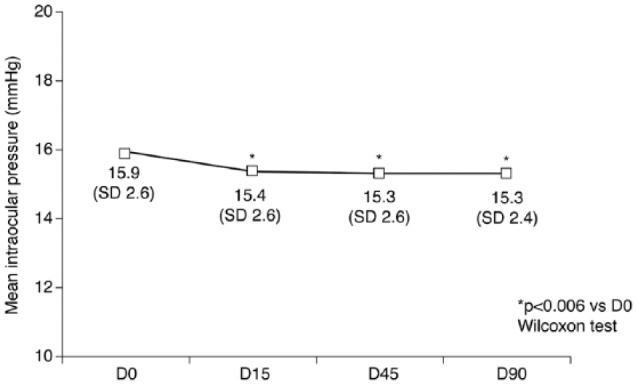
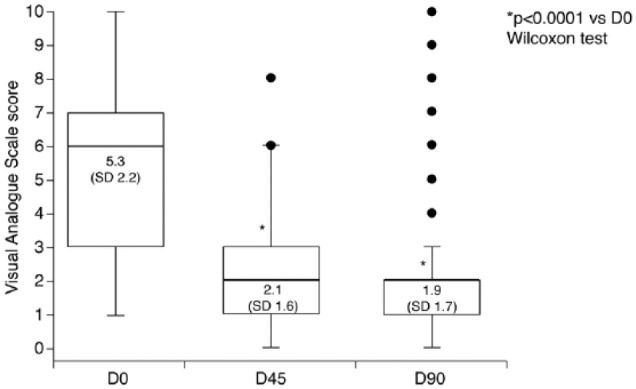
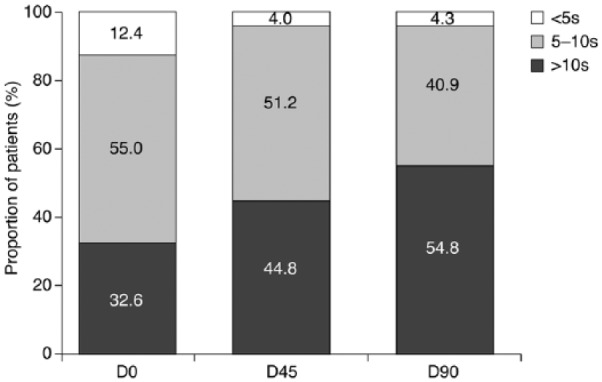
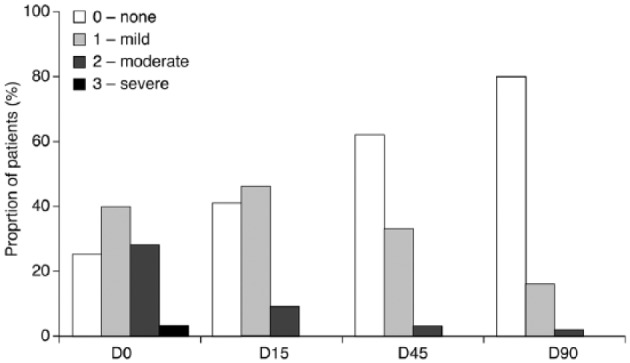
: Mean best-corrected visual acuity remained unchanged during the study. Mean intraocular pressure compared with baseline (D0) remained stable throughout the study (D0, 15.9 mmHg (standard deviation = 2.6); D90, 15.3 mmHg (standard deviation = 2.4); p < 0.006). Tear film break-up time improved or remained unchanged relative to baseline in 92% of patients at D45 and in 93% at D90. Moderate-to-severe conjunctival hyperemia was seen in 56.8% of patients at D0, but this figure decreased to 13.7%, 2.2%, and 1.6% at D15, D45, and D90, respectively. Subjective assessment of tolerability (0-10 scale) indicated improvement with change of therapy (mean score: 5.3 (standard deviation = 2.2) at D0 versus 1.9 (standard deviation = 1.7) at D90; p < 0.0001).
: Preservative-free latanoprost has at least the same intraocular pressure-lowering efficacy as benzalkonium chloride-latanoprost, with a better tolerability profile. This may translate into greater control of treatment and improved quality of life.
评估青光眼或高眼压症患者从含苯扎氯铵的拉坦前列素转换为无防腐剂拉坦前列素后的耐受性和疗效。
共有140例使用含苯扎氯铵的拉坦前列素控制病情至少3个月的青光眼或高眼压症患者转换为使用无防腐剂拉坦前列素治疗。在第15天、45天和90天(D15、D45和D90)进行评估,包括最佳矫正视力、眼压、裂隙灯检查、荧光素染色、泪膜破裂时间、患者症状评估以及耐受性的主观估计。
研究期间平均最佳矫正视力保持不变。与基线(D0)相比,平均眼压在整个研究过程中保持稳定(D0,15.9 mmHg(标准差 = 2.6);D90,15.3 mmHg(标准差 = 2.4);p < 0.006)。在D45时,92%的患者泪膜破裂时间相对于基线有所改善或保持不变,在D90时这一比例为93%。在D0时,56.8%的患者出现中度至重度结膜充血,但在D15、D45和D90时,这一数字分别降至13.7%、2.2%和1.6%。耐受性的主观评估(0 - 10分制)表明治疗改变后有所改善(平均得分:D0时为5.3(标准差 = 2.2),D90时为1.9(标准差 = 1.7);p < 0.0001)。
无防腐剂拉坦前列素的降眼压疗效至少与含苯扎氯铵的拉坦前列素相同,且耐受性更好。这可能转化为更好的治疗控制和更高的生活质量。