Vang J, Simert G, Hansson J A, Thylen U, Bengmark T S
Ann Surg. 1977 Feb;185(2):224-8. doi: 10.1097/00000658-197702000-00016.
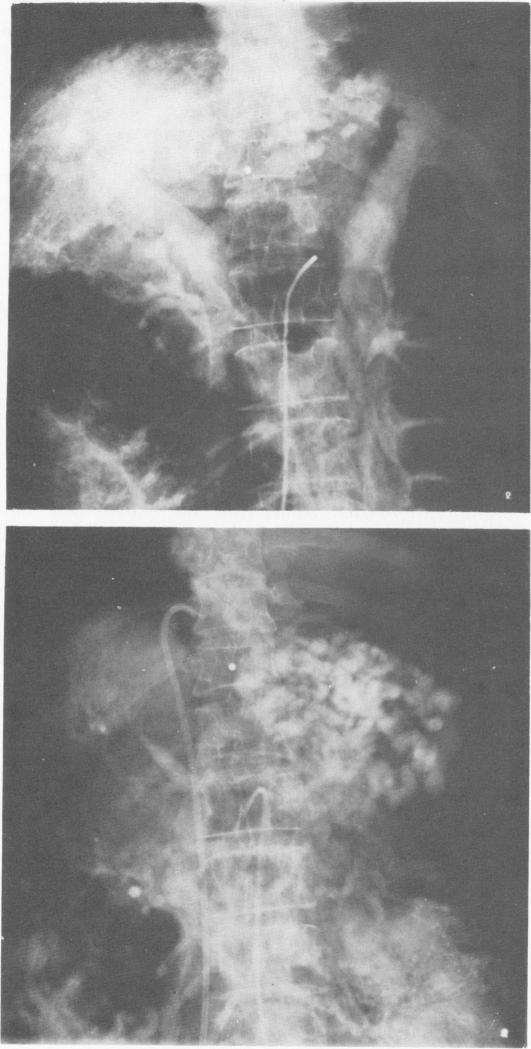
Twenty-five patients were treated with a distal spleno-renal shunt modified after that of Warren. The operative mortality was 4/25. One patient had an early thrombosis. All post-operative angiography otherwise showed patent shunts. After a median observation time of 43 months, 10/20 patients included in the followup were dead. The chief cause of death was liver failure. Encephalopathy has been common although generally of minor degree. Hypersplenism, judged by thrombocyte count, was not significantly affected by the operation. Six of 21 patients have had gastrointestinal hemorrhage after the operation but no hemorrhage proved fatal. Postoperatively esophageal varices size was considerably diminished in most cases as judged by contrast x-ray. Ascites has not been a problem in this series. Postoperative angiography showed a marked and rapid reduction of portal blood flow to the liver with progressively more blood deviated through the coronary vein towards the shunt. This reduction in portal flow is a possible explanation of the high frequency of postoperative liver failure. This version of the distal spleno-renal shunt has probably no advantages over the portacaval shunt.
25例患者接受了改良后的远端脾肾分流术(参照沃伦术式)。手术死亡率为4/25。1例患者出现早期血栓形成。其他所有术后血管造影均显示分流管通畅。在中位观察时间43个月后,纳入随访的20例患者中有10例死亡。主要死因是肝衰竭。脑病较为常见,尽管一般程度较轻。通过血小板计数判断,脾功能亢进并未因手术受到显著影响。21例患者中有6例术后发生胃肠道出血,但无出血导致死亡。根据对比X线检查判断,大多数病例术后食管静脉曲张大小显著减小。腹水在本系列中并非问题。术后血管造影显示门静脉向肝脏的血流明显且迅速减少,越来越多的血液通过冠状静脉转向分流管。门静脉血流减少可能是术后肝衰竭发生率高的一个原因。这种版本的远端脾肾分流术可能并不比门腔分流术更具优势。