Centre for Prehospital and Emergency Research, Department of Clinical Medicine, Aalborg University, Søndre Skovvej 15, 9000, Aalborg, Denmark.
Emergency Department Hjørring, North Denmark Regional Hospital, Hjørring, Denmark.
BMC Health Serv Res. 2018 Jul 13;18(1):548. doi: 10.1186/s12913-018-3361-x.
Emergency departments handle a large proportion of acute patients. In 2007, it was recommended centralizing the Danish healthcare system and establishing emergency departments as the main common entrance for emergency patients. Since this reorganization, few studies describing the emergency patient population in this new setting have been carried out and none describing diagnoses and mortality. Hence, we aimed to investigate diagnoses and 1- and 30-day mortality of patients in the emergency departments in the North Denmark Region during 2014-2016.
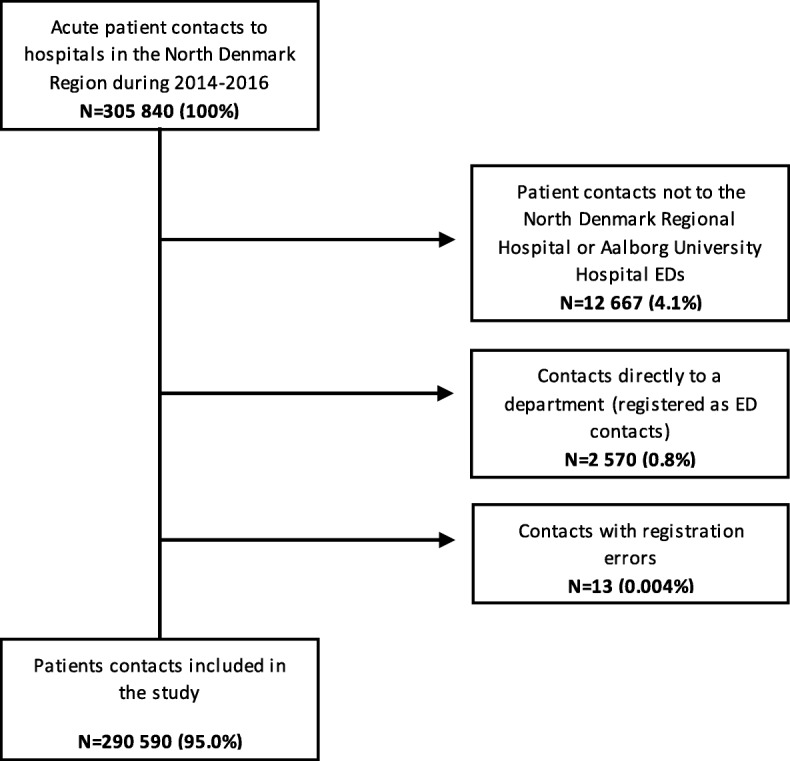
Population-based historic cohort study in the North Denmark Region (580,000 inhabitants) of patients with contact to emergency departments during 2014-2016. The study included patients who were referred by general practitioners (daytime and out-of-hours), by emergency medical services or who were self-referred. Primary diagnoses (ICD-10) were retrieved from the regional Patient Administrative System. For non-specific diagnoses (ICD-10 chapter 'Symptoms and signs' and 'Other factors'), we searched the same hospital stay for a specific diagnosis and used this, if one was given. We performed descriptive analysis reporting distribution and frequency of diagnoses. Moreover, 1- and 30-day mortality rate estimates were performed using the Kaplan-Meier estimator.
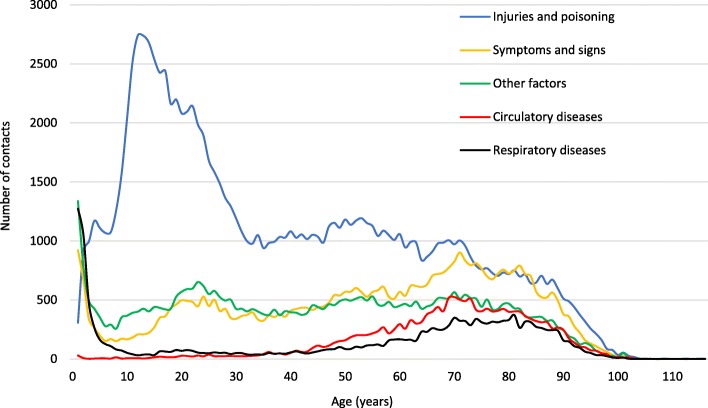
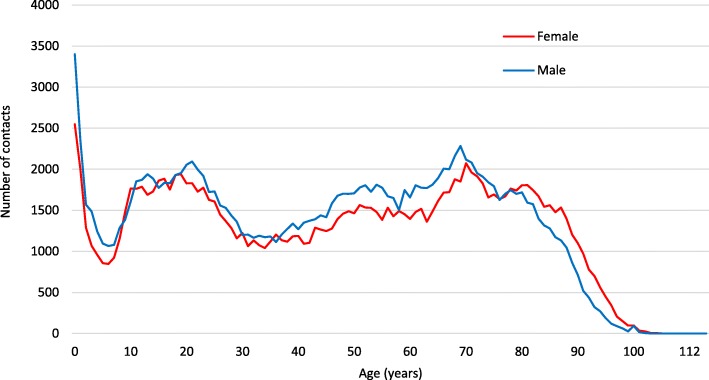
We included 290,590 patient contacts corresponding to 166 ED visits per 1000 inhabitants per year. The three most frequent ICD-10 chapters used were 'Injuries and poisoning' (38.3% n = 111,274), 'Symptoms and signs' (16.1% n = 46,852) and 'Other factors' (14.52% n = 42,195). Mortality at day 30 (95% confidence intervals) for these chapters were 0.86% (0.81-0.92), 3.95% (3.78-4.13) and 2.84% (2.69-3.00), respectively. The highest 30-day mortality were within chapters 'Neoplasms' (14.22% (12.07-16.72)), 'Endocrine diseases' (8.95% (8.21-9.75)) and 'Respiratory diseases' (8.44% (8.02-8.88)).
Patients in contact with the emergency department receive a wide range of diagnoses within all chapters of ICD-10, and one third of the diagnoses given are non-specific. Within the non-specific chapters, we found a 30-day mortality, surpassing several of the more organ specific ICD-10 chapters.
Observational study - no trial registration was performed.
急诊科处理大量急性患者。2007 年,丹麦建议集中医疗保健系统,并建立急诊科作为急诊患者的主要入口。自这次重组以来,很少有研究描述新环境中的急诊患者人群,也没有研究描述诊断和死亡率。因此,我们旨在调查 2014-2016 年丹麦北地区急诊科的急诊患者的诊断和 1 天和 30 天的死亡率。
在丹麦北地区(58 万居民)进行基于人群的历史队列研究,该地区的患者在 2014-2016 年间与急诊科有过接触。该研究包括由全科医生(白天和非工作时间)、紧急医疗服务或自行转诊的患者。从区域患者管理系统中检索主要诊断(ICD-10)。对于非特定诊断(ICD-10 第 10 章“症状和体征”和“其他因素”),我们在同一住院期间搜索特定诊断,并在有特定诊断时使用该诊断。我们进行了描述性分析,报告了诊断的分布和频率。此外,还使用 Kaplan-Meier 估计器进行了 1 天和 30 天的死亡率估计。
我们纳入了 290590 例患者就诊,相当于每年每 1000 名居民中有 166 例急诊科就诊。使用最频繁的三个 ICD-10 章节是“损伤和中毒”(38.3%,n=111274)、“症状和体征”(16.1%,n=46852)和“其他因素”(14.52%,n=42195)。这些章节的 30 天死亡率(95%置信区间)分别为 0.86%(0.81-0.92)、3.95%(3.78-4.13)和 2.84%(2.69-3.00)。30 天内死亡率最高的章节是“肿瘤”(14.22%(12.07-16.72%))、“内分泌疾病”(8.95%(8.21-9.75%))和“呼吸疾病”(8.44%(8.02-8.88%))。
与急诊科接触的患者接受了 ICD-10 所有章节的广泛诊断,其中三分之一的诊断是非特异性的。在非特异性章节中,我们发现 30 天死亡率超过了一些更具器官特异性的 ICD-10 章节。
观察性研究-未进行试验注册。