Christensen Erika Frischknecht, Bendtsen Mette Dahl, Larsen Thomas Mulvad, Jensen Flemming Bøgh, Lindskou Tim Alex, Holdgaard Hans Ole, Hansen Poul Anders, Johnsen Søren Paaske, Christiansen Christian Fynbo
Department of Clinical Medicine, Prehospital and Emergency Research,Aalborg University, Aalborg, Denmark.
Department of Anaesthesiology and Intensive Care, Emergency Clinic, Aalborg University Hospital, Aalborg, Denmark.
BMJ Open. 2017 Aug 21;7(8):e014508. doi: 10.1136/bmjopen-2016-014508.
Demand for ambulances is growing. Nevertheless, knowledge is limited regarding diagnoses and outcomes in patients receiving emergency ambulances. This study aims to examine time trends in diagnoses and mortality among patients transported with emergency ambulance to hospital.
Population-based cohort study with linkage of Danish national registries.
The North Denmark Region in 2007-2014.
Cohort of 148 757 patients transported to hospital by ambulance after calling emergency services.
The number of emergency ambulance service patients, distribution of their age, sex, hospital diagnoses, comorbidity, and 1-day and 30-day mortality were assessed by calendar year. Poisson regression with robust variance estimation was used to estimate both age-and sex-adjusted relative risk of death and prevalence ratios for Charlson Comorbidity Index (CCI) to allow comparison by year, with 2007 as reference year.
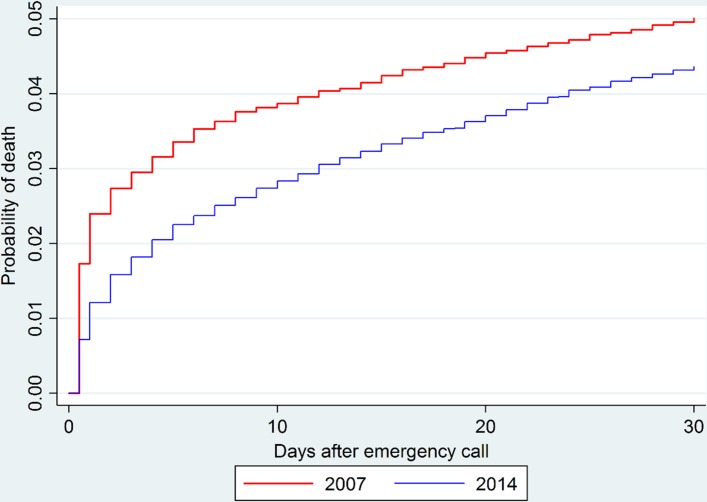
The annual number of emergency ambulance service patients increased from 24.3 in 2007 to 40.2 in 2014 per 1000 inhabitants. The proportions of women increased from 43.1% to 46.4% and of patients aged 60+ years from 39.9% to 48.6%, respectively. The proportion of injuries gradually declined, non-specific diagnoses increased, especially the last year. Proportion of patients with high comorbidity (CCI≥3) increased from 6.4% in 2007 to 9.4% in 2014, corresponding to an age- and sex-adjusted prevalence ratio of 1.27 (95% CI 1.16 to 1.39). The 1-day and 30 day mortality decreased from 2.40% to 1.21% and from 5.01% to 4.36%, respectively, from 2007 to 2014, corresponding to age-adjusted and sex-adjusted relative risk of 0.43 (95% CI 0.37 to 0.50) and 0.72 (95% CI 0.66 to 0.79), respectively.
During the 8-year period, the incidence of emergency ambulance service patients, the proportion of women, elderly, and non-specific diagnoses increased. The level of comorbidity increased substantially, whereas the 1-day and 30-day mortality decreased.
对救护车的需求在不断增长。然而,对于接受急救救护车的患者的诊断和预后的了解却很有限。本研究旨在调查乘坐急救救护车前往医院的患者的诊断时间趋势和死亡率。
基于人群的队列研究,与丹麦国家登记处进行关联。
2007 - 2014年丹麦北部地区。
148757名呼叫急救服务后由救护车送往医院的患者队列。
按日历年评估急救救护车服务患者的数量、年龄、性别、医院诊断、合并症情况以及1天和30天死亡率。采用具有稳健方差估计的泊松回归来估计年龄和性别调整后的死亡相对风险以及Charlson合并症指数(CCI)的患病率比,以便逐年进行比较,以2007年作为参考年份。
每1000名居民中,急救救护车服务患者的年度数量从2007年的24.3例增加到2014年的40.2例。女性比例从43.1%增加到46.4%,60岁及以上患者的比例从39.9%增加到48.6%。受伤比例逐渐下降,非特异性诊断增加,尤其是在最后一年。高合并症(CCI≥3)患者的比例从2007年的6.4%增加到2014年的9.4%,对应年龄和性别调整后的患病率比为1.27(95%可信区间1.16至1.39)。从2007年到2014年,1天和30天死亡率分别从2.40%降至1.21%,从5.01%降至4.36%,对应年龄调整和性别调整后的相对风险分别为0.43(95%可信区间0.37至0.50)和0.72(95%可信区间0.66至0.79)。
在这8年期间,急救救护车服务患者的发病率、女性、老年人和非特异性诊断的比例增加。合并症水平大幅上升,而1天和30天死亡率下降。