Shandong Provincial Key Laboratory of Oral Tissue Regeneration, Department of Bone Metabolism, School of Stomatology Shandong University, Jinan 250012, China.
Shandong Provincial Key Laboratory of Oral Tissue Regeneration, Department of Orthodontics, School of Stomatology Shandong University, Jinan 250012, China.
Int J Mol Sci. 2018 Jul 12;19(7):2029. doi: 10.3390/ijms19072029.
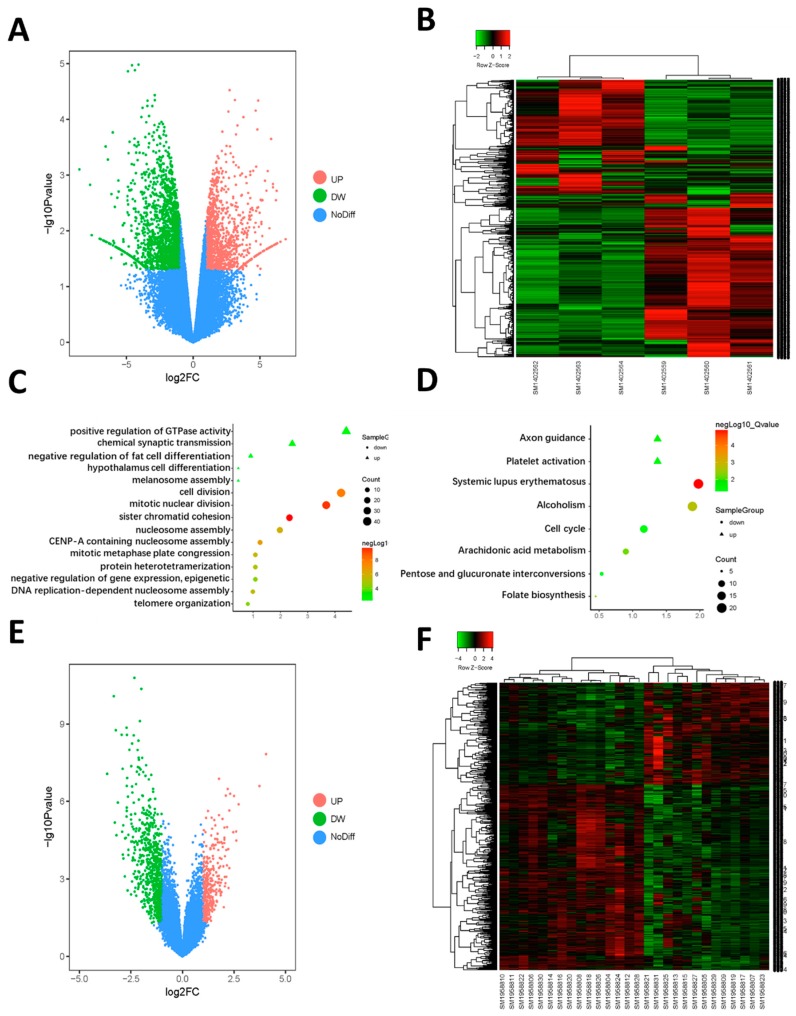
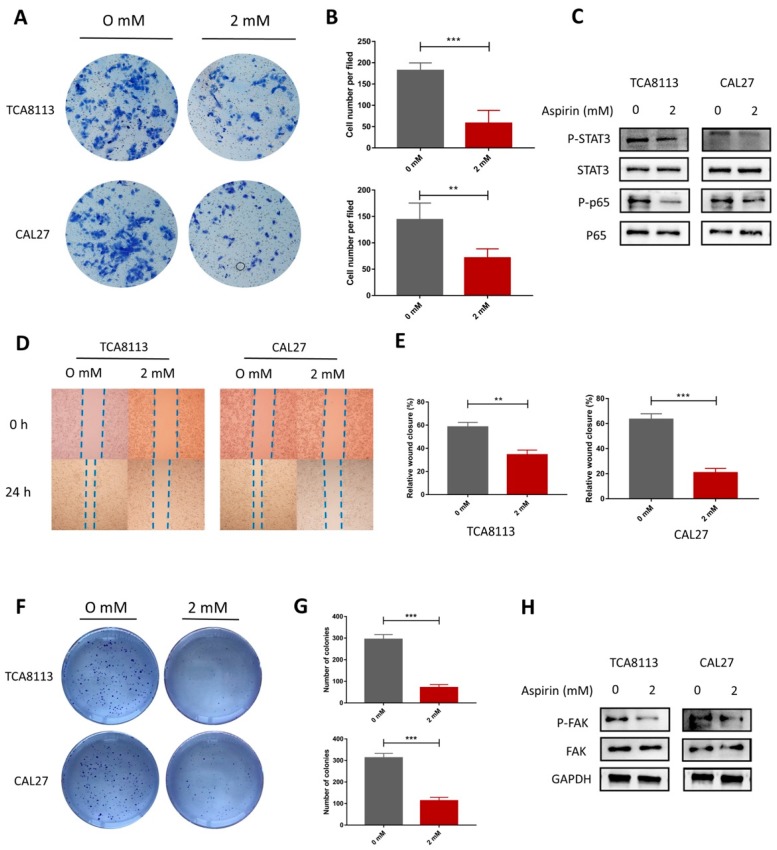
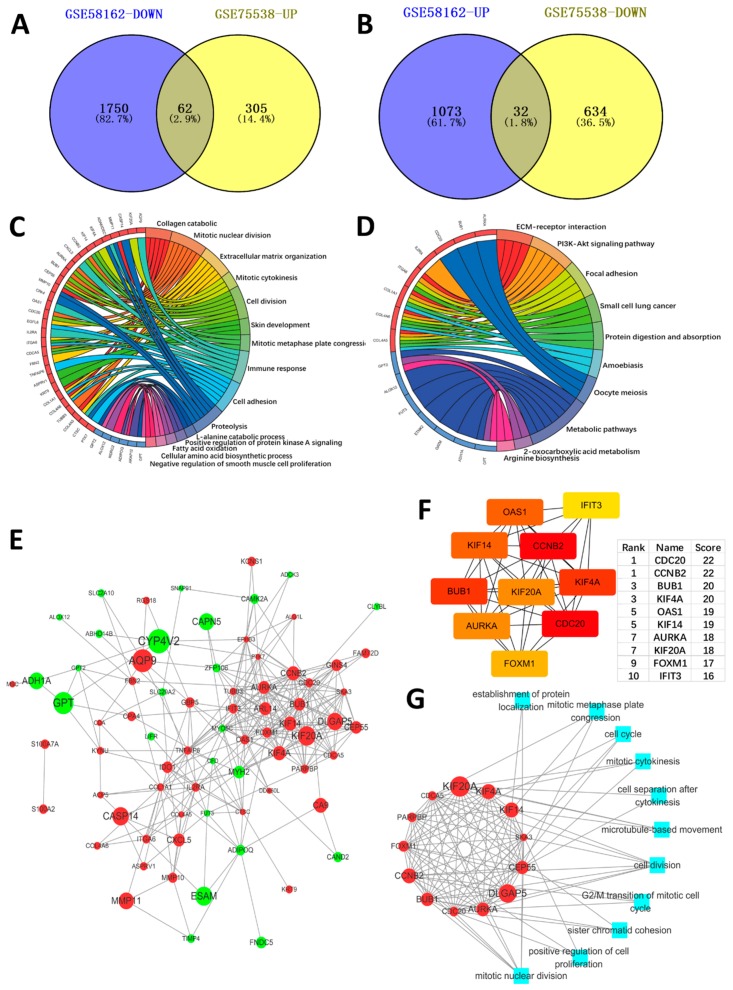
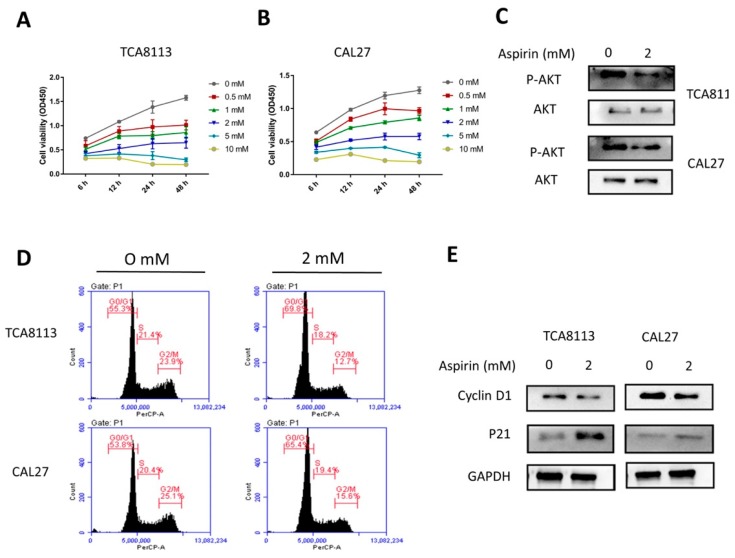
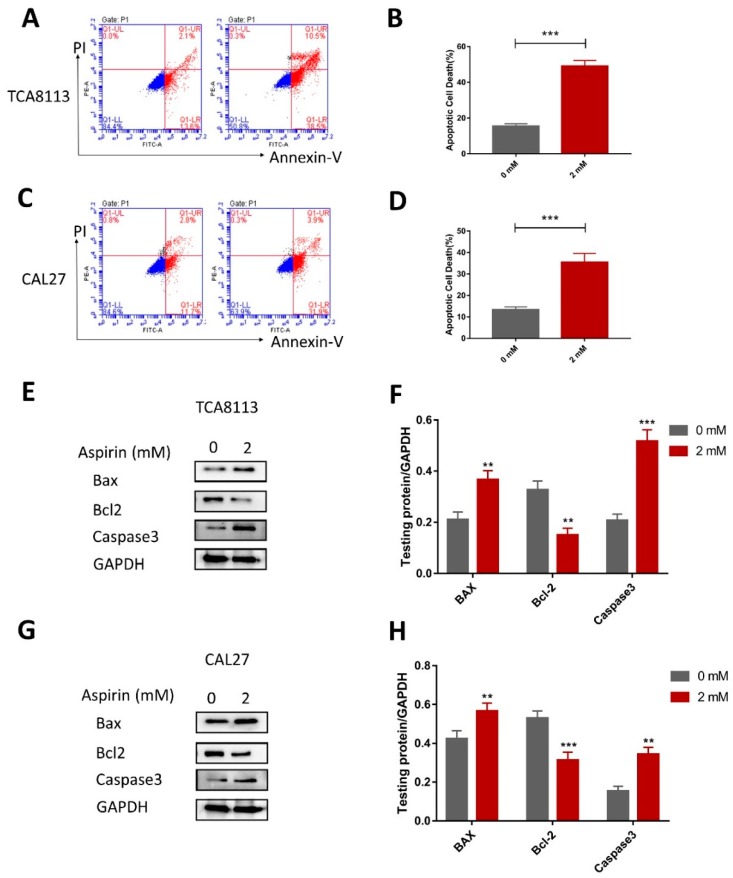
Oral squamous cell carcinoma (OSCC) is one of the most common cancers worldwide. In China, its 5-year survival rate is roughly 50%, owing to acquired chemotherapeutic resistance and metastasis of the disease. Accumulating evidence demonstrates that aspirin (ASA) acts as a preventive or therapeutic agent in multiple cancers; however, anti-tumor activities induced by aspirin are unclear in OSCC. To investigate the possible role of aspirin in OSCC development, we first employed bioinformatics to analyze the anti-OSCC effects of aspirin. We performed a genetic oncology (GO) enrichment analysis using the Database for Annotation, Visualization, and Integrated Discovery (DAVID), and the protein⁻protein interaction (PPI) network analysis by Cytoscape for differentially expressed genes (DEGs). We also evaluated the potential effects of aspirin on cell proliferation, invasion, migration, and apoptosis in two well-characterized OSCC cell lines (TCA8113 and CAL27). The bioinformatic results revealed that aspirin could inhibit proliferation by blocking the cell cycle, and could reduce migration and invasion via the PI3K-Akt and focal adhesion pathways. We found that ASA could downregulate the OSCC cell proliferation colony formation, invasion, and migration, as well as upregulate apoptosis. Furthermore, we found that ASA suppressed the activation of the focal adhesion kinase (FAK) and the phosphorylation of Akt, NF-κB, and STAT3. Overall, our data suggested that ASA may be developed as a chemopreventive agent to effectively treat OSCC.
口腔鳞状细胞癌(OSCC)是全球最常见的癌症之一。在中国,其 5 年生存率约为 50%,这归因于获得性化疗耐药和疾病转移。越来越多的证据表明,阿司匹林(ASA)在多种癌症中作为预防或治疗药物发挥作用;然而,阿司匹林在 OSCC 中诱导的抗肿瘤活性尚不清楚。为了研究阿司匹林在 OSCC 发展中的可能作用,我们首先采用生物信息学方法分析阿司匹林对 OSCC 的抑制作用。我们使用数据库 for Annotation、Visualization、and Integrated Discovery(DAVID)进行了遗传肿瘤学(GO)富集分析,并使用 Cytoscape 进行了蛋白质-蛋白质相互作用(PPI)网络分析以鉴定差异表达基因(DEGs)。我们还评估了阿司匹林在两种经过充分表征的 OSCC 细胞系(TCA8113 和 CAL27)中对细胞增殖、侵袭、迁移和凋亡的潜在影响。生物信息学结果表明,阿司匹林可以通过阻断细胞周期来抑制增殖,并且可以通过 PI3K-Akt 和黏着斑途径减少迁移和侵袭。我们发现 ASA 可以下调 OSCC 细胞的增殖集落形成、侵袭和迁移,并上调凋亡。此外,我们发现 ASA 抑制了黏着斑激酶(FAK)的激活和 Akt、NF-κB 和 STAT3 的磷酸化。总体而言,我们的数据表明,ASA 可能被开发为一种化学预防剂,以有效治疗 OSCC。