Bruno Tongun Justin, Sebit Mohammed Boy, Mukunya David, Ndeezi Grace, Nankabirwa Victoria, Tylleskar Thorkild, Tumwine James K
1Centre for International Health, University of Bergen, Bergen, Norway.
2Department of Paediatrics and Child Health, College of Medicine, University of Juba, Juba, South Sudan.
Int Breastfeed J. 2018 Jul 5;13:28. doi: 10.1186/s13006-018-0170-0. eCollection 2018.
The global breastfeeding recommendation states that all infants should be put to the breast within one hour of birth, which is defined as timely initiation or early initiation of breastfeeding. Early initiation of breastfeeding is associated with reduced risk in infant illness and death. Understanding the determinants of delay in initiation of breastfeeding might spur health staff and policy makers to foster timely breastfeeding. We assessed the prevalence and determinants of delay in initiation of breastfeeding among mothers in Juba Teaching Hospital.
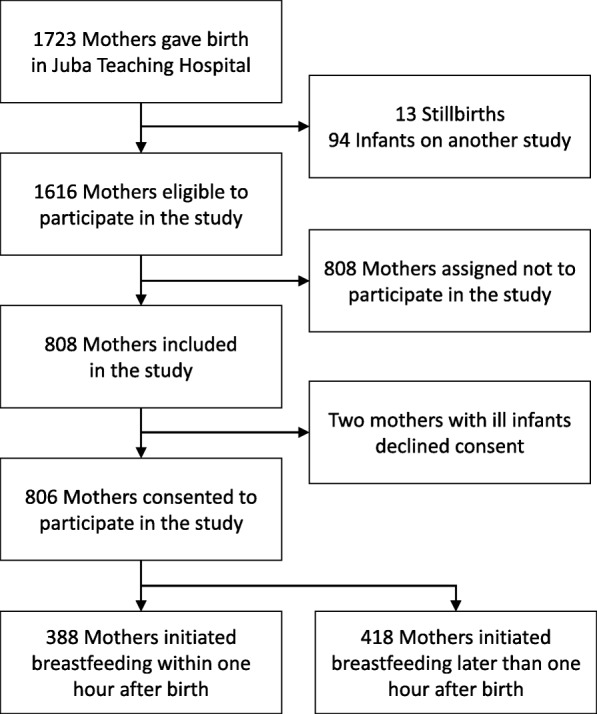
The present study enrolled 806 mother-infant pairs within 24 hrs of birth in Juba Teaching Hospital in 2017. The mothers were interviewed about the time of initiation of breastfeeding, sociodemographic and birth characteristics. The independent variables associated with delay in initiation of breastfeeding were identified using multivariable logistic regression analysis.
In the current study, 52% (418/806) of the mothers initiated breastfeeding later than one hour after birth. Birth by Caesarean section (Adjusted Odds Ratio [AOR] 41; 95% Confidence Interval [CI] 12.21, 138), discarding of colostrum (AOR 9.89; 95% CI 4.14, 23.62), unmarried mothers (AOR 3.76; 95% CI 1.53, 9.24), exposure to infant formula advertisement (AOR 1.82; 95% CI 1.09, 3.02) and no house ownership (AOR 1.52; 95% CI 1.11, 2.09) were independent factors associated with delay in initiation of breastfeeding.
We found that more than half of the mothers delayed the initiation of breastfeeding. Therefore, we recommend training on best breastfeeding practices and counselling skills for health staff in Juba Teaching Hospital. Policy dialogue, with the relevant ministries and departments on the promotion and protection of early initiation of breastfeeding is crucial.
全球母乳喂养建议指出,所有婴儿均应在出生后一小时内开始母乳喂养,这被定义为及时开始或早期开始母乳喂养。早期开始母乳喂养与降低婴儿患病和死亡风险相关。了解母乳喂养开始延迟的决定因素可能会促使卫生工作人员和政策制定者促进及时进行母乳喂养。我们评估了朱巴教学医院母亲中母乳喂养开始延迟的患病率及其决定因素。
本研究于2017年在朱巴教学医院招募了806对母婴,这些母婴均在出生后24小时内入组。就母乳喂养开始时间、社会人口统计学和出生特征对母亲进行了访谈。使用多变量逻辑回归分析确定与母乳喂养开始延迟相关的独立变量。
在本研究中,52%(418/806)的母亲在出生后一小时后才开始母乳喂养。剖宫产分娩(调整后的优势比[AOR]为41;95%置信区间[CI]为12.21,138)、丢弃初乳(AOR为9.89;95%CI为4.14,23.62)、未婚母亲(AOR为3.76;95%CI为1.53,9.24)、接触婴儿配方奶粉广告(AOR为1.82;95%CI为1.09,3.02)以及无自有住房(AOR为1.52;95%CI为1.11,2.09)是与母乳喂养开始延迟相关的独立因素。
我们发现超过一半的母亲延迟了母乳喂养的开始。因此,我们建议为朱巴教学医院的卫生工作人员开展关于最佳母乳喂养实践和咨询技巧的培训。与相关部委和部门就促进和保护早期开始母乳喂养进行政策对话至关重要。