Lv Yantao, Zhang Shihai, Guan Wutai, Chen Fang, Zhang Yinzhi, Chen Jun, Liu Yang
1Guangdong Provincial Key Laboratory of Animal Nutrition Control, College of Animal Science, South China Agricultural University, Guangzhou, 510642 People's Republic of China.
3Agro-Biological Gene Research Center, Guangdong Academy of Agricultural Sciences, Guangzhou, 510640 People's Republic of China.
Genes Nutr. 2018 Jul 6;13:18. doi: 10.1186/s12263-018-0606-6. eCollection 2018.
Milk in mammals is a key source of lipids for offspring, providing both critical energy and essential fatty acids. For lactating sows, palmitic acid is one of the most abundant fatty acids in milk, providing 10~12% of the suckling pig total dietary energy supply. However, the effects of exogenous palmitic acid on milk fat synthesis in sow mammary glands are not well-known. In this study, we investigated the effects of palmitic acid on lipogenic genes in porcine mammary epithelial cells (pMECs) to explore the role of exogenous palmitic acid in mediating milk triacylglycerols (TAG) synthesis.
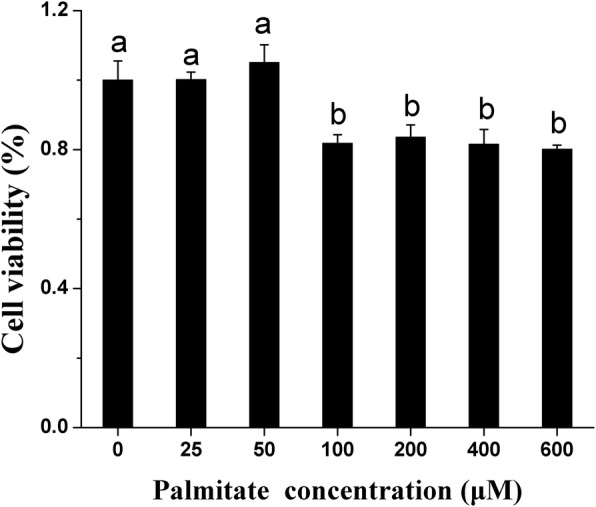
Porcine mammary epithelial cells were cultured for 24 h in the presence of different concentrations of palmitate (0, 25, 50, 100, 200, 400, and 600 μM). The effect of palmitate on cell viability was tested via MTT assay. Intracellular lipid accumulation was measured through Oil Red O staining, and TAG levels were quantified by enzymatic colorimetric methods. Expression of genes and proteins involved in milk fat biosynthesis were assayed with quantitative real-time polymerase chain reaction (PCR) and Western blotting, respectively.
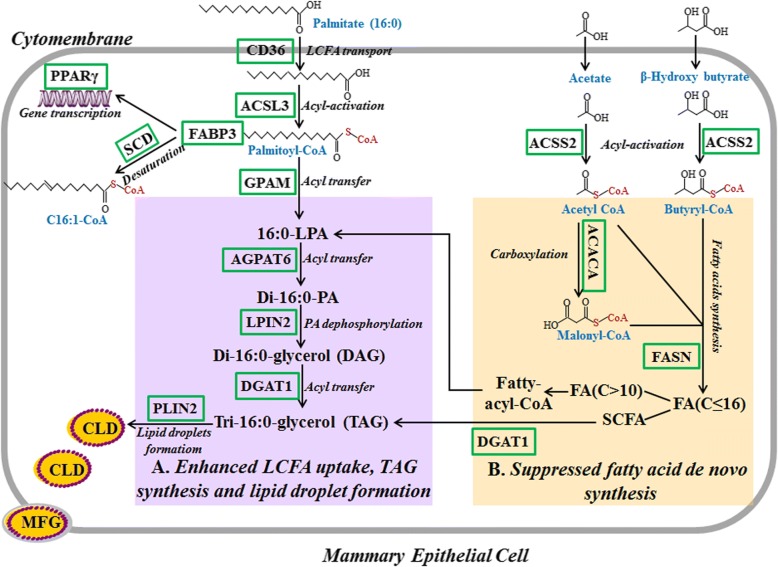
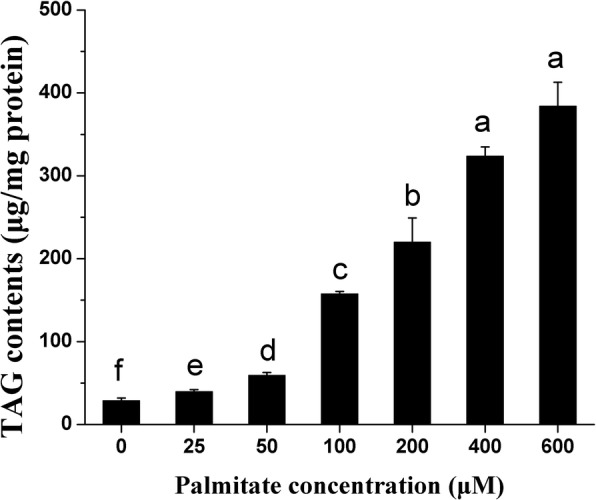
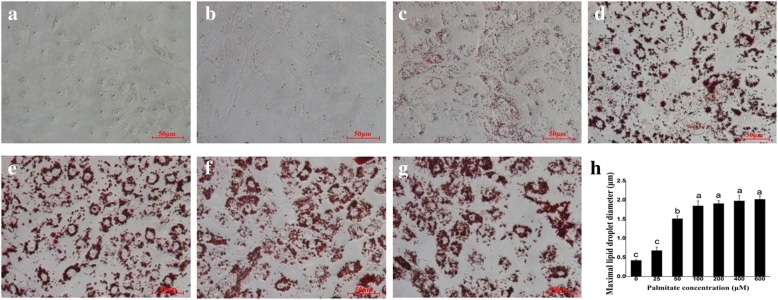
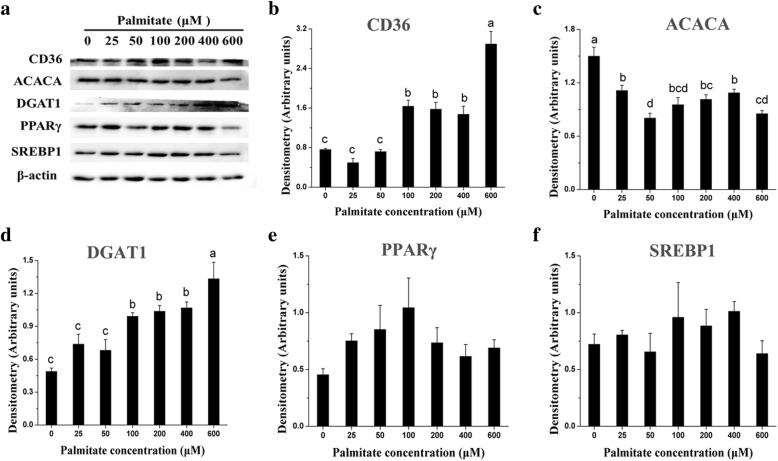
Incubation with palmitate promoted cellular lipid synthesis in a dose-dependent manner, as reflected by the increased TAG content and enhanced formation of cytosolic lipid droplets. The increased lipid synthesis by palmitate was probably attributable to the upregulated mRNA expression of genes associated with milk fat biosynthesis, including long-chain fatty acid uptake (, ), intracellular activation and transport , ), TAG synthesis (, , ), lipid droplet formation (), and regulation of transcription (). Western blot analysis of CD36 and DGAT1 proteins confirmed the increased lipid synthesis with increasing incubation of palmitate. However, the genes involved in fatty acid de novo synthesis (, ), fatty acid desaturation (), and regulation of transcription (, ) were inversely affected by incubation with increasing concentrations of palmitate. Western blot analysis of ACACA protein confirmed this decrease associated with increasing levels of palmitate.
Results from this study suggest that palmitate stimulated the cytosolic TAG accumulation in pMECs, probably by promoting lipogenic genes and proteins that are involved in lipid synthesis. However, addition of palmitate decreased the fatty acid de novo synthesis in pMECs.
哺乳动物的乳汁是后代脂质的关键来源,提供关键能量和必需脂肪酸。对于泌乳母猪而言,棕榈酸是乳汁中最丰富的脂肪酸之一,为哺乳仔猪提供10%至12%的膳食能量供应。然而,外源棕榈酸对母猪乳腺中乳脂肪合成的影响尚不清楚。在本研究中,我们研究了棕榈酸对猪乳腺上皮细胞(pMECs)中脂肪生成基因的影响,以探讨外源棕榈酸在介导乳三酰甘油(TAG)合成中的作用。
将猪乳腺上皮细胞在不同浓度的棕榈酸盐(0、25、50、100、200、400和600μM)存在下培养24小时。通过MTT法检测棕榈酸盐对细胞活力的影响。通过油红O染色测量细胞内脂质积累,并通过酶比色法对TAG水平进行定量。分别用定量实时聚合酶链反应(PCR)和蛋白质免疫印迹法检测参与乳脂肪生物合成的基因和蛋白质的表达。
用棕榈酸盐孵育以剂量依赖性方式促进细胞脂质合成,这通过TAG含量增加和胞质脂质滴形成增强得以体现。棕榈酸盐增加的脂质合成可能归因于与乳脂肪生物合成相关基因的mRNA表达上调,包括长链脂肪酸摄取( , )、细胞内激活和转运( , )、TAG合成( , , )、脂质滴形成( )和转录调控( )。对CD36和DGAT1蛋白的蛋白质免疫印迹分析证实,随着棕榈酸盐孵育时间增加,脂质合成增加。然而,参与脂肪酸从头合成( , )、脂肪酸去饱和( )和转录调控( , )的基因受到棕榈酸盐浓度增加孵育的反向影响。对ACACA蛋白的蛋白质免疫印迹分析证实了这种与棕榈酸盐水平增加相关的降低。
本研究结果表明,棕榈酸盐可能通过促进参与脂质合成的脂肪生成基因和蛋白质,刺激pMECs中胞质TAG积累。然而,添加棕榈酸盐会降低pMECs中脂肪酸的从头合成。