1Department of Hematology, Affiliated People's Hospital of Jiangsu University, 8 Dianli Rd, 212002 Zhenjiang, People's Republic of China.
The Key Lab of Precision Diagnosis and Treatment of Zhenjiang City, Zhenjiang, Jiangsu People's Republic of China.
Clin Epigenetics. 2018 Jul 5;10:92. doi: 10.1186/s13148-018-0523-y. eCollection 2018.
Methylation-associated family genes have been proved to be involved in multiple essential processes during carcinogenesis and act as potential biomarkers for cancer diagnosis, staging, prediction of prognosis, and monitoring of response to therapy. Herein, we revealed methylation and its clinical implication in acute myeloid leukemia (AML) and myelodysplastic syndromes (MDS).
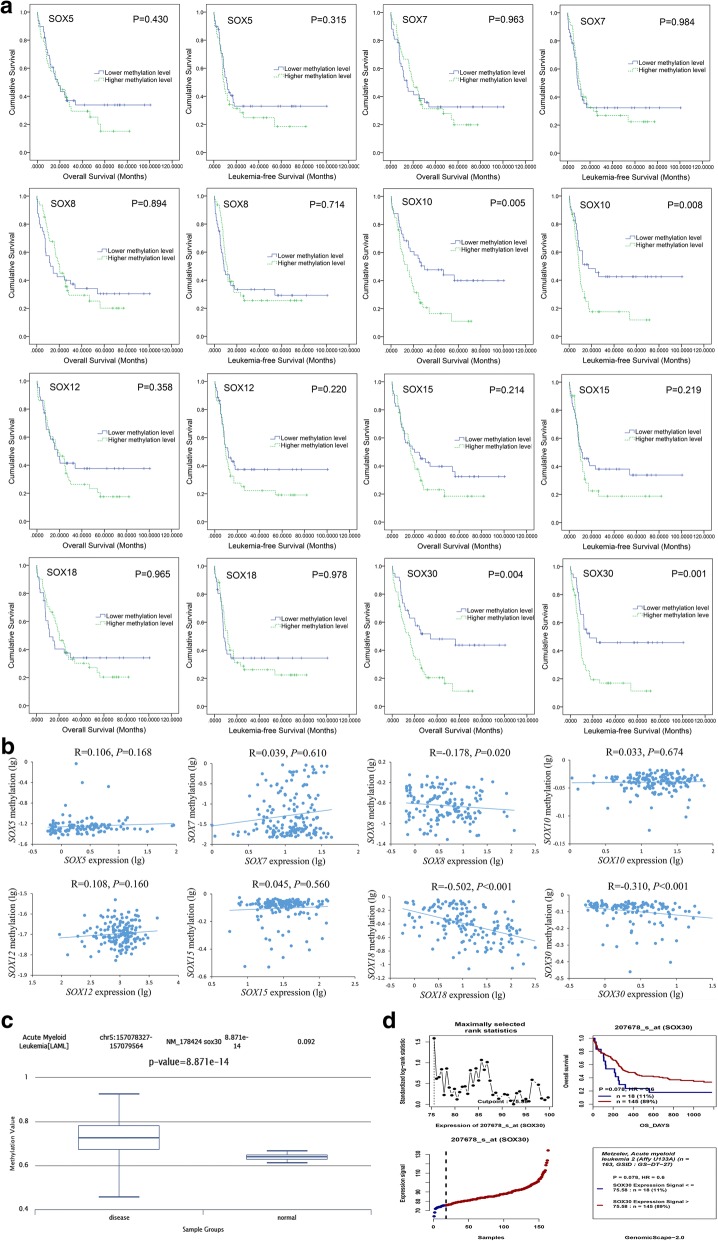
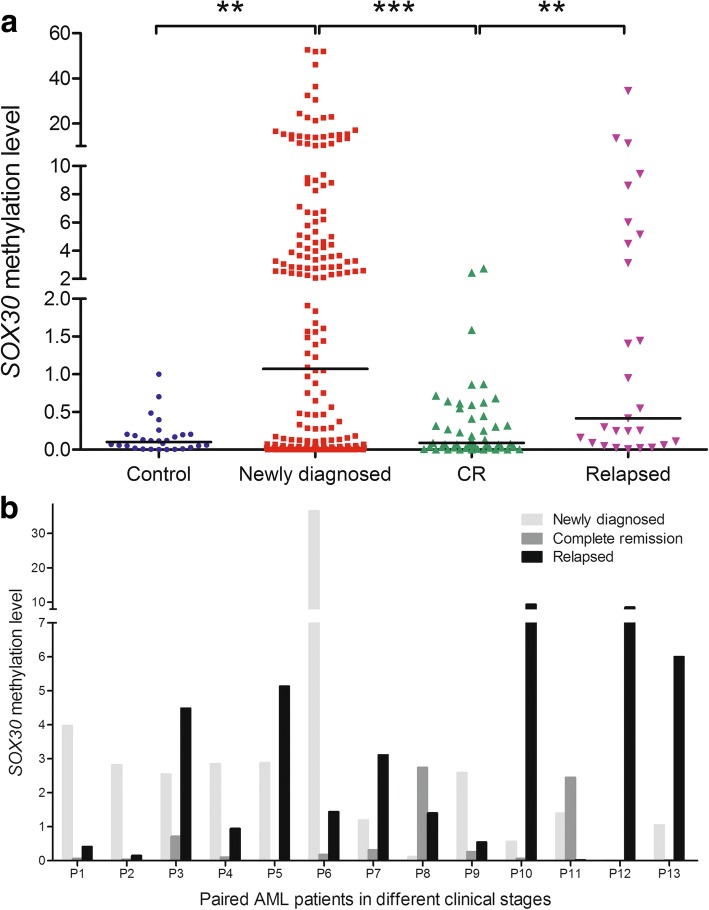
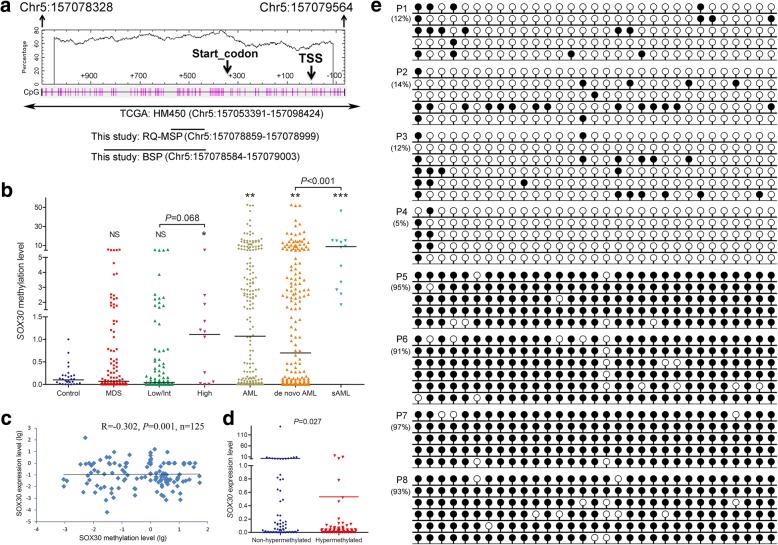
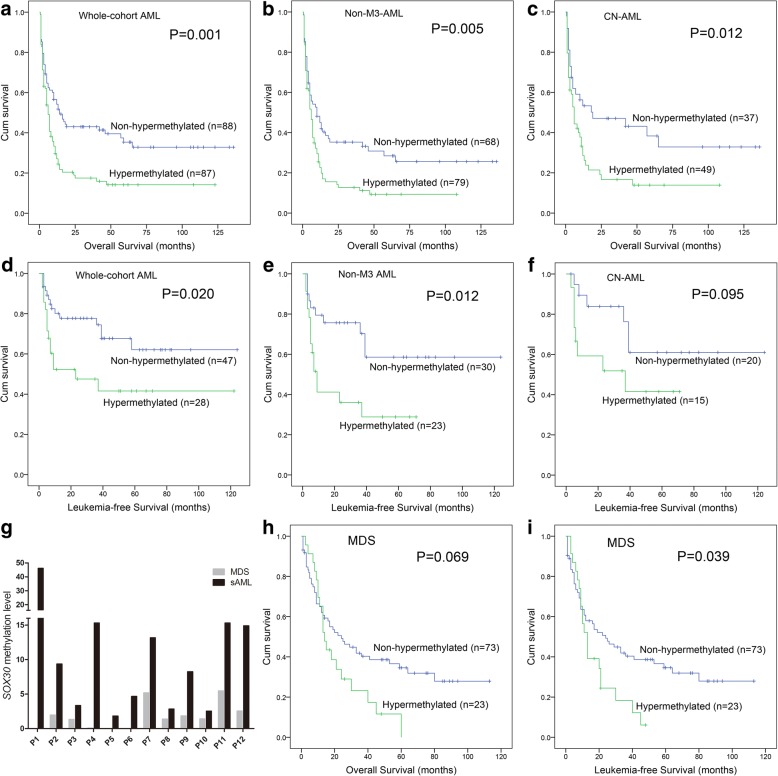
In the discovery stage, we identified that methylation, a frequent event in AML, was negatively associated with expression and correlated with overall survival (OS) and leukemia-free survival (LFS) in cytogenetically normal AML among family members from The Cancer Genome Atlas (TCGA) datasets. In the validation stage, we verified that methylation level was significantly higher in AML even in MDS-derived AML compared to controls, whereas hypermethylation was not a frequent event in MDS. methylation was inversely correlated with expression in AML patients. Survival analysis showed that hypermethylation was negatively associated with complete remission (CR), OS, and LFS in AML, where it only affected LFS in MDS. Notably, among MDS/AML paired patients, methylation level was significantly increased in AML stage than in MDS stage. In addition, methylation was found to be significantly decreased in AML achieved CR when compared to diagnosis time and markedly increased in relapsed AML when compared to the CR population.
Our findings revealed that methylation was associated with disease progression in MDS and acted as an independent prognostic and predictive biomarker in AML.
甲基化相关家族基因已被证明参与致癌过程中的多个基本过程,并作为癌症诊断、分期、预后预测和治疗反应监测的潜在生物标志物。在此,我们揭示了甲基化及其在急性髓系白血病(AML)和骨髓增生异常综合征(MDS)中的临床意义。
在发现阶段,我们确定在 AML 中频繁发生的甲基化与 TCGA 数据集内正常核型 AML 中的家族成员的表达呈负相关,并与总生存期(OS)和无白血病生存期(LFS)相关。在验证阶段,我们验证了 AML 中甲基化水平明显高于对照组,即使在 MDS 衍生的 AML 中也是如此,而在 MDS 中,甲基化不是一个频繁事件。AML 患者中甲基化与表达呈负相关。生存分析表明,甲基化与 AML 的完全缓解(CR)、OS 和 LFS 呈负相关,而在 MDS 中仅影响 LFS。值得注意的是,在 MDS/AML 配对患者中,AML 阶段的甲基化水平明显高于 MDS 阶段。此外,与诊断时间相比,CR 时 AML 中的甲基化水平显著降低,与 CR 人群相比,复发 AML 中的甲基化水平显著增加。
我们的研究结果表明,甲基化与 MDS 中的疾病进展有关,并在 AML 中作为独立的预后和预测生物标志物。