Božić Tanja, Lin Qiong, Frobel Joana, Wilop Stefan, Hoffmann Melanie, Müller-Tidow Carsten, Brümmendorf Tim H, Jost Edgar, Wagner Wolfgang
Helmholtz-Institute for Biomedical Engineering, Stem Cell Biology and Cellular Engineering, University Hospital of the RWTH Aachen, Pauwelsstrasse 20, 52074 Aachen, Germany.
Institute for Biomedical Engineering - Cell Biology, University Hospital of the RWTH Aachen, Aachen, Germany.
Clin Epigenetics. 2015 Nov 4;7:116. doi: 10.1186/s13148-015-0153-6. eCollection 2015.
Epigenetic aberrations play a central role in the pathophysiology of acute myeloid leukemia (AML). It has been shown that molecular signatures based on DNA-methylation (DNAm) patterns can be used for classification of the disease. In this study, we followed the hypothesis that DNAm at a single CpG site might support risk stratification in AML.
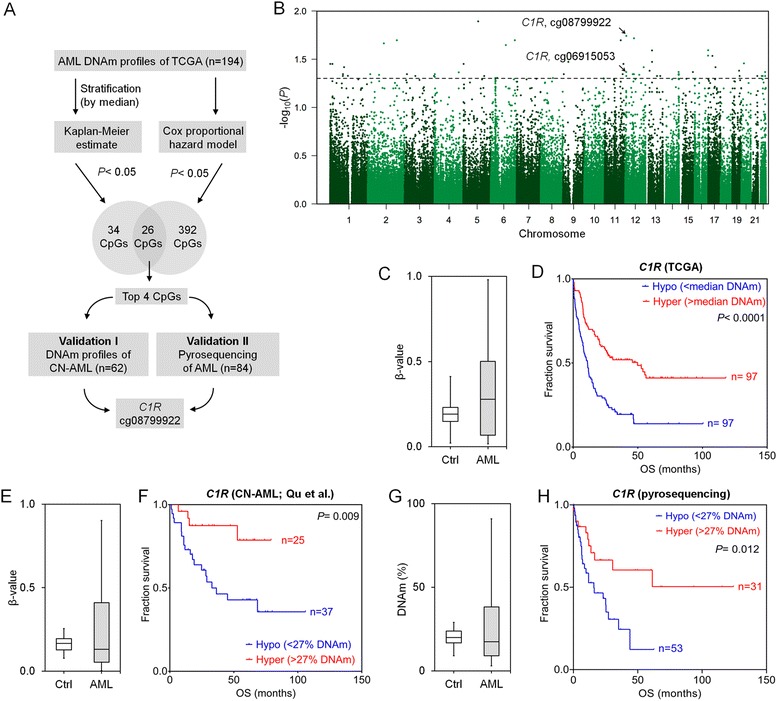
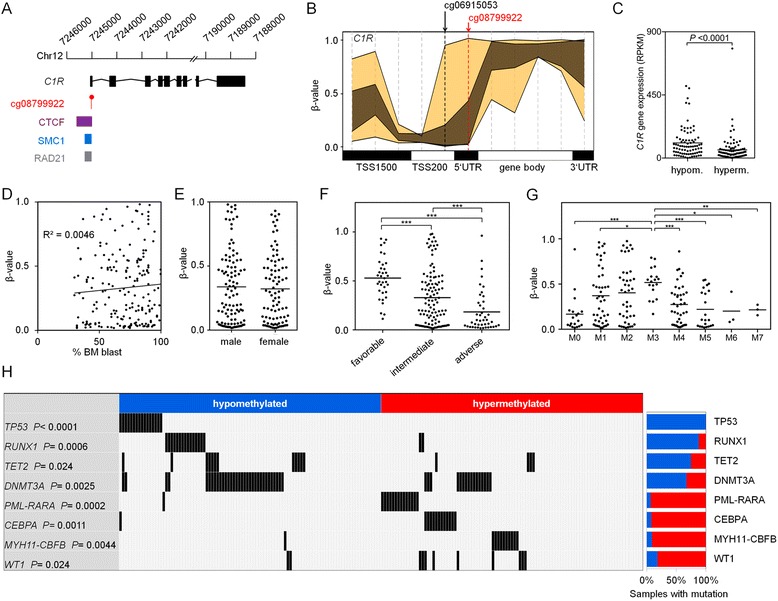
Using DNAm profiles of 194 patients from The Cancer Genome Atlas (TCGA), we identified a CpG site in complement component 1 subcomponent R (C1R) as best suited biomarker: patients with higher methylation at this CpG site (>27 % DNAm) reveal significantly longer overall survival (53 versus 11 months; P < 0.0001). This finding was validated in an independent set of 62 DNAm profiles of cytogenetically normal AML patients (P = 0.009) and with a region-specific pyrosequencing assay in 84 AML samples (P = 0.012). DNAm of C1R correlated with genomic DNAm and gene expression patterns, whereas there was only moderate association with gene expression levels of C1R. These results indicate that DNAm of C1R is a biomarker reflecting chromatin reorganization rather than being of pathophysiological relevance per se. Notably, DNAm of C1R was associated with occurrence of specific genomic mutations that are traditionally used for risk stratification in AML. Furthermore, DNAm of C1R correlates also with overall survival in several other types of cancer, but the prognostic relevance was less pronounced than in AML.
Analysis of DNAm at C1R provides a simple, robust, and cost-effective biomarker to further complement risk assessment in AML.
表观遗传异常在急性髓系白血病(AML)的病理生理学中起核心作用。已表明基于DNA甲基化(DNAm)模式的分子特征可用于该疾病的分类。在本研究中,我们遵循这样的假设,即单个CpG位点的DNAm可能有助于AML的风险分层。
利用来自癌症基因组图谱(TCGA)的194例患者的DNAm谱,我们确定补体成分1亚成分R(C1R)中的一个CpG位点是最适合的生物标志物:该CpG位点甲基化程度较高(>27% DNAm)的患者总生存期显著更长(53个月对11个月;P<0.0001)。这一发现在一组独立的62例细胞遗传学正常的AML患者的DNAm谱中得到验证(P = 0.009),并在84例AML样本中通过区域特异性焦磷酸测序分析得到验证(P = 0.012)。C1R的DNAm与基因组DNAm和基因表达模式相关,而与C1R的基因表达水平仅有中等程度的关联。这些结果表明,C1R的DNAm是一种反映染色质重组的生物标志物,而非本身具有病理生理学相关性。值得注意的是,C1R的DNAm与AML中传统用于风险分层的特定基因组突变的发生相关。此外,C1R的DNAm在其他几种癌症类型中也与总生存期相关,但预后相关性不如在AML中明显。
对C1R处DNAm的分析提供了一种简单、可靠且经济高效的生物标志物,以进一步补充AML的风险评估。