Groupement de Défense Sanitaire de Bretagne, 56019, Vannes, France.
BIOEPAR, INRA, Oniris, Université Bretagne Loire, 44307, Nantes, France.
Vet Res. 2018 Jul 13;49(1):60. doi: 10.1186/s13567-018-0557-3.
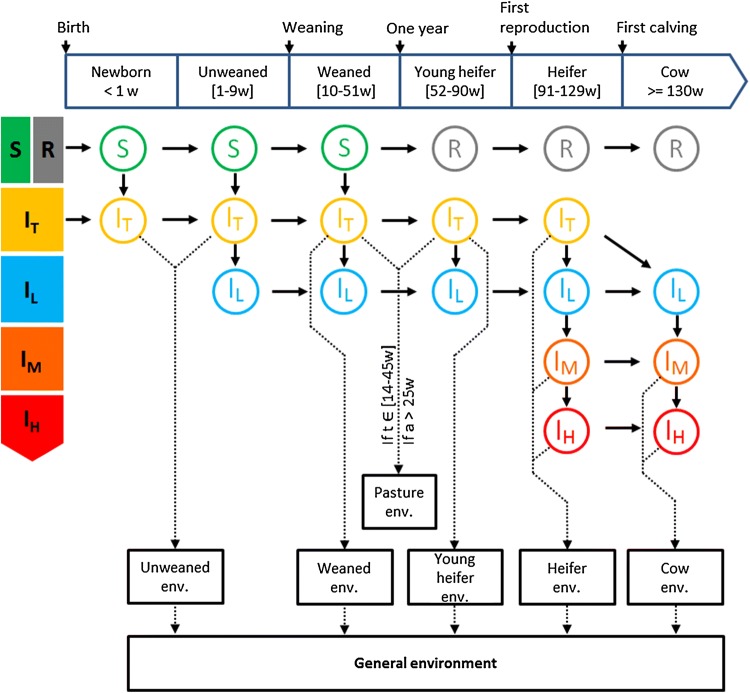
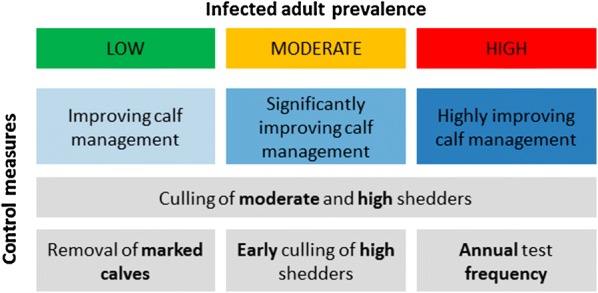
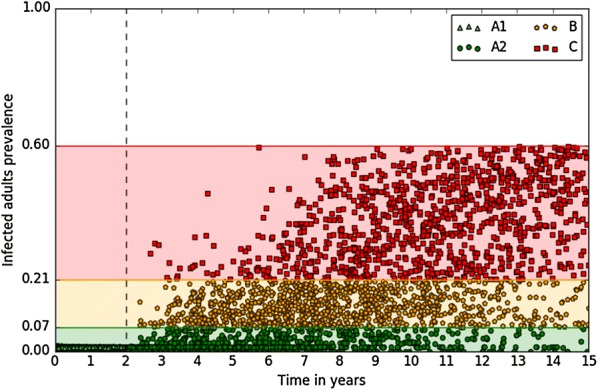
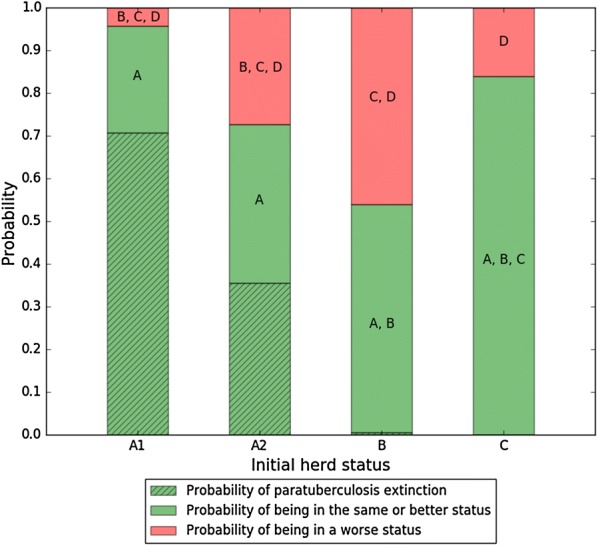
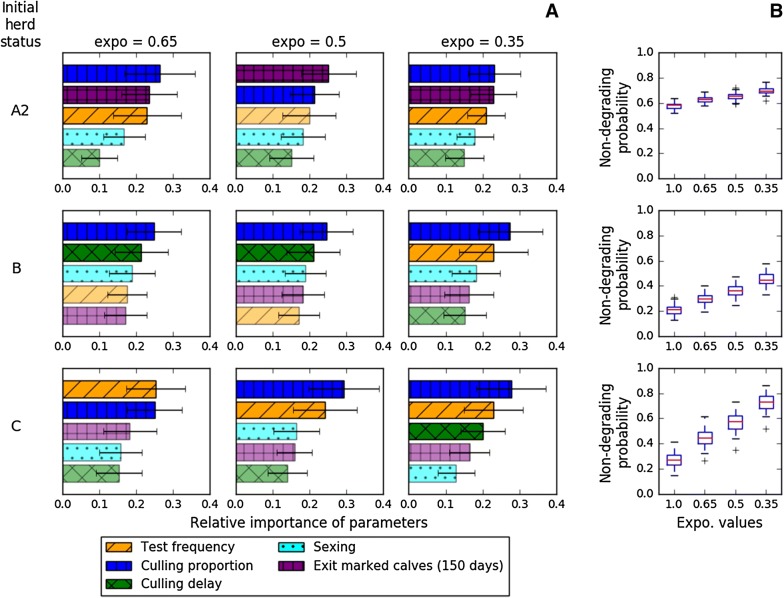
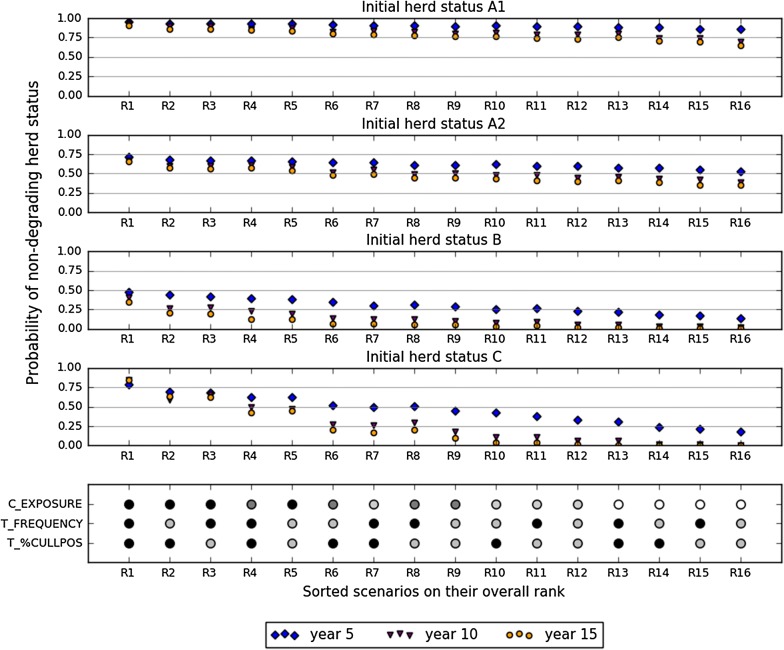
Paratuberculosis, a gastrointestinal disease caused by Mycobacterium avium subsp. paratuberculosis (Map), can lead to severe economic losses in dairy cattle farms. Current measures are aimed at controlling prevalence in infected herds, but are not fully effective. Our objective was to determine the most effective control measures to prevent an increase in adult prevalence in infected herds. We developed a new individual-based model coupling population and infection dynamics. Animals are characterized by their age (6 groups) and health state (6 states). The model accounted for all transmission routes and two control measures used in the field, namely reduced calf exposure to adult faeces and test-and-cull. We defined three herd statuses (low, moderate, and high) based on realistic prevalence ranges observed in French dairy cattle herds. We showed that the most relevant control measures depend on prevalence. Calf management and test-and-cull both were required to maximize the probability of stabilizing herd status. A reduced calf exposure was confirmed to be the most influential measure, followed by test frequency and the proportion of infected animals that were detected and culled. Culling of detected high shedders could be delayed for up to 3 months without impacting prevalence. Management of low prevalence herds is a priority since the probability of status stabilization is high after implementing prioritized measures. On the contrary, an increase in prevalence was particularly difficult to prevent in moderate prevalence herds, and was only feasible in high prevalence herds if the level of control was high.
副结核病是一种由鸟分枝杆菌副结核亚种(Map)引起的胃肠道疾病,可导致奶牛场遭受严重的经济损失。目前的措施旨在控制感染牛群的流行率,但并非完全有效。我们的目的是确定最有效的控制措施,以防止感染牛群中成年牛流行率的增加。我们开发了一种新的基于个体的模型,将种群和感染动力学结合在一起。动物的特征是年龄(6 组)和健康状态(6 种状态)。该模型考虑了所有的传播途径和两种在田间使用的控制措施,即减少犊牛接触成年粪便和检测-扑杀。我们根据在法国奶牛群中观察到的现实流行范围定义了三种牛群状态(低、中、高)。我们表明,最相关的控制措施取决于流行率。牛犊管理和检测-扑杀都需要最大程度地稳定牛群状态的概率。减少犊牛暴露被证实是最有影响力的措施,其次是检测频率和检测到并扑杀的感染动物的比例。可以将检测到的高排菌动物的扑杀延迟长达 3 个月,而不会影响流行率。管理低流行率牛群是优先事项,因为在实施优先措施后,稳定状态的概率很高。相反,在中流行率牛群中,流行率的增加尤其难以预防,只有在控制水平高的情况下,在高流行率牛群中才可行。