Center for the Evaluation of Value and Risk in Health, Institute for Clinical Research and Health Policy Studies, Tufts Medical Center, Boston, MA, USA.
Center for the Evaluation of Value and Risk in Health, Institute for Clinical Research and Health Policy Studies, Tufts Medical Center, Boston, MA, USA.
Value Health. 2018 Jul;21(7):759-761. doi: 10.1016/j.jval.2017.12.016. Epub 2018 Feb 21.
To determine what thresholds are most often cited in the cost-effectiveness literature for low- and middle-income countries (LMICs), given various recommendations proposed and used in the literature to date, and thereafter to assess whether studies appropriately justified their use of threshold values.
We reviewed the contents of the Tufts Medical Center Global Health Cost-Effectiveness Analysis Registry, a repository of all English language cost-per-disability-adjusted life-year averted studies indexed in PubMed. Our review included all catalogued cost-per-disability-adjusted life-year studies published from 2000 through 2015. We restricted attention to studies that investigated interventions in LMICs.
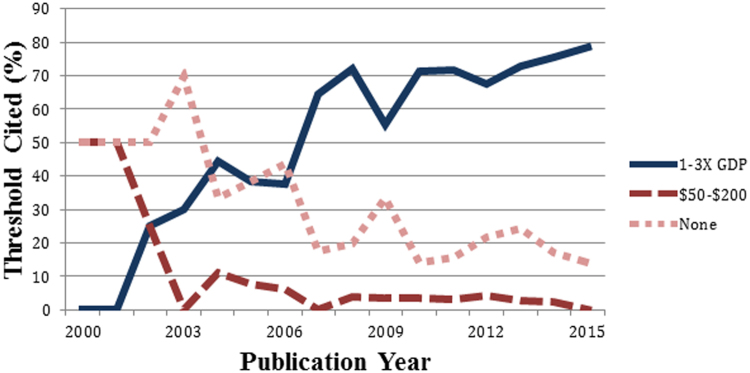
Our analysis identified 381 studies (80%) focused on LMICs. Of these studies, 250 (66%) cited the World Health Organization's 1 to 3 times gross domestic product per capita threshold. A full-text review of 60 (24%) of these articles (randomly selected) revealed that none justified use of this threshold in the particular country or countries studied beyond citing (generic) guideline documents.
Cost-effectiveness analysis can help inform health care spending, but its value depends on incorporating assumptions that are valid for the applicable setting. Rather than rely on commonly used, generic economic thresholds, we encourage authors to use context-specific thresholds that reflect local preferences.
鉴于文献中迄今提出并使用的各种建议,确定在中低收入国家(LMICs)的成本效益文献中最常引用的阈值,然后评估研究是否恰当地证明了其使用阈值的合理性。
我们审查了塔夫茨医疗中心全球卫生成本效益分析登记处的内容,该登记处是 PubMed 索引的所有英文残疾调整生命年成本效益研究的存储库。我们的审查包括 2000 年至 2015 年期间发表的所有目录残疾调整生命年研究。我们只关注研究中 LMICs 的干预措施。
我们的分析确定了 381 项研究(80%)侧重于 LMICs。其中 250 项(66%)研究引用了世界卫生组织的人均国内生产总值 1 至 3 倍的阈值。对这 60 篇文章中的 60 篇(随机选择)的全文审查显示,除了引用(通用)指南文件外,没有一篇文章在特定国家或研究国家证明使用该阈值的合理性。
成本效益分析可以帮助确定医疗保健支出,但它的价值取决于纳入适用于适用环境的有效假设。我们鼓励作者使用反映当地偏好的具体情况阈值,而不是依赖于常用的通用经济阈值。