Max Planck University College London Centre for Computational Psychiatry and Ageing Research, London WC1B 5EH, United Kingdom,
Wellcome Centre for Human Neuroimaging, University College London, London WC1N 3BG, United Kingdom, and.
J Neurosci. 2018 Aug 8;38(32):7170-7178. doi: 10.1523/JNEUROSCI.0192-18.2018. Epub 2018 Jul 13.
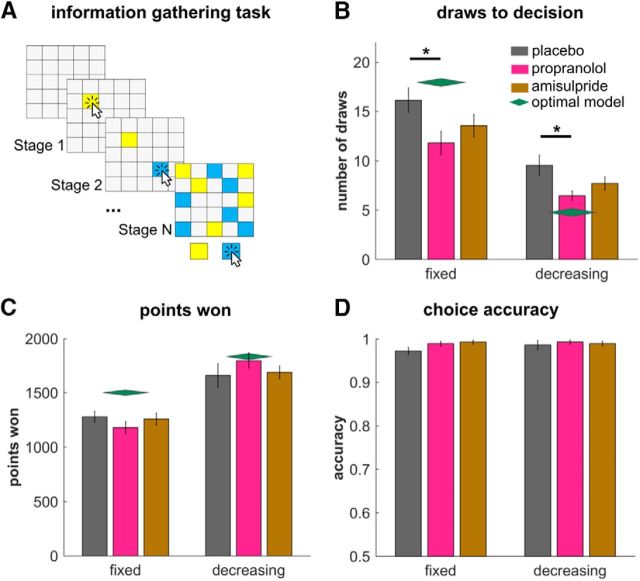
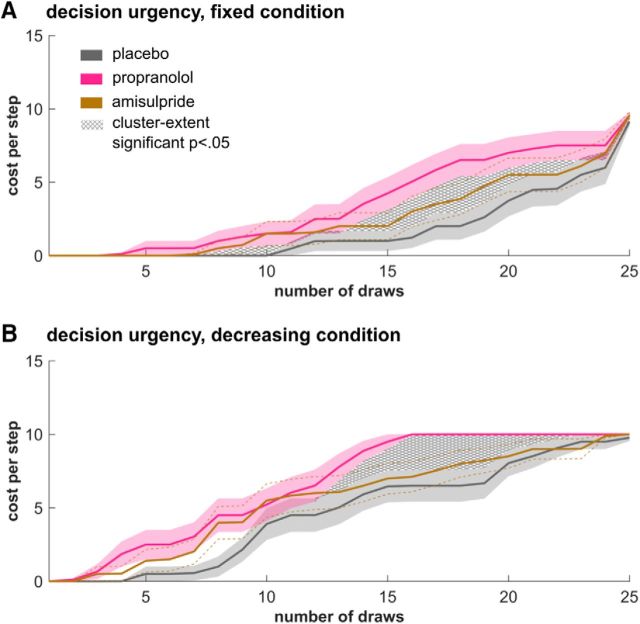
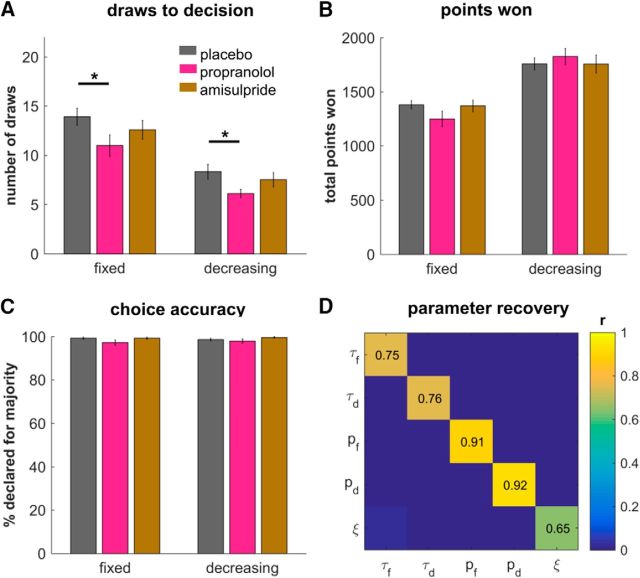
Arbitrating between timely choice and extended information gathering is critical for effective decision making. Aberrant information gathering behavior is thought to be a feature of psychiatric disorders such as schizophrenia and obsessive-compulsive disorder, but we know little about the underlying neurocognitive control mechanisms. In a double-blind, placebo-controlled drug study involving 60 healthy human subjects (30 female), we examined the effects of noradrenaline and dopamine antagonism on information gathering during performance of an information sampling task. We show that modulating noradrenaline function with 40 mg of the β-blocker propranolol leads to decreased information gathering behavior. Modulating dopamine function via a single dose of 400 mg of amisulpride revealed some effects that were intermediate between those of propranolol and placebo. Using a Bayesian computational model, we show that sampling behavior is best explained by inclusion of a nonlinear urgency signal that promotes commitment to an early decision. Noradrenaline blockade promotes the expression of this decision-related urgency signal during information gathering. We discuss the findings with respect to psychopathological conditions that are linked to aberrant information gathering. Knowing when to stop gathering information and commit to a choice option is nontrivial. This is an important element in arbitrating between information gain and energy conservation. In this double-blind, placebo-controlled drug study, we investigated the role of catecholamines noradrenaline and dopamine on sequential information gathering. We found that blockade of noradrenaline led to a decrease in information gathering. Dopamine blockade showed an intermediate, but nonsignificant, effect. Using a Bayesian computational model, we show that this noradrenaline effect is driven by increased decision urgency, a signal that reflects an escalating subjective cost of sampling. The observation that noradrenaline modulates decision urgency suggests new avenues for treating patients that show information gathering deficits.
在有效的决策中,及时做出选择和扩展信息收集之间的平衡至关重要。信息收集行为异常被认为是精神障碍(如精神分裂症和强迫症)的特征之一,但我们对其潜在的神经认知控制机制知之甚少。在一项涉及 60 名健康人类受试者(30 名女性)的双盲、安慰剂对照药物研究中,我们研究了去甲肾上腺素和多巴胺拮抗作用对信息取样任务中信息收集的影响。我们发现,用 40 毫克β受体阻滞剂普萘洛尔调节去甲肾上腺素功能会导致信息收集行为减少。通过单次给予 400 毫克氨磺必利调节多巴胺功能,揭示了一些在普萘洛尔和安慰剂之间的中间效应。使用贝叶斯计算模型,我们表明,采样行为最好通过纳入促进早期决策承诺的非线性紧迫性信号来解释。去甲肾上腺素阻断促进了该决策相关紧迫性信号在信息收集过程中的表达。我们根据与异常信息收集相关的精神病理学条件讨论了这些发现。知道何时停止收集信息并做出选择并不简单。这是在信息获取和能量节约之间进行权衡的重要因素。在这项双盲、安慰剂对照药物研究中,我们研究了儿茶酚胺去甲肾上腺素和多巴胺对连续信息收集的作用。我们发现,去甲肾上腺素阻断导致信息收集减少。多巴胺阻断显示出中间但无统计学意义的效果。使用贝叶斯计算模型,我们表明这种去甲肾上腺素效应是由决策紧迫性的增加驱动的,这是一个反映采样主观成本不断上升的信号。去甲肾上腺素调节决策紧迫性的观察结果表明,为表现出信息收集缺陷的患者提供新的治疗途径。