Regional Cancer Network Onco-Occitanie, Toulouse University Institute of Cancer-Oncopole
Department of Hematology, Toulouse University Institute of Cancer-Oncopole.
Haematologica. 2018 Dec;103(12):2040-2048. doi: 10.3324/haematol.2018.192468. Epub 2018 Jul 13.
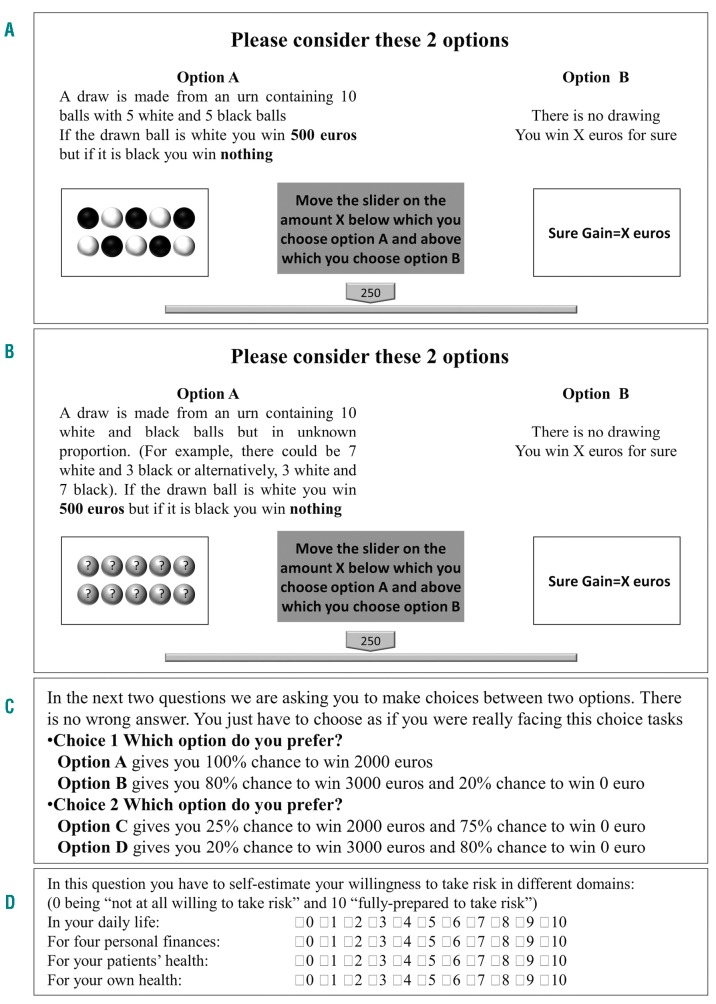
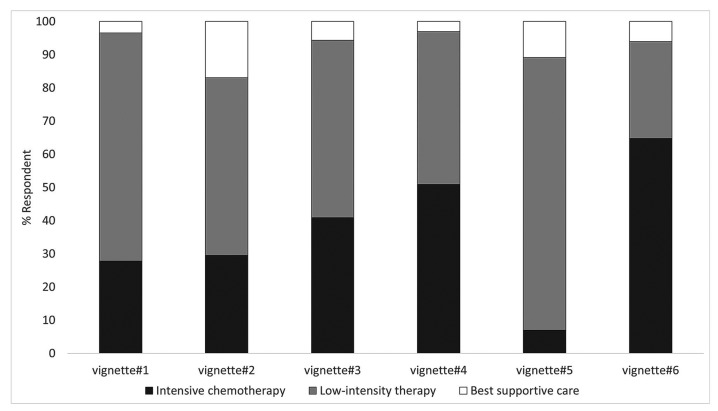
Elderly patients with acute myeloid leukemia can be treated with intensive chemotherapy, low-intensity therapy such as low-dose aracytine or hypomethylating agents, or best supportive care. The choice between these treatments is a function of many patient-related and disease-related factors. We investigated how physicians' behavioral characteristics affect medical decision-making between intensive and non-intensive therapy in this setting. A nationwide cross-sectional online survey of hematologists collected data on medical decision-making for 6 clinical vignettes involving older acute myeloid leukemia patients that were representative of routine practice. Questionnaires elicited physicians' demographic and occupational characteristics along with their individual behavioral characteristics according to a decision theory framework. From the pattern of responses to the vignettes, a K-means clustering algorithm was used to distinguish those who were likely to prescribe more intensive therapy and those who were likely to prescribe less intensive or no therapy. Multivariate analyses were used to identify physician's characteristics predictive of medical decision-making. We obtained 230 assessable answers, which represented an adjusted response rate of 45.4%. A multivariate model (n=210) revealed that physicians averse to uncertainty recommend significantly more intensive chemotherapy: Odds Ratio (OR) [95% Confidence Interval (CI)]: 1.15 [1.01;1.30]; =0.039. Male physicians who do not conform to the expected utility model (assumed as economically irrational) recommend more intensive chemotherapy [OR (95% CI) = 3.45 (1.34; 8.85); =0.01]. Patient volume per physician also correlated with therapy intensity [OR (95% CI)=0.98 (0.96; 0.99); =0.032]. The physicians' medical decision-making was not affected by their age, years of experience, or hospital facility. The significant association between medical decision and individual behavioral characteristics of the physician identifies a novel non-biological factor that may affect acute myeloid leukemia patients' outcomes and explain variations in clinical practice. It should also encourage the use of validated predictive models and the description of novel bio-markers to best select patients for intensive chemotherapy or low-intensity therapy.
老年急性髓系白血病患者可以接受强化化疗、低强度治疗,如小剂量阿糖胞苷或低甲基化剂治疗,或最佳支持治疗。这些治疗方法的选择取决于许多与患者相关和与疾病相关的因素。我们研究了医生的行为特征如何影响这种情况下强化治疗和非强化治疗之间的医学决策。一项全国性的血液病学家在线横断面调查收集了 6 个临床病例的医学决策数据,这些病例代表了常规实践。调查问卷根据决策理论框架收集了医生的人口统计学和职业特征以及他们的个体行为特征。根据对病例的反应模式,使用 K-均值聚类算法将那些可能开更强化治疗的医生与那些可能开非强化或不治疗的医生区分开来。多变量分析用于确定医生特征对医学决策的预测作用。我们获得了 230 份可评估的答案,调整后的应答率为 45.4%。多变量模型(n=210)显示,规避不确定性的医生更推荐强化化疗:比值比(OR)[95%置信区间(CI)]:1.15 [1.01;1.30];=0.039。不符合预期效用模型(被认为是经济上不合理的)的男性医生更推荐强化化疗[OR(95% CI)=3.45(1.34;8.85);=0.01]。每位医生的患者量也与治疗强度相关[OR(95% CI)=0.98(0.96;0.99);=0.032]。医生的医疗决策不受其年龄、经验年限或医院设施的影响。医生的医疗决策与个体行为特征之间的显著关联确定了一个新的非生物学因素,可能影响急性髓系白血病患者的结局并解释临床实践的差异。它还应该鼓励使用经过验证的预测模型和描述新的生物标志物,以最好地选择接受强化化疗或低强度治疗的患者。