Department of Epidemiology, Erasmus MC University Medical Center, Rotterdam, The Netherlands.
Department of Epidemiology, Harvard T.H. Chan School of Public Health, Boston, MA, USA.
Eur J Neurol. 2018 Dec;25(12):1470-1476. doi: 10.1111/ene.13752. Epub 2018 Aug 6.
Creativity in Parkinson's disease (PD) is strongly related to dopaminergic activity and medication. We hypothesized that patients with PD, including those who are in the pre-diagnostic phase of PD, are prone to choose highly structured 'conventional' professional occupations and avoid highly creative 'artistic' occupations.
At baseline of the population-based Rotterdam Study, we asked 12 147 individuals aged ≥45 years about their latest occupation and categorized occupations according to the RIASEC model. Participants underwent baseline and follow-up (median 11 years) examinations for PD. We determined associations of artistic (versus any other occupation) and conventional (versus any other occupation) occupations with PD. Additionally, we pooled our results with a recently published case-control study (Radboud Study).
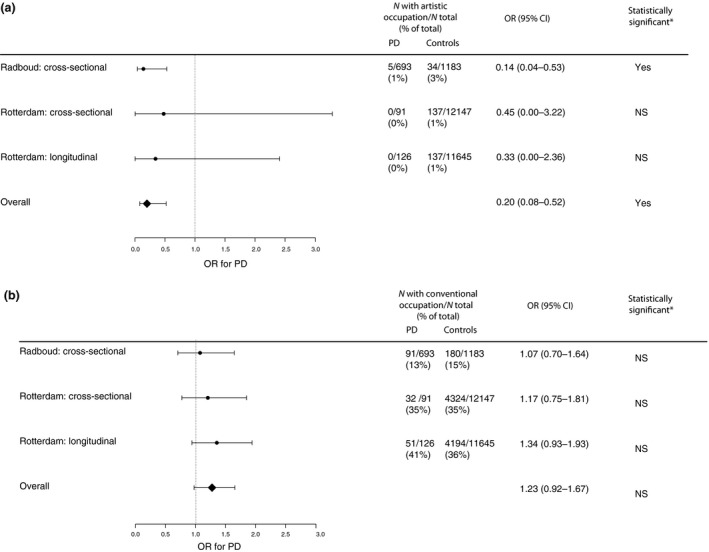
At baseline, conventional occupations were common [n = 4356 (36%)], whereas artistic occupations were rare [n = 137 (1%)]. There were 217 patients with PD, including 91 with prevalent PD and 126 with incident PD. The risk of PD varied substantially across occupational categories (chi-square, 14.61; P = 0.01). The penalized odds ratio (OR) of artistic occupations for PD was 0.19 [95% confidence interval (CI), 0.00-1.31; P = 0.11], whereas the OR of conventional occupations for PD was 1.23 (95% CI, 0.95-1.66; P = 0.10). The direction and magnitude of ORs were similar in cross-sectional and longitudinal subsamples. Pooled ORs across the Rotterdam and Radboud Studies were 0.20 (95% CI, 0.08-0.52; P < 0.001) for artistic and 1.23 (95% CI, 0.92-1.67; P = 0.08) for conventional occupations.
The risk of PD varies substantially by choice of professional occupation. Our findings suggest that dopaminergic degeneration affects choice of occupation, which may start in the pre-diagnostic phase of PD.
帕金森病(PD)患者的创造力与多巴胺能活性和药物治疗密切相关。我们假设 PD 患者,包括处于 PD 诊断前阶段的患者,更倾向于选择高度结构化的“传统”职业,而避免高度创造性的“艺术”职业。
在基于人群的鹿特丹研究的基线时,我们询问了 12147 名年龄≥45 岁的个体他们最近的职业,并根据 RIASEC 模型对职业进行分类。参与者接受了 PD 的基线和随访(中位时间为 11 年)检查。我们确定了艺术(与任何其他职业相比)和传统(与任何其他职业相比)职业与 PD 的关联。此外,我们将研究结果与最近发表的病例对照研究(拉德堡德研究)进行了汇总。
基线时,常见的是传统职业[共 4356 人(36%)],而艺术职业则很少见[共 137 人(1%)]。共有 217 名 PD 患者,其中 91 名患有现患 PD,126 名患有新发 PD。职业类别之间的 PD 风险差异很大(卡方检验,14.61;P=0.01)。艺术职业患 PD 的风险比(OR)为 0.19(95%置信区间,0.00-1.31;P=0.11),而传统职业患 PD 的 OR 为 1.23(95%置信区间,0.95-1.66;P=0.10)。横断面和纵向亚组中 OR 的方向和大小相似。鹿特丹和拉德堡德研究的汇总 OR 分别为艺术职业 0.20(95%置信区间,0.08-0.52;P<0.001)和传统职业 1.23(95%置信区间,0.92-1.67;P=0.08)。
PD 的风险与职业选择差异很大。我们的研究结果表明,多巴胺能变性会影响职业选择,这种情况可能在 PD 的诊断前阶段就开始了。