Kopp Nathan D, Parrish Phoebe C R, Lugo Michael, Dougherty Joseph D, Kozel Beth A
Department of Genetics, Washington University School of Medicine, St. Louis, Missouri.
National Heart Lung and Blood Institute, National Institutes of Health, Bethesda, Maryland.
Mol Genet Genomic Med. 2018 Sep;6(5):749-765. doi: 10.1002/mgg3.429. Epub 2018 Jul 15.
Large, multigenic deletions at chromosome 7q11.23 result in a highly penetrant constellation of physical and behavioral symptoms known as Williams-Beuren syndrome (WS). Of particular interest is the unusual social-cognitive profile evidenced by deficits in social cognition and communication reminiscent of autism spectrum disorders (ASD) that are juxtaposed with normal or even relatively enhanced social motivation. Interestingly, duplications in the same region also result in ASD-like phenotypes as well as social phobias. Thus, the region clearly regulates human social motivation and behavior, yet the relevant gene(s) have not been definitively identified.
Here, we deeply phenotyped 85 individuals with WS and used exome sequencing to analyze common and rare variation for association with the remaining variance in social behavior as assessed by the Social Responsiveness Scale.
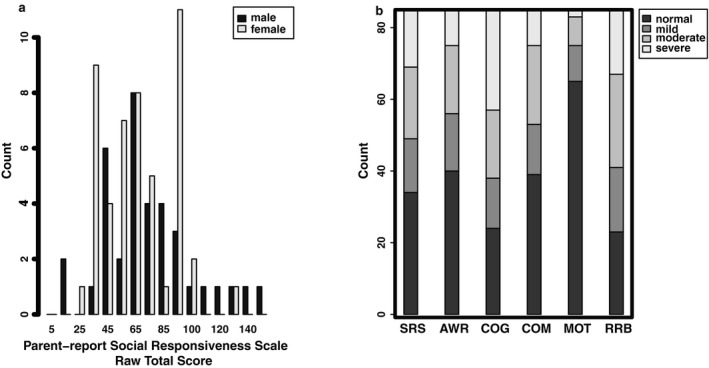
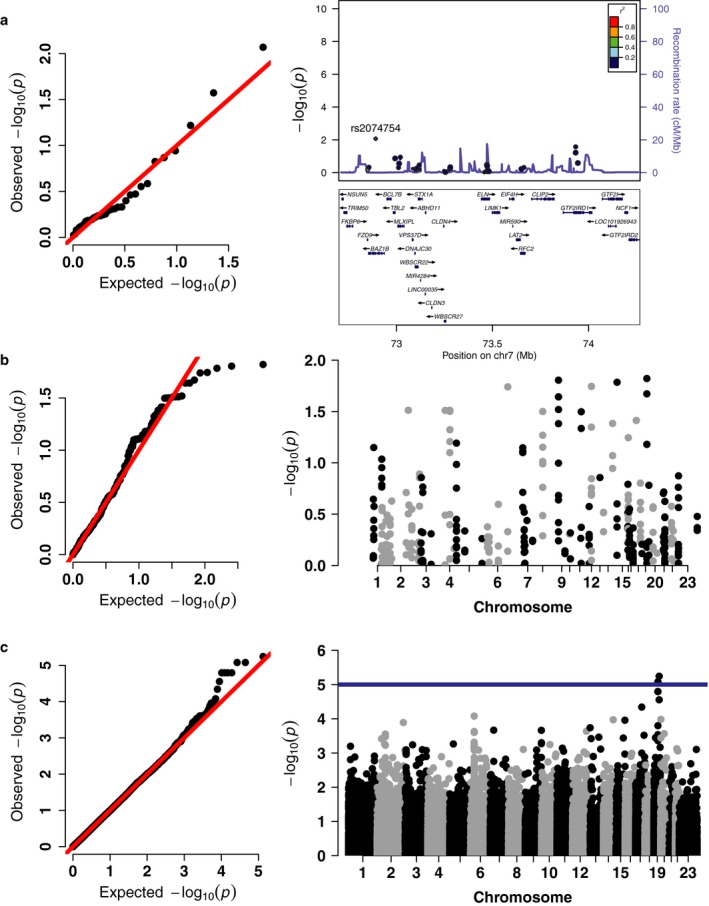
We replicated the previously reported unusual juxtaposition of behavioral symptoms in this new patient collection, but we did not find any new alleles of large effect in the targeted analysis of the remaining copy of genes in the Williams syndrome critical region. However, we report on two nominally significant SNPs in two genes that have been implicated in the cognitive and social phenotypes of Williams syndrome, BAZ1B and GTF2IRD1. Secondary discovery driven explorations focusing on known ASD genes and an exome wide scan do not highlight any variants of a large effect.
Whole exome sequencing of 85 individuals with WS did not support the hypothesis that there are variants of large effect within the remaining Williams syndrome critical region that contribute to the social phenotype. This deeply phenotyped and genotyped patient cohort with a defined mutation provides the opportunity for similar analyses focusing on noncoding variation and/or other phenotypic domains.
7号染色体q11.23区域的大型多基因缺失会导致一系列具有高度外显率的身体和行为症状,即威廉斯-博伦综合征(WS)。特别值得关注的是其不同寻常的社会认知特征,表现为社会认知和沟通方面的缺陷,类似于自闭症谱系障碍(ASD),但同时又伴有正常甚至相对增强的社会动机。有趣的是,同一区域的重复也会导致类似ASD的表型以及社交恐惧症。因此,该区域显然对人类社会动机和行为具有调节作用,但相关基因尚未得到明确鉴定。
在此,我们对85名WS患者进行了深入的表型分析,并使用外显子组测序来分析常见和罕见变异与社交行为剩余变异之间的关联,社交行为通过社交反应量表进行评估。
我们在这个新的患者群体中复制了先前报道的行为症状的不同寻常并列情况,但在对威廉斯综合征关键区域中基因的剩余拷贝进行靶向分析时,未发现任何具有显著效应的新等位基因。然而,我们报告了两个基因中两个名义上显著的单核苷酸多态性(SNP),这两个基因与威廉斯综合征的认知和社会表型有关,即BAZ1B和GTF2IRD1。聚焦于已知ASD基因的二次发现驱动探索以及全外显子组扫描均未突出任何具有显著效应的变异。
对85名WS患者进行的全外显子组测序不支持以下假设:威廉斯综合征关键区域内剩余部分存在对社会表型有贡献的具有显著效应的变异。这个经过深入表型分析和基因分型且具有明确突变的患者队列,为专注于非编码变异和/或其他表型领域的类似分析提供了机会。