Grasso Giovanni, Landi Alessandro
Department of Experimental Biomedicine and Clinical Neurosciences, Neurosurgical Clinic, School of Medicine, University of Palermo, Palermo, Italy.
Department of Neurology and Psychiatry, Neurosurgery, Sapienza University of Rome, Rome, Italy.
J Craniovertebr Junction Spine. 2018 Apr-Jun;9(2):87-92. doi: 10.4103/jcvjs.JCVJS_36_18.
The purpose of this study was to extend the results of our previous study providing a minimum of 4-year follow-up results of a prospective study following implantation of a cervical cage with an integrated fixation system.
The use of cervical intersomatic cages with an integrated fixation system for anterior cervical discectomy and fusion (ACDF) has increased rapidly in this last decade. In addition to immediate stabilization, these implants allow avoidance of anterior plating and iliac crest bone-grafting.
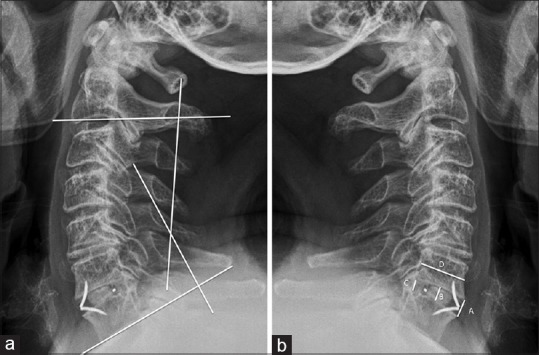
Patients were studied prospectively, and data were collected and analyzed. Intersomatic cages with an integrated fixation system were used in consecutive 100 patients operated on for ACDF. Intraoperative parameters, clinical, and outcome scores were recorded. Radiographs were taken to evaluate implant positioning and fusion rate, disc height (DH), and changes in adjacent disc spaces. All the patients had a minimum 4-year follow-up.
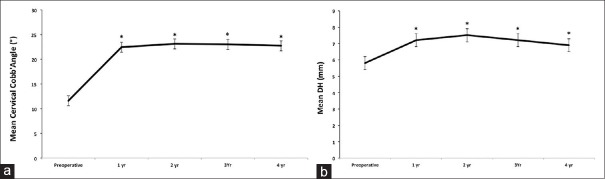
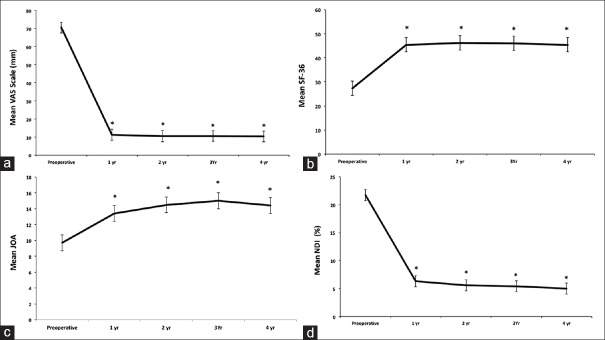
A total of 127 cages were implanted in the 100 patients. Compared to preoperatively, the visual analog scale, 36-item short-form health survey, the Japanese Orthopedic Association, and the Neck Disability Index scores were significantly improved at 1-year follow-up without change during subsequent follow-up. At 4 years, the fusion rate was 97%. Two patients complained about minor dysphagia-related symptoms, which resolved rapidly. DH index and cervical Cobb angle were significantly restored after surgery, and the results were maintained during the whole follow-up.
This is a prospective, independently conducted study on cages with an integrated fixation system with 4-year long follow-up. Findings of this study seem to be interesting regarding outcomes and low complications rates compared to recent series using other implants with integrated fixation system. Larger, randomized controlled trials are warranted.
本研究的目的是扩展我们先前研究的结果,该研究提供了一项前瞻性研究的至少4年随访结果,该前瞻性研究是关于植入带有一体化固定系统的颈椎椎间融合器之后的情况。
在过去十年中,用于颈椎前路椎间盘切除融合术(ACDF)的带有一体化固定系统的颈椎椎间融合器的使用迅速增加。除了即时稳定作用外,这些植入物还可避免前路钢板固定和髂嵴植骨。
对患者进行前瞻性研究,收集并分析数据。连续100例行ACDF手术的患者使用了带有一体化固定系统的椎间融合器。记录术中参数、临床和结果评分。拍摄X线片以评估植入物位置、融合率、椎间盘高度(DH)以及相邻椎间盘间隙的变化。所有患者均至少随访4年。
100例患者共植入127个椎间融合器。与术前相比,视觉模拟量表、36项简短健康调查问卷、日本骨科协会和颈部功能障碍指数评分在1年随访时显著改善,在随后的随访中无变化。4年时,融合率为97%。两名患者抱怨有轻微的吞咽困难相关症状,但很快缓解。术后DH指数和颈椎Cobb角显著恢复,并且在整个随访期间结果保持稳定。
这是一项对带有一体化固定系统的椎间融合器进行的前瞻性、独立开展的研究,随访长达4年。与近期使用其他带有一体化固定系统的植入物的系列研究相比,本研究的结果在结局和低并发症发生率方面似乎很有意义。有必要开展更大规模的随机对照试验。