Sar-Pomian Marta, Konop Marek, Gala Kamila, Rudnicka Lidia, Olszewska Malgorzata
Department of Dermatology, Medical University of Warsaw, Warsaw, Poland.
Department of Immunology, Transplantology and Internal Diseases, Medical University of Warsaw, Warsaw, Poland.
Postepy Dermatol Alergol. 2018 Jun;35(3):293-298. doi: 10.5114/pdia.2017.71267. Epub 2017 Nov 8.
Scalp involvement in the course of pemphigus is observed in 16-60% of patients.
To determine the prognostic significance of scalp involvement in pemphigus vulgaris and pemphigus foliaceus.
A total of 75 patients (46 with pemphigus vulgaris, 29 with pemphigus foliaceus) were included into this prospective study. The following clinical data were analyzed: Pemphigus Disease Area Index, time to complete clinical remission and duration of complete clinical remission. Indirect immunofluorescence and enzyme-linked immunosorbent assay were performed to monitor serum pemphigus antibodies.
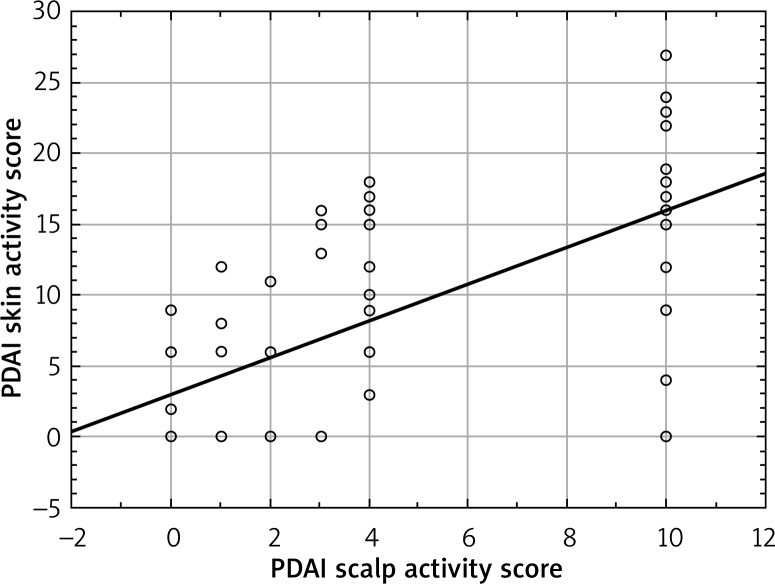
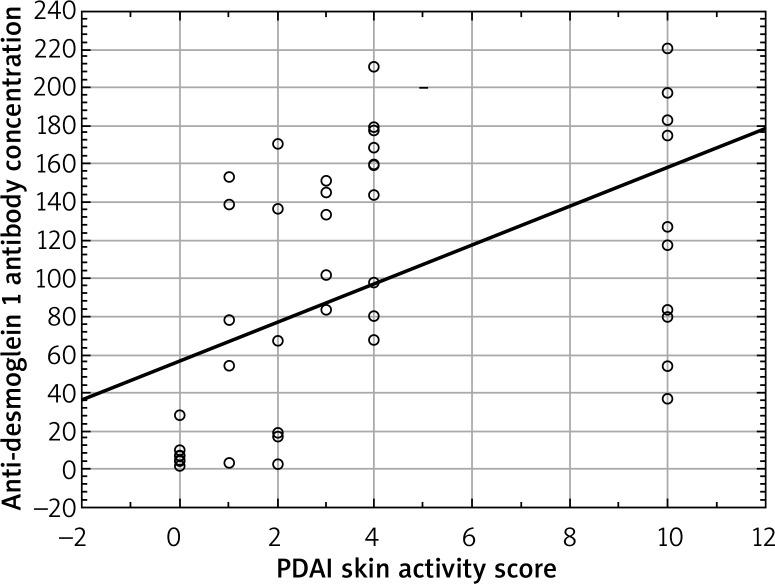
Scalp involvement was observed in 30/46 (65.2%) patients with pemphigus vulgaris and 28/29 (96.6%) patients with pemphigus foliaceus. A positive correlation was found between scalp involvement and general disease severity as measured by the Pemphigus Disease Area Index ( = 0.7, < 0.05). The time required to achieve a complete clinical remission in patients with and without scalp involvement was 39.1 ±47.1 and 9.1 ±7.8 months, respectively. The duration of complete clinical remission was 14.1 ±17.4 and 105.7 ±108.8 months, respectively. The respective time required to achieve serological remission was 37.7 ±58.5 and 15.5 ±18.8 months, whereas the duration of serological remission was 9.2 ±18.8 and 39.1 ±60.1 months, respectively. The average concentration of anti-desmoglein 1 autoantibodies was significantly higher in patients with scalp involvement compared to patients without scalp involvement (109.9 ±68.0 U/ml and 21.3 ±39.4 U/ml).
Scalp involvement in pemphigus is associated with a higher disease severity, longer time required to achieve complete clinical and serological remission and may indicate the need for a more aggressive therapeutical approach.
在16%-60%的天疱疮患者病程中会出现头皮受累情况。
确定头皮受累在寻常型天疱疮和落叶型天疱疮中的预后意义。
本前瞻性研究共纳入75例患者(46例寻常型天疱疮患者,29例落叶型天疱疮患者)。分析以下临床数据:天疱疮疾病面积指数、完全临床缓解时间和完全临床缓解持续时间。进行间接免疫荧光和酶联免疫吸附试验以监测血清天疱疮抗体。
46例寻常型天疱疮患者中有30例(65.2%)出现头皮受累,29例落叶型天疱疮患者中有28例(96.6%)出现头皮受累。通过天疱疮疾病面积指数衡量,发现头皮受累与总体疾病严重程度呈正相关(r = 0.7,P < 0.05)。有头皮受累和无头皮受累的患者实现完全临床缓解所需时间分别为39.1±47.1个月和9.1±7.8个月。完全临床缓解持续时间分别为14.1±17.4个月和105.7±108.8个月。实现血清学缓解所需的相应时间分别为37.7±58.5个月和15.5±18.8个月,而血清学缓解持续时间分别为9.2±18.8个月和39.1±60.1个月。与无头皮受累的患者相比,有头皮受累的患者抗桥粒芯糖蛋白1自身抗体的平均浓度显著更高(109.9±68.0 U/ml和21.3±39.4 U/ml)。
天疱疮患者头皮受累与更高的疾病严重程度、实现完全临床和血清学缓解所需的更长时间相关,可能表明需要更积极的治疗方法。