Ashraf Ghulam M, Baeesa Saleh S
King Fahd Medical Research Center, King Abdulaziz University, Jeddah, Saudi Arabia.
Division of Neurosurgery, College of Medicine, King Abdulaziz University, Jeddah, Saudi Arabia.
Front Neurosci. 2018 Jun 29;12:430. doi: 10.3389/fnins.2018.00430. eCollection 2018.
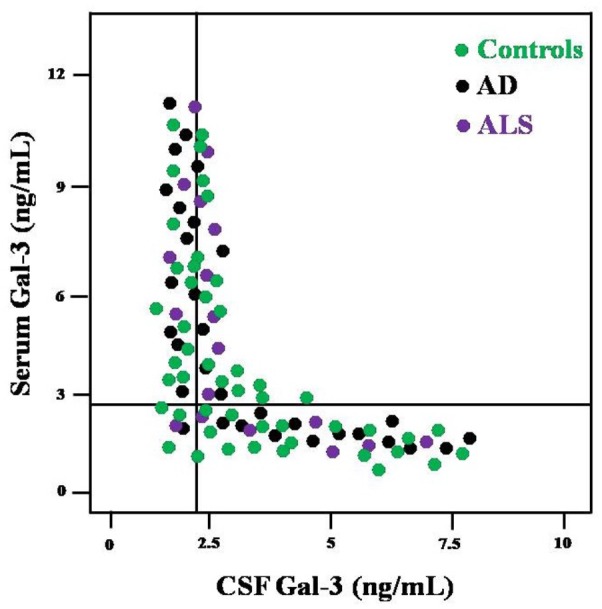
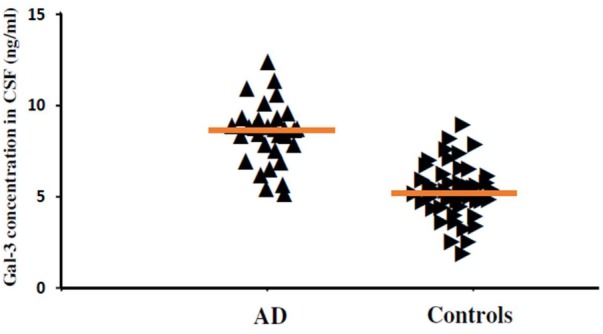
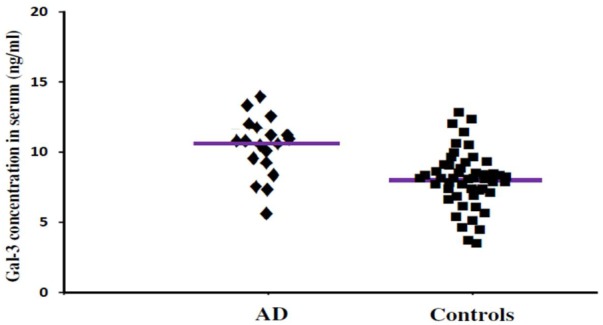
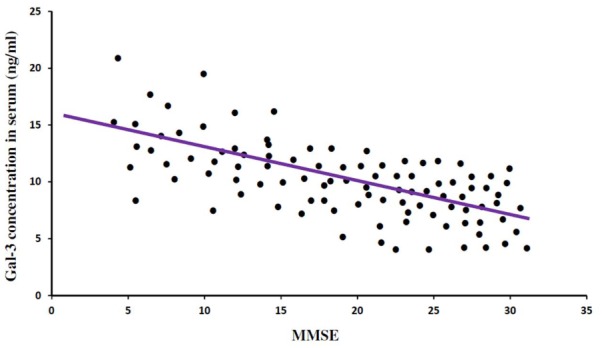
We performed this study to investigate the possibility of a definitive pattern of Galectin-3 (Gal-3) expression in the cerebrospinal fluid (CSF) and serum of Alzheimer's disease (AD) and Amyotrophic Lateral Sclerosis (ALS) patients. In our study, we collected the CSF and serum samples of 31 AD patients, 19 ALS patients and 50 normal healthy subjects (controls). Quantitative ELISA measured Gal-3 concentrations in CSF and serum samples. A comparative analysis was performed to analyze and understand the Gal-3 expression pattern. A number of neuropsychological assessments and statistical analyses were carried out to validate our findings. Recent researches have established the role of galectins in various neurodegenerative disorders (NDDs), but a definitive pattern of galectin expression is still elusive. A significant difference was observed in serum and CSF Gal-3 concentrations between AD patients and healthy controls. The difference in serum and CSF Gal-3 concentrations between ALS patients vs. controls was lesser as compared to AD patients vs. controls. The difference in serum and CSF Gal-3 concentrations of AD vs. ALS patients was not significant. The MMSE score and serum and CSF Gal-3 concentrations in AD and ALS patients, and controls exhibited a significant positive correlation. The findings of the present study are expected to provide an insight into the definitive pattern of Gal-3 expression in AD and ALS patients, and might thus establish Gal-3 as a strong biomarker. This in turn will open up new and promising research avenues targeting the expression of galectins to modulate the progression of NDDs, and pave the way for novel therapeutic options.
我们开展这项研究以调查阿尔茨海默病(AD)和肌萎缩侧索硬化症(ALS)患者脑脊液(CSF)和血清中半乳糖凝集素-3(Gal-3)表达的明确模式的可能性。在我们的研究中,我们收集了31例AD患者、19例ALS患者和50名正常健康受试者(对照组)的脑脊液和血清样本。采用定量酶联免疫吸附测定法(ELISA)测量脑脊液和血清样本中的Gal-3浓度。进行了对比分析以分析和了解Gal-3的表达模式。开展了多项神经心理学评估和统计分析以验证我们的研究结果。最近的研究已证实半乳糖凝集素在各种神经退行性疾病(NDDs)中的作用,但半乳糖凝集素表达的明确模式仍不清楚。观察到AD患者与健康对照组之间血清和脑脊液中Gal-3浓度存在显著差异。与AD患者与对照组相比,ALS患者与对照组之间血清和脑脊液中Gal-3浓度的差异较小。AD患者与ALS患者之间血清和脑脊液中Gal-3浓度的差异不显著。AD和ALS患者以及对照组的简易精神状态检查表(MMSE)评分与血清和脑脊液中Gal-3浓度呈显著正相关。本研究结果有望深入了解AD和ALS患者Gal-3表达的明确模式,从而可能将Gal-3确立为一种强有力的生物标志物。这反过来将开辟新的、有前景的研究途径,针对半乳糖凝集素的表达来调节神经退行性疾病的进展,并为新的治疗选择铺平道路。