Balzarini Rhonda N, Shumlich Erin J, Kohut Taylor, Campbell Lorne
Department of Psychology, University of Western Ontario, London, ON, Canada.
Front Psychol. 2018 Jun 29;9:894. doi: 10.3389/fpsyg.2018.00894. eCollection 2018.
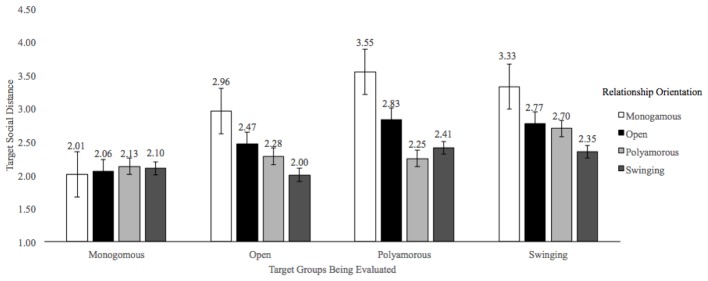
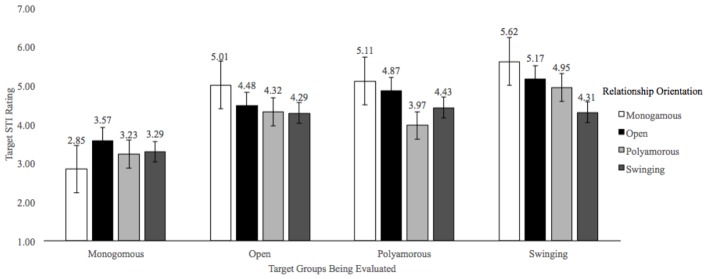
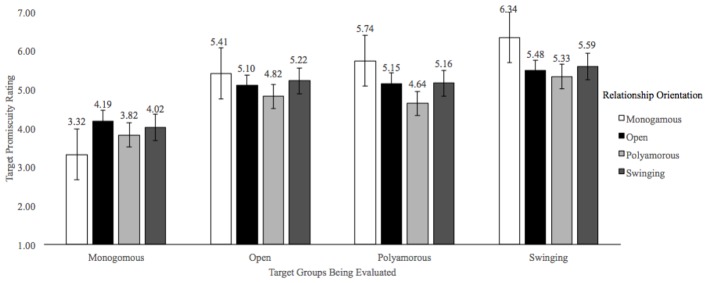
Previous research suggests that both monogamous and consensually non-monogamous (CNM) participants rate monogamous targets more positively. However, this pattern of stigma toward CNM relationships and the "halo effect" surrounding monogamy is at odds with the view that people typically favor members from their own groups over members of other groups. In the current research, we sought to re-examine the halo effect, using a more direct measure of stigma (i.e., desired social distance), in a methodological context that differentiates between the three most common types of CNM relationships. A convenience sample ( = 641) of individuals who self-identified as monogamous ( = 447), open ( = 80), polyamorous ( = 62), or swinger ( = 52) provided social distance ratings in response to these same relationship orientations in a counterbalanced order. Congruent with prior findings, CNM participants favored monogamous targets over CNM targets as a broad category (replicating the halo effect). However, results indicated this effect dissipated when participants were asked to differentiate between relationships they identify with, and other CNM relationships. Furthermore, supplementary findings suggest that monogamous targets were perceived to be the least promiscuous and were associated with the lowest perceived sexually transmitted infection (STI) rates, while swinger targets were perceived as the most promiscuous and were associated with the highest perceived STI rates. Consequently, our results imply social distance is partly attributable to the perception of STI risk, but not perceptions of promiscuity.
先前的研究表明,实行一夫一妻制和双方自愿非一夫一妻制(CNM)的参与者对实行一夫一妻制的对象评价更为积极。然而,这种对CNM关系的污名化模式以及围绕一夫一妻制的“光环效应”,与人们通常更青睐自己群体成员而非其他群体成员的观点相悖。在当前的研究中,我们试图重新审视光环效应,在一种能区分三种最常见CNM关系类型的方法学背景下,使用一种更直接的污名化衡量指标(即期望的社会距离)。一个由自我认定为一夫一妻制(n = 447)、开放式关系(n = 80)、多配偶制(n = 62)或交换伴侣制(n = 52)的个体组成的便利样本,以平衡的顺序对这些相同的关系取向给出了社会距离评分。与先前的研究结果一致,作为一个宽泛类别,CNM参与者更青睐实行一夫一妻制的对象而非CNM对象(重现了光环效应)。然而,结果表明,当要求参与者区分他们认同的关系和其他CNM关系时,这种效应就消失了。此外,补充研究结果表明,实行一夫一妻制的对象被认为是最不滥交的,且与最低的性传播感染(STI)率相关,而交换伴侣制的对象被认为是最滥交的,且与最高的性传播感染率相关。因此,我们的结果意味着社会距离部分归因于对性传播感染风险的认知,而非对滥交的认知。