Silva Sara, Lage Pedro, Cabral Francisco, Alves Rui, Catarino Ana, Félix Ana, André Saudade
NOVA Medical School/Faculdade de Ciências Médicas, Universidade Nova de Lisboa, 1169-056 Lisbon, Portugal.
Department of Gastroenterology, Instituto Português de Oncologia de Lisboa Francisco Gentil (IPOLFG), 1099-023 Lisbon, Portugal.
Oncol Lett. 2018 Aug;16(2):1449-1454. doi: 10.3892/ol.2018.8853. Epub 2018 May 31.
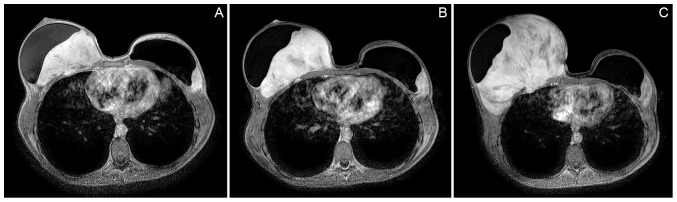
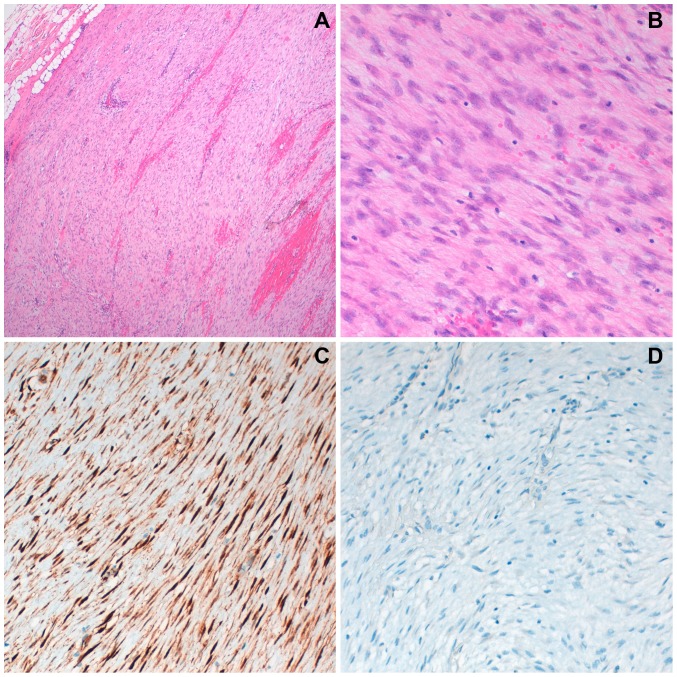
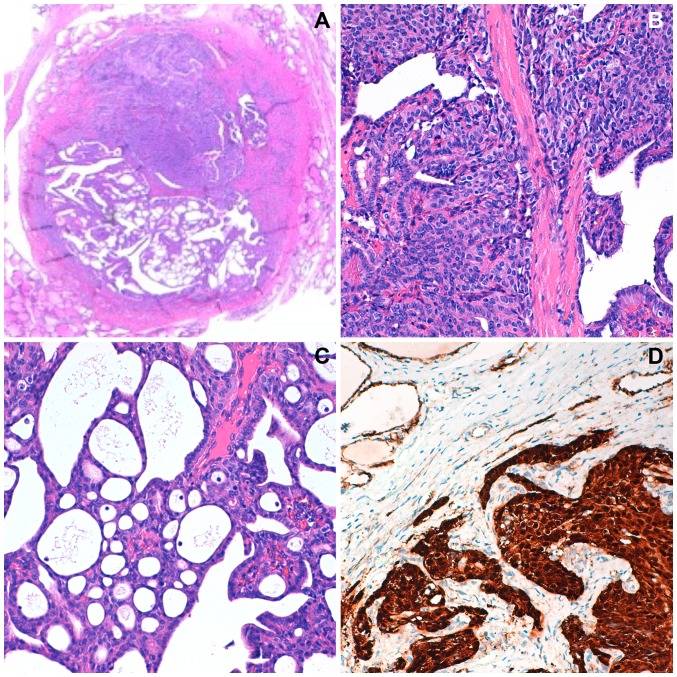
Breast fibromatosis is a benign fibroblastic proliferation accounting for less than 0.2% of breast tumors. It presents sporadically or as a manifestation of familial adenomatous polyposis (FAP). Fibromatosis in FAP may develop in patients with adenomatous polyposis coli () gene mutations at any location through the gene. Notably, there is an increased risk if mutation is downstream codon 1400. The present case report described a 33-year-old woman with recurrent bilateral breast fibromatosis after breast implants in a context of classic FAP. mutation (codon-935) was detected at the age of 16. In the same year, a thyroidectomy for a cribriform-morular papillary thyroid carcinoma (pT1) was performed. Seven years later, a prophylactic total colectomy with >100 adenomas without invasive carcinoma was performed and the patient was kept under surveillance. At the age of 30 years old, she underwent breast silicone implantation for cosmetic reasons. One year later, bilateral breast tumors were diagnosed in core biopsy as fibromatosis (nuclear β-catenin+, estrogen receptors-). After no success with medical treatment with tamoxifen, bilateral mastectomy was performed. The patient relapsed one year later and a fibromatosis lesion in the right thoracic wall was excised again. The patient demonstrated no signs of relapse 24 months after the surgery. This rare case illustrates that the increased risk of developing fibromatosis in patients with FAP, even in the classic form, should be considered before deciding to place breast implants.
乳腺纤维瘤病是一种良性纤维母细胞增殖性疾病,占乳腺肿瘤的比例不到0.2%。它可散发出现,或作为家族性腺瘤性息肉病(FAP)的一种表现形式。FAP患者的纤维瘤病可通过腺瘤性息肉病 coli()基因突变在任何部位发生。值得注意的是,如果突变发生在密码子1400下游,则风险会增加。本病例报告描述了一名33岁女性,在经典FAP背景下植入乳房假体后出现复发性双侧乳腺纤维瘤病。16岁时检测到突变(密码子-935)。同年,因筛状-桑葚状乳头状甲状腺癌(pT1)行甲状腺切除术。7年后,行预防性全结肠切除术,切除100多个腺瘤且无浸润性癌,患者接受随访。30岁时,因美容原因接受乳房硅胶植入术。1年后,在核心活检中诊断双侧乳腺肿瘤为纤维瘤病(核β-连环蛋白阳性,雌激素受体阴性)。他莫昔芬药物治疗无效后,行双侧乳房切除术。1年后患者复发,再次切除右胸壁的纤维瘤病病变。术后24个月患者未出现复发迹象。这个罕见病例表明,在决定植入乳房假体之前,应考虑FAP患者发生纤维瘤病的风险增加,即使是经典形式。