Zhang Yunqing, Qu Shoufang, Zhao Jinyin, Yu Ting, Guo Liping, Yin Songchao, Hu Xiaoxu, Chen Weijun, Lai Wei, Huang Jie
Department of Dermatology, The Third Affiliated Hospital of Sun Yat-sen University, Guangzhou, Guangdong 510630, P.R. China.
Division of In Vitro Diagnostic Reagents, National Institutes for Food and Drug Control, Beijing 100050, P.R. China.
Oncol Lett. 2018 Aug;16(2):1615-1621. doi: 10.3892/ol.2018.8844. Epub 2018 May 30.
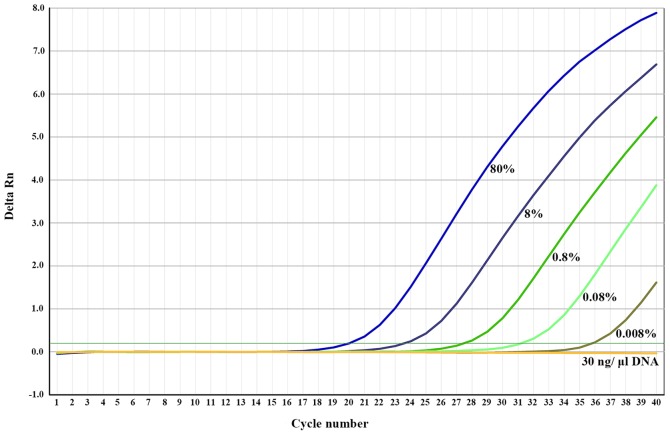
To enable the rapid and sensitive screening of the BRAF V600E mutation in clinical samples, a novel method combining restriction fragment length polymorphism (RFLP) analysis with the popular amplification refractory mutation system (ARMS) TaqMan quantitative (qPCR) genotyping method in a single reaction tube was developed. A total of 2 primer pairs were designed to enrich for and genotype the BRAF mutational hotspot (RFLP primers and ARMS primers) and a restriction enzyme was used to remove the wild-type alleles. The analysis revealed that this method detected mutant alleles in mixed samples containing >0.1% mutant sequences. In a survey of 53 melanoma samples, this method detected 21 mutation-positive samples. This novel RFLP-ARMS TaqMan qPCR protocol may prove useful for detecting mutations in clinical samples containing only a small proportion of mutant alleles.
为了能够在临床样本中快速、灵敏地筛查BRAF V600E突变,开发了一种新方法,该方法将限制性片段长度多态性(RFLP)分析与流行的扩增阻滞突变系统(ARMS)TaqMan定量(qPCR)基因分型方法结合在单个反应管中。总共设计了2对引物来富集BRAF突变热点并进行基因分型(RFLP引物和ARMS引物),并使用一种限制性酶去除野生型等位基因。分析表明,该方法可在含有>0.1%突变序列的混合样本中检测到突变等位基因。在对53个黑色素瘤样本的检测中,该方法检测到21个突变阳性样本。这种新的RFLP-ARMS TaqMan qPCR方案可能对检测仅含有少量突变等位基因的临床样本中的突变有用。