Gilany Kambiz, Jafarzadeh Naser, Mani-Varnosfaderani Ahmad, Minai-Tehrani Arash, Sadeghi Mohammed Reza, Darbandi Mahsa, Darbandi Sara, Amini Mehdi, Arjmand Babak, Pahlevanzadeh Zhamak
Reproductive Biotechnology Research Center, Avicenna Research Institute, ACECR, Tehran, Iran.
Metabolomics and Genomics Research Center, Endocrinology and Metabolism Molecular Cellular Sciences Institute, Tehran University of Medical Sciences, Tehran, Iran.
J Reprod Infertil. 2018 Apr-Jun;19(2):109-114.
Non-obstructive azoospermia (NOA) occurs in approximately 10% of infertile men. Retrieval of the spermatozoa from the testicle of NOA patients is an invasive approach. Seminal plasma is an excellent source for exploring to find the biomarkers for presence of spermatozoa in testicular tissue. The present discovery phase study aimed to use metabolic fingerprinting to detect spermatogenesis from seminal plasma in NOA patients as a non-invasive method.
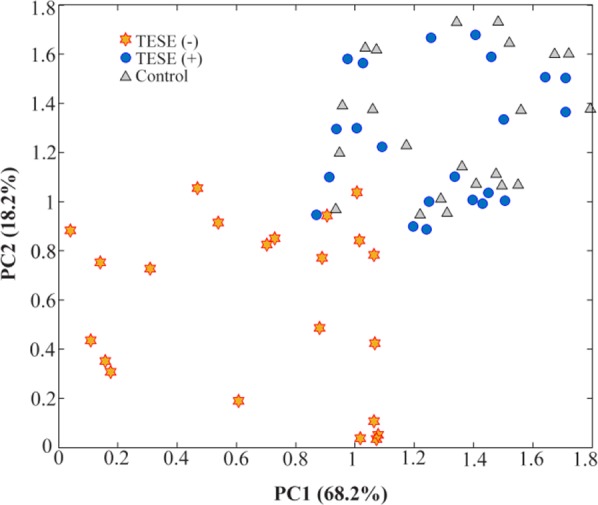
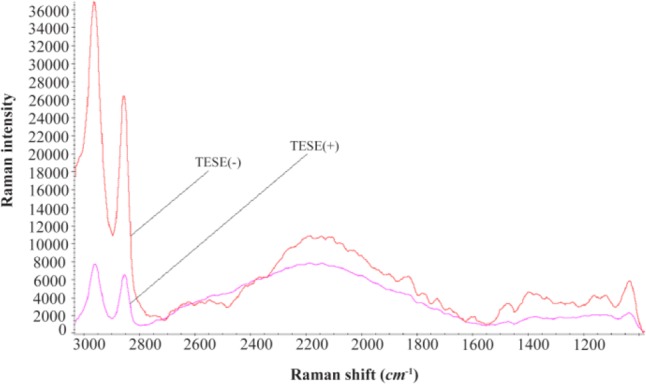
In this study, 20 men with NOA were identified based on histological analysis who had their first testicular biopsy in 2015 at Avicenna Fertility Center, Tehran, Iran. They were divided into two groups, a positive testicular sperm extraction (TESE(+)) and a negative testicular sperm extraction (TESE(-)). Seminal plasma of NOA patients was collected before they underwent testicular sperm extraction (TESE) operation. The metabolomic fingerprinting was evaluated by Raman spectrometer. Principal component analysis (PCA) and an unsupervised statistical method, was used to detect outliers and find the structure of the data. The PCA was analyzed by MATLAB software.
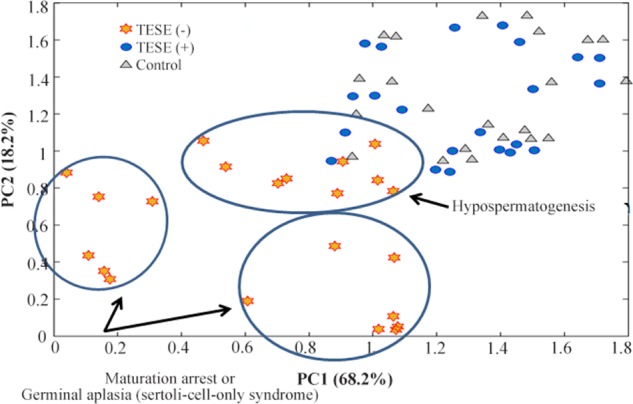
Metabolic fingerprinting of seminal plasma from NOA showed that TESE (+) versus TESE(-) patients were classified by PCA. Furthermore, a possible subdivision of TESE(-) group was observed. Additionally, TESE(-) patients were in extreme oxidative imbalance compared to TESE(+) patients.
Metabolic fingerprinting of seminal plasma can be considered as a breakthrough, an easy and cheap method for prediction presence of spermatogenesis in NOA.
非梗阻性无精子症(NOA)约发生于10%的不育男性中。从NOA患者的睾丸中获取精子是一种侵入性方法。精浆是探索寻找睾丸组织中精子存在生物标志物的极佳来源。本探索性研究旨在使用代谢指纹图谱作为一种非侵入性方法,从NOA患者的精浆中检测精子发生情况。
在本研究中,基于组织学分析确定了20名患有NOA的男性,他们于2015年在伊朗德黑兰的阿维森纳生育中心首次接受睾丸活检。他们被分为两组:睾丸精子提取阳性组(TESE(+))和睾丸精子提取阴性组(TESE(-))。在NOA患者接受睾丸精子提取(TESE)手术前收集其精浆。通过拉曼光谱仪评估代谢组学指纹图谱。主成分分析(PCA),一种无监督统计方法,用于检测异常值并找出数据结构。PCA由MATLAB软件进行分析。
NOA患者精浆的代谢指纹图谱显示,PCA可对TESE(+)与TESE(-)患者进行分类。此外,观察到TESE(-)组可能存在细分情况。另外,与TESE(+)患者相比,TESE(-)患者处于极端的氧化失衡状态。
精浆的代谢指纹图谱可被视为一项突破,是一种用于预测NOA患者精子发生情况的简便且廉价的方法。