Abedini Naghi, Parish Masoud, Farzin Haleh, Pourfathi Hojjat, Akhsham Masume
Tabriz University of Medical Sciences, Tabriz, Iran.
Department of Anesthesiology, Taleghani Hospital, Tabriz University of Medical Sciences, Tabriz, Iran.
Anesth Pain Med. 2018 Apr 28;8(2):e64427. doi: 10.5812/aapm.64427. eCollection 2018 Apr.
The management of the airways is an essential component of anesthesia planning. Laryngeal mask airway (LMA) plays an important role in modern anesthesia, however, intubation by LMA has some complications. It may cause inadequate anesthesia depth, which can lead to adverse events. The aim of this study was to evaluate the optimal time for intubation by LMA under general anesthesia.
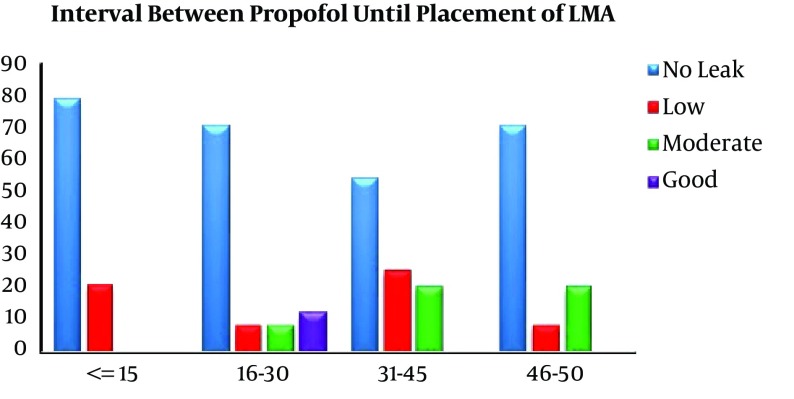
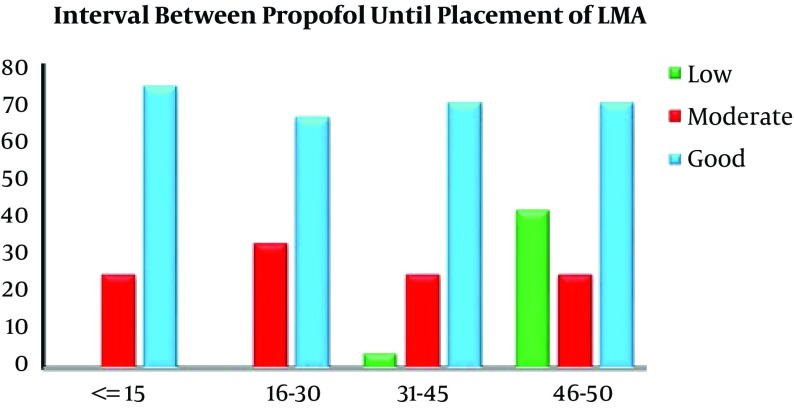
This study was conducted on 96 patients, who underwent operation and were appropriate candidates for intubation with appropriate LMA. The participants were divided to four groups, each with 24 cases, based on the time interval between anesthetic agent administration and intubation with LMA; 15 seconds for the first group, 16 to 30 seconds for the second group, 31 to 45 seconds for the third group, and 45 to 60 seconds for the fourth group. The patients involved in these groups were selected based on the following prerequisites, patients' age, gender, easy intubation, need for additional drug administration, basic blood pressure before drug administration, within the time intervals one, three, and five minutes after placement of LMA, duration of LMA, SaO before and after placement of LMA, coughing, patient's movement, laryngospasm, gag reflex after intubation, allowing appropriate ventilation, presence of sore throat after surgery, number of attempts, extent of mouth opening and leak in peri-LMA space.
Overall, 72 males and 24 females participated in this study with a mean age of 40.64. Intubation by LMA was performed easily during the first attempt in 58% of the participants, with minimal resistance in 28.6% and with some problems during the second attempt in 10.5% of the cases. Throat pain after the operation was significantly lower. Systolic and diastolic pressure and heart rate had no statistically significant difference.
The results showed that in the first 15 seconds after the drug (e.g. propofol) administration, there were lower complications, rapid placement, and optimized time for the placement of LMA. The rate of success and its quality were reduced during the first attempt of insertion and termination of the effect of propofol.
气道管理是麻醉计划的重要组成部分。喉罩气道(LMA)在现代麻醉中发挥着重要作用,然而,使用LMA进行插管存在一些并发症。它可能导致麻醉深度不足,进而引发不良事件。本研究的目的是评估全身麻醉下使用LMA插管的最佳时间。
本研究对96例接受手术且适合使用合适LMA进行插管的患者进行。根据麻醉剂给药与使用LMA插管之间的时间间隔,将参与者分为四组,每组24例;第一组为15秒,第二组为16至30秒,第三组为31至45秒,第四组为45至60秒。这些组中的患者根据以下前提条件进行选择,患者的年龄、性别、插管容易程度、是否需要额外给药、给药前的基础血压、放置LMA后1分钟、3分钟和5分钟的时间间隔内、LMA的使用时长、放置LMA前后的血氧饱和度、咳嗽、患者活动、喉痉挛、插管后的 gag 反射、是否允许适当通气、术后喉咙疼痛情况、尝试次数、张口程度以及LMA周围空间的漏气情况。
总体而言,本研究共有72名男性和24名女性参与,平均年龄为40.64岁。58%的参与者在首次尝试时使用LMA插管很容易,28.6%的参与者阻力最小,10.5%的病例在第二次尝试时存在一些问题。术后喉咙疼痛明显减轻。收缩压、舒张压和心率无统计学显著差异。
结果表明,在给药(如丙泊酚)后的前15秒内,并发症较少,LMA放置迅速,放置时间优化。在首次插入尝试期间以及丙泊酚作用终止时,成功率及其质量均有所降低。