Gerth Janina, Kumar Sathish, Rijal Upadhaya Ajeet, Ghebremedhin Estifanos, von Arnim Christine A F, Thal Dietmar R, Walter Jochen
Department of Neurology University of Bonn Bonn Germany.
Laboratory for Neuropathology Institute for Pathology University of Ulm Ulm Germany.
Ann Clin Transl Neurol. 2018 Jun 6;5(7):815-831. doi: 10.1002/acn3.577. eCollection 2018 Jul.
Amyloid (A) depositions in plaques and cerebral amyloid angiopathy (CAA) represent common features of Alzheimer's disease (AD). Sequential deposition of post-translationally modified A in plaques characterizes distinct biochemical stages of A maturation. However, the molecular composition of vascular A deposits in CAA and its relation to plaques remain enigmatic.
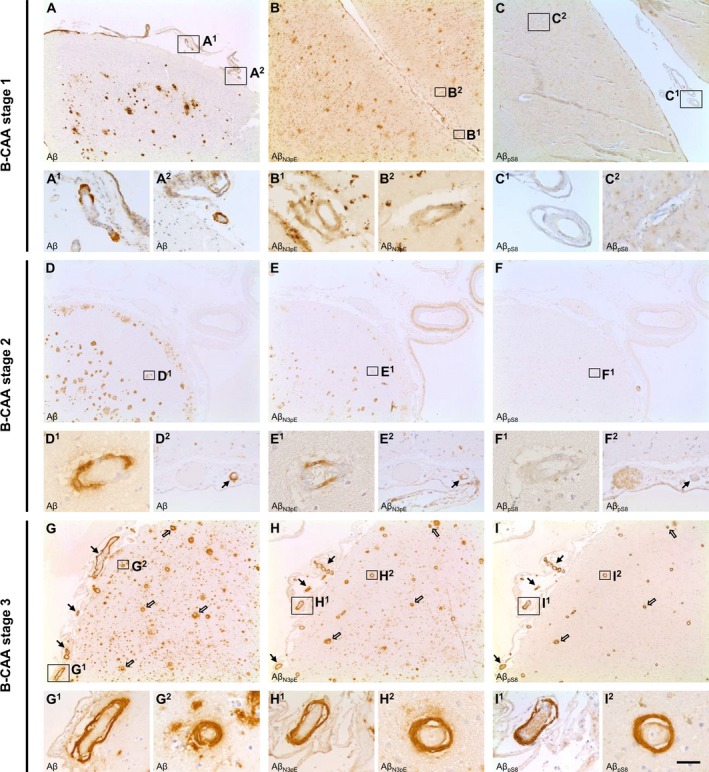
Vascular and parenchymal deposits were immunohistochemically analyzed for pyroglutaminated and phosphorylated A in the medial temporal and occipital lobe of 24 controls, 27 pathologically-defined preclinical AD, and 20 symptomatic AD cases.
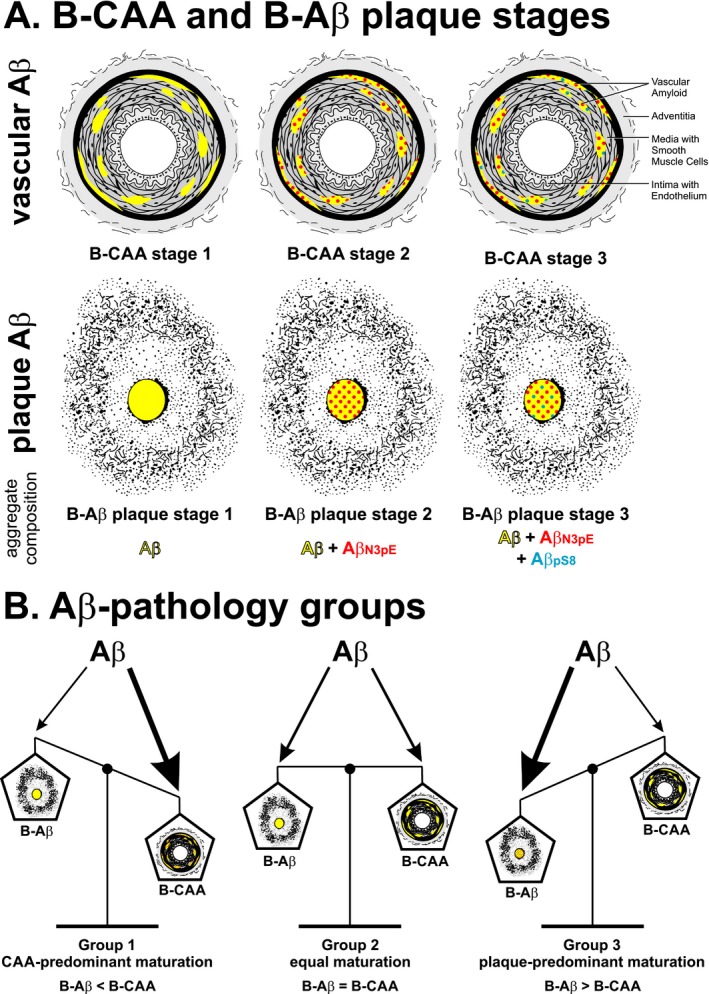
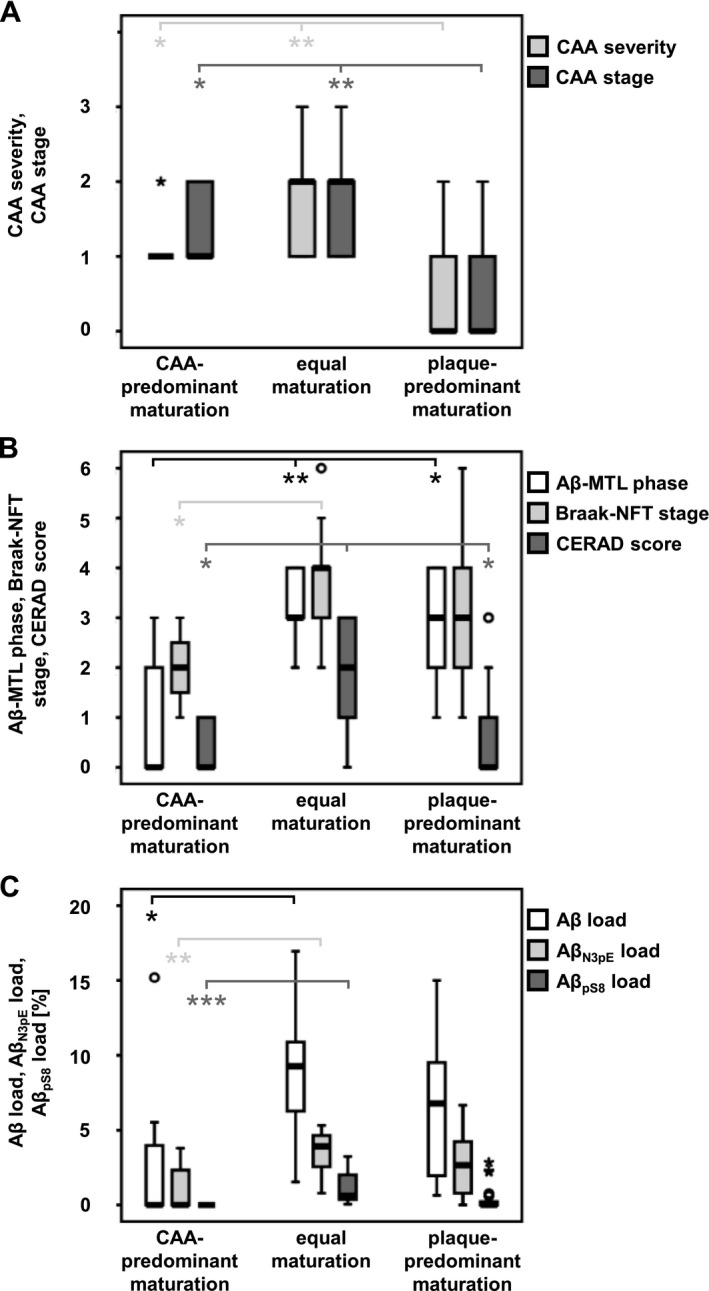
Sequential deposition of A in CAA resembled A maturation in plaques and enabled the distinction of three biochemical stages of CAA. B-CAA stage 1 was characterized by deposition of A in the absence of pyroglutaminated A and phosphorylated A. B-CAA stage 2 showed additional A and B-CAA stage 3 additional A. Based on the A maturation staging in CAA and plaques, three case groups for A pathology could be distinguished: group 1 with advanced A maturation in CAA; group 2 with equal A maturation in CAA and plaques; group 3 with advanced A maturation in plaques. All symptomatic AD cases presented with end-stage plaque maturation, whereas CAA could exhibit immature A deposits. Notably, A pathology group 1 was associated with arterial hypertension, and group 2 with the development of dementia.
Balance of A maturation in CAA and plaques defines distinct pathological subgroups of -amyloidosis. The association of CAA-related A maturation with cognitive decline, the individual contribution of CAA and plaque pathology to the development of dementia within the defined A pathology subgroups, and the subgroup-related association with arterial hypertension should be considered for differential diagnosis and therapeutic intervention.
淀粉样蛋白(A)在斑块和脑淀粉样血管病(CAA)中的沉积是阿尔茨海默病(AD)的常见特征。斑块中翻译后修饰的A的顺序沉积表征了A成熟的不同生化阶段。然而,CAA中血管A沉积物的分子组成及其与斑块的关系仍不清楚。
对24名对照者、27名病理确诊的临床前期AD患者和20名有症状AD患者的内侧颞叶和枕叶的血管和实质沉积物进行焦谷氨酰化和磷酸化A的免疫组织化学分析。
CAA中A的顺序沉积类似于斑块中A的成熟,并能够区分CAA的三个生化阶段。B-CAA 1期的特征是在没有焦谷氨酰化A和磷酸化A的情况下A的沉积。B-CAA 2期显示额外的A,B-CAA 3期显示更多的A。基于CAA和斑块中A的成熟分期,可以区分出三个A病理学病例组:第1组CAA中A成熟程度高;第2组CAA和斑块中A成熟程度相同;第3组斑块中A成熟程度高。所有有症状的AD病例均表现为斑块成熟的终末期,而CAA可能表现出不成熟的A沉积物。值得注意的是,A病理学第1组与动脉高血压相关,第2组与痴呆的发生相关。
CAA和斑块中A成熟的平衡定义了淀粉样变性的不同病理亚组。在鉴别诊断和治疗干预中,应考虑CAA相关的A成熟与认知衰退的关联、CAA和斑块病理学在已定义的A病理学亚组内对痴呆发展的个体贡献以及与动脉高血压的亚组相关关联。