Plant Developmental Genetics, Institute of Biophysics v.v.i, Academy of Sciences of the Czech Republic, Královopolská 135, 612 65, Brno, Czech Republic.
BMC Genomics. 2018 Jul 16;19(1):540. doi: 10.1186/s12864-018-4936-y.
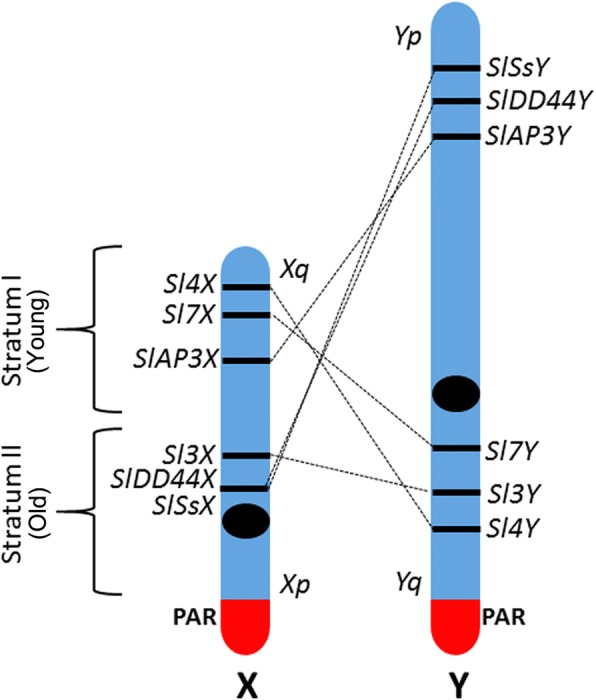
S. latifolia is a model organism for the study of sex chromosome evolution in plants. Its sex chromosomes include large regions in which recombination became gradually suppressed. The regions tend to expand over time resulting in the formation of evolutionary strata. Non-recombination and later accumulation of repetitive sequences is a putative cause of the size increase in the Y chromosome. Gene decay and accumulation of repetitive DNA are identified as key evolutionary events. Transposons in the X and Y chromosomes are distributed differently and there is a regulation of transposon insertion by DNA methylation of the target sequences, this points to an important role of DNA methylation during sex chromosome evolution in Silene latifolia. The aim of this study was to elucidate whether the reduced expression of the Y allele in S. latifolia is caused by genetic degeneration or if the cause is methylation triggered by transposons and repetitive sequences.
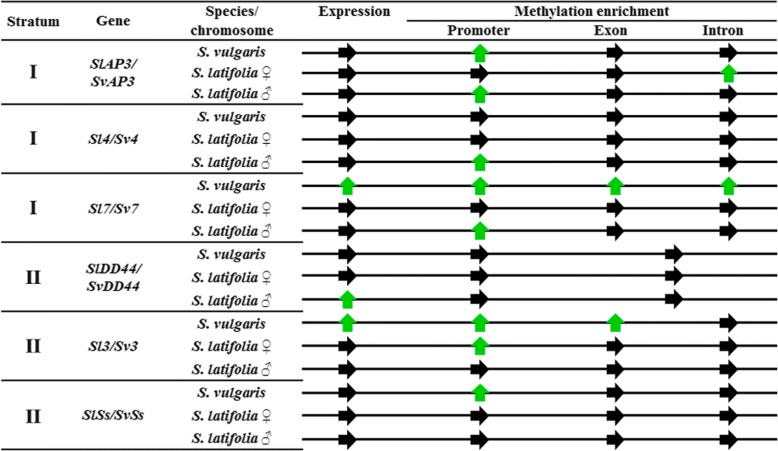
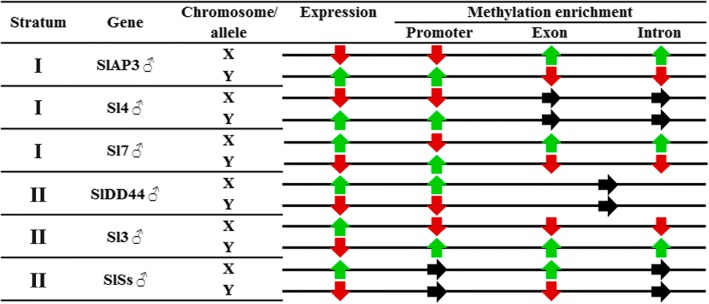
Gene expression analysis in S. latifolia males has shown expression bias in both X and Y alleles. To determine whether these differences are caused by genetic degeneration or methylation spread by transposons and repetitive sequences, we selected several sex-linked genes with varying degrees of degeneration and from different evolutionary strata. Immunoprecipitation of methylated DNA (MeDIP) from promoter, exon and intron regions was used and validated through bisulfite sequencing. We found DNA methylation in males, and only in the promoter of genes of stratum I (older). The Y alleles in genes of stratum I were methylation enriched compared to X alleles. There was also abundant and high percentage methylation in the CHH context in most sequences, indicating de novo methylation through the RdDM pathway.
We speculate that TE accumulation and not gene decay is the cause of DNA methylation in the S. latifolia Y sex chromosome with influence on the process of heterochromatinization.
S. latifolia 是研究植物性染色体进化的模式生物。其性染色体包括重组逐渐受到抑制的大片段。这些区域随着时间的推移往往会扩张,从而形成进化层。非重组和重复序列的积累被认为是 Y 染色体增大的原因。基因衰减和重复 DNA 的积累被认为是关键的进化事件。X 和 Y 染色体上的转座子分布不同,并且靶序列的 DNA 甲基化可以调节转座子的插入,这表明 DNA 甲基化在 Silene latifolia 的性染色体进化中起着重要作用。本研究旨在阐明 S. latifolia 中 Y 等位基因表达降低是由于遗传退化还是转座子和重复序列引发的甲基化所致。
S. latifolia 雄性中的基因表达分析显示 X 和 Y 等位基因均存在表达偏向。为了确定这些差异是由遗传退化还是转座子和重复序列引发的甲基化引起的,我们选择了几个具有不同退化程度和不同进化层的性连锁基因。通过启动子、外显子和内含子区域的甲基化 DNA 免疫沉淀(MeDIP),并通过亚硫酸氢盐测序进行验证。我们发现雄性中有 DNA 甲基化,且仅在 I 层(较老)基因的启动子中。与 X 等位基因相比,I 层基因的 Y 等位基因甲基化程度更高。大多数序列中 CHH 背景也存在丰富且高比例的甲基化,表明通过 RdDM 途径发生了从头甲基化。
我们推测 TE 积累而不是基因衰减是 S. latifolia Y 性染色体中 DNA 甲基化的原因,影响异染色质化过程。