Odum School of Ecology, University of Georgia, Athens, GA, USA.
Center for the Ecology of Infectious Diseases, University of Georgia, Athens, GA, USA.
Parasit Vectors. 2018 Jul 17;11(1):426. doi: 10.1186/s13071-018-3013-3.
Mosquitoes are strongly influenced by environmental temperatures, both directly and indirectly via carry-over effects, a phenomenon by which adult phenotypes are shaped indirectly by the environmental conditions experienced in previous life stages. In landscapes with spatially varying microclimates, such as a city, the effects of environmental temperature can therefore lead to spatial patterns in disease dynamics. To explore the contribution of carry-over effects on the transmission of dengue-2 virus (DENV-2), we conducted a semi-field experiment comparing the demographic and transmission rates of Aedes albopictus reared on different urban land classes in the summer and autumn season. We parameterized a model of vectorial capacity using field- and literature-derived measurements to estimate the bias introduced into predictions of vectorial capacity not accounting for carry-over effects.
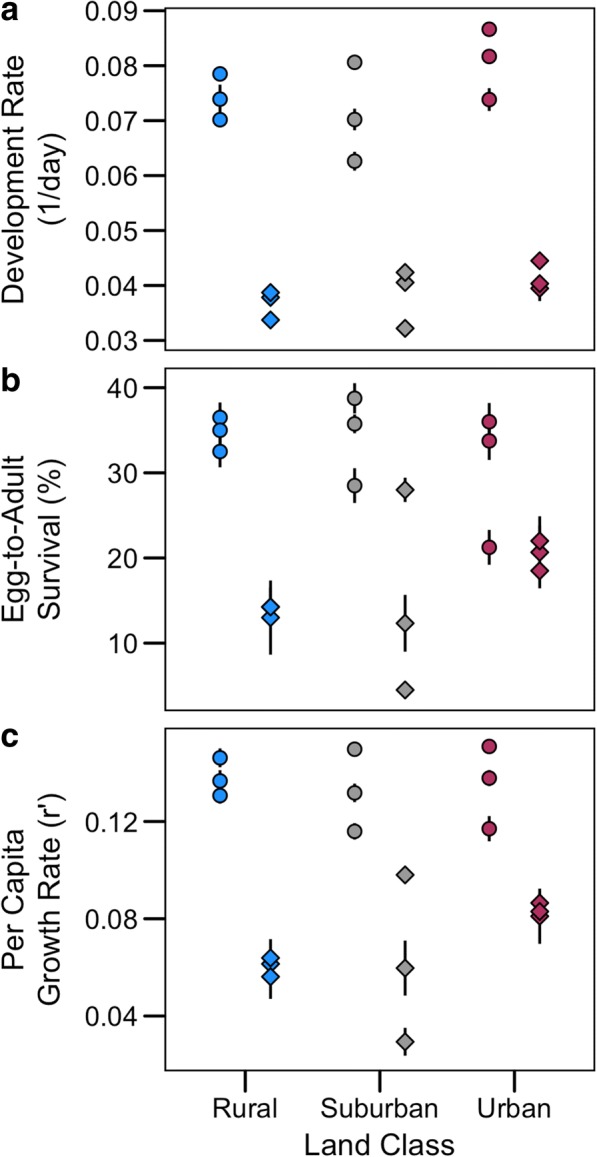
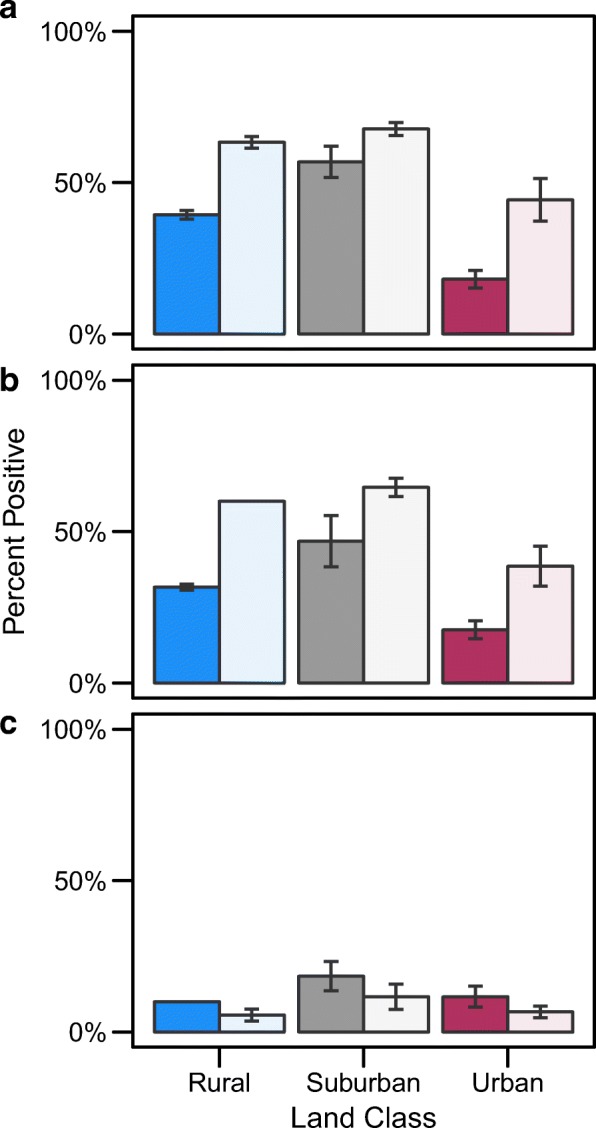
The larval environment of different land classes and seasons significantly impacted mosquito life history traits. Larval development and survival rates were higher in the summer than the autumn, with no difference across land class. The effect of land class on adult body size differed across season, with suburban mosquitoes having the smallest wing length in the summer and the largest wing length in the autumn, when compared to other land classes. Infection and dissemination rates were higher in the autumn and on suburban and rural land classes compared to urban. Infectiousness did not differ across land class or season. We estimate that not accounting for carry-over effects can underestimate disease transmission potential in suburban and urban sites in the summer by up to 25%.
Our findings demonstrate the potential of the larval environment to differentially impact stages of DENV-2 infection in Ae. albopictus mosquitoes via carry-over effects. Failure to account for carry-over effects of the larval environment in mechanistic models can lead to biased estimates of disease transmission potential at fine-scales in urban environments.
蚊子受环境温度的直接和间接影响很大,这种间接影响是通过代际效应实现的,即成年表型通过先前生活阶段经历的环境条件间接塑造。在具有空间变化微气候的景观中,如城市,环境温度的影响可能导致疾病动态的空间模式。为了探索代际效应对登革热 2 型病毒(DENV-2)传播的贡献,我们在夏季和秋季进行了一项半田间实验,比较了在不同城市土地类别中饲养的白纹伊蚊的种群动态和传播率。我们使用现场和文献测量值来参数化向量能力模型,以估计不考虑代际效应的向量能力预测中的偏差。
不同土地类别和季节的幼虫环境显著影响了蚊子的生活史特征。夏季的幼虫发育和存活率高于秋季,而不同土地类别的幼虫发育和存活率没有差异。季节对成蚊体型的影响因土地类别而异,与其他土地类别相比,郊区蚊子在夏季的翅膀长度最小,在秋季的翅膀长度最大。与城市相比,郊区和农村土地类别的感染和传播率更高,而秋季的感染和传播率更高。传染性在不同土地类别或季节之间没有差异。我们估计,如果不考虑代际效应,夏季郊区和城市站点的疾病传播潜力可能会低估 25%。
我们的研究结果表明,幼虫环境通过代际效应可能会对登革热 2 型病毒在白纹伊蚊中的感染阶段产生不同的影响。在机制模型中,如果不考虑幼虫环境的代际效应,可能会导致在城市环境中对疾病传播潜力的精细尺度的估计产生偏差。