Shocket Marta S, Bernhardt Joey R, Miazgowicz Kerri L, Orakzai Alyzeh, Savage Van M, Hall Richard J, Ryan Sadie J, Murdock Courtney C
Lancaster Environment Centre, Lancaster University, UK.
Department of Geography, University of Florida, USA.
bioRxiv. 2024 Sep 23:2024.09.20.614098. doi: 10.1101/2024.09.20.614098.
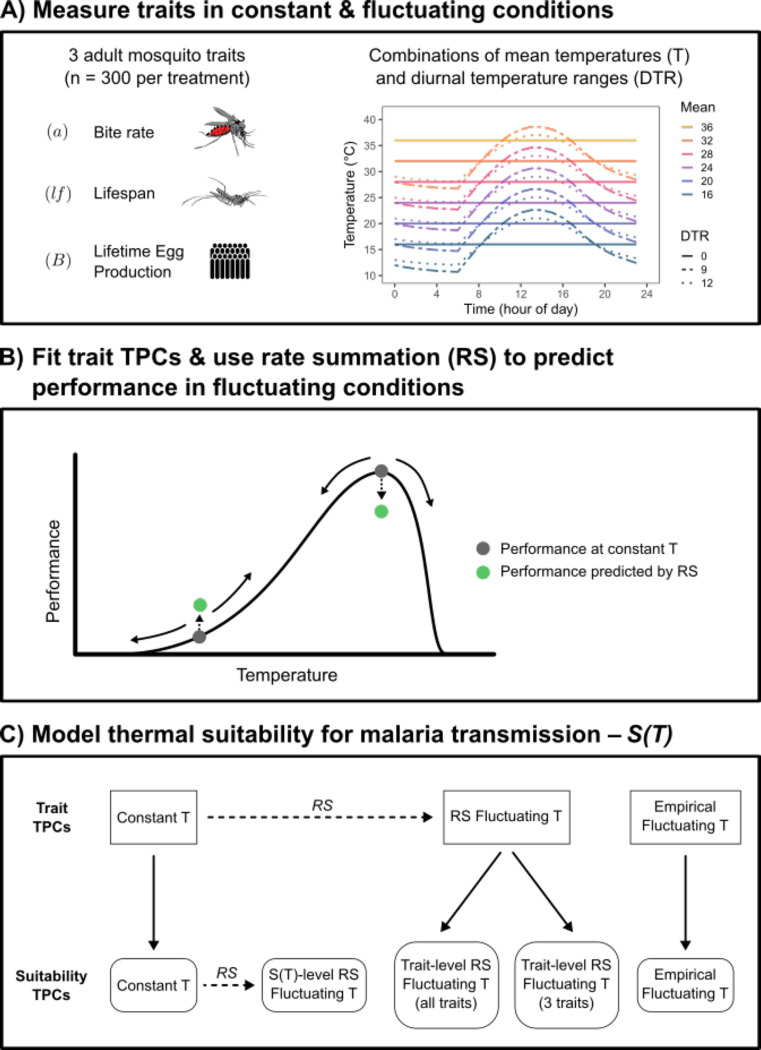
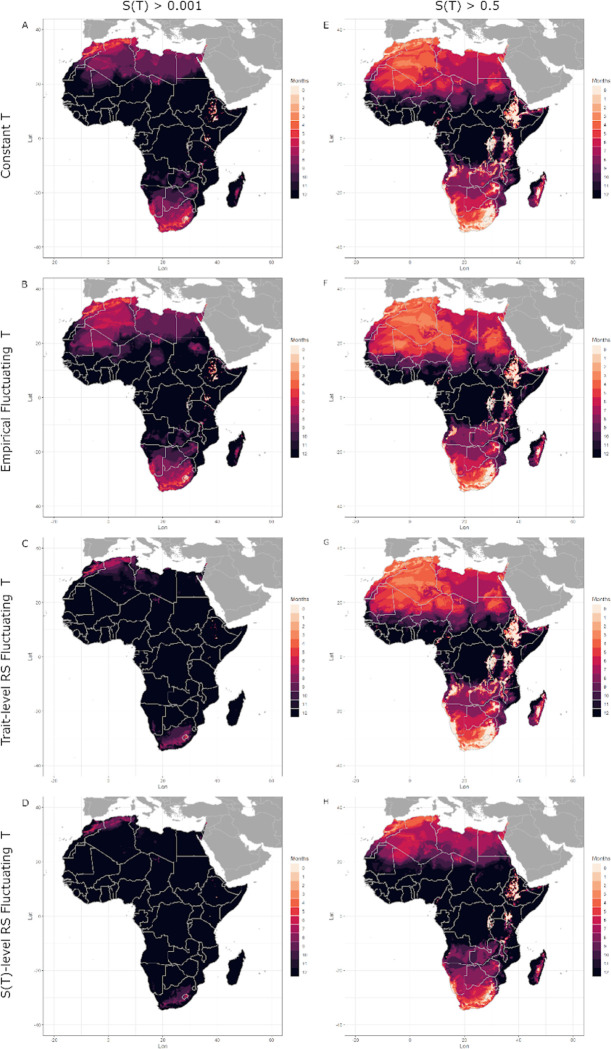
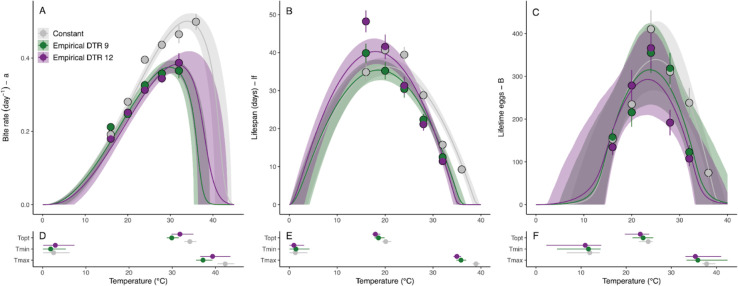
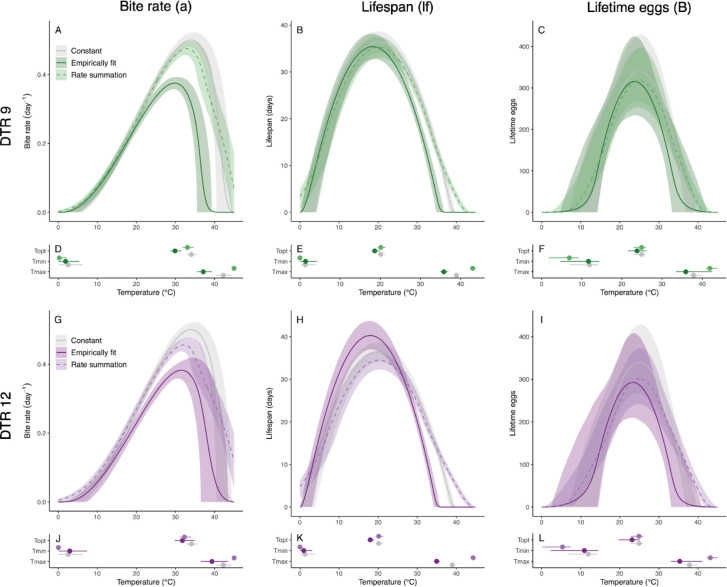
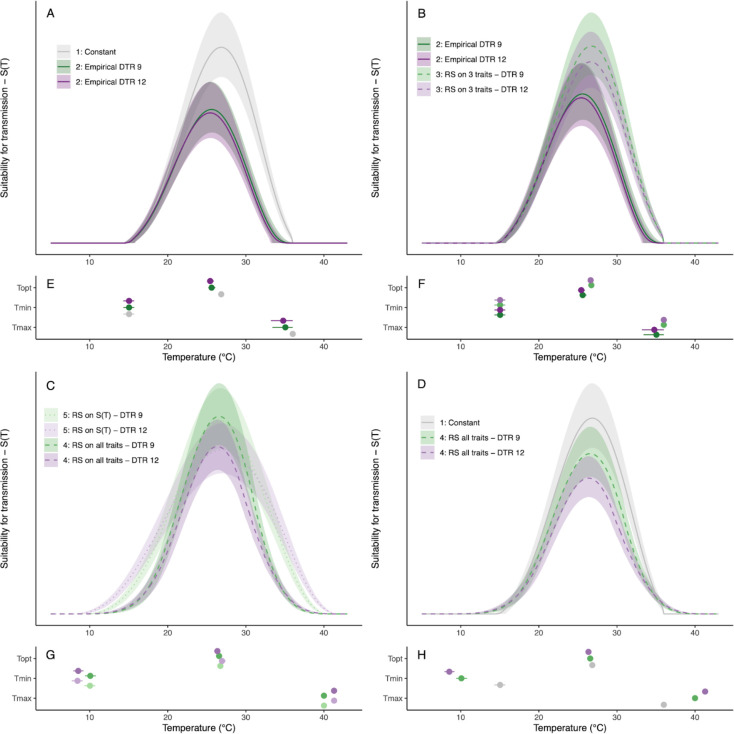
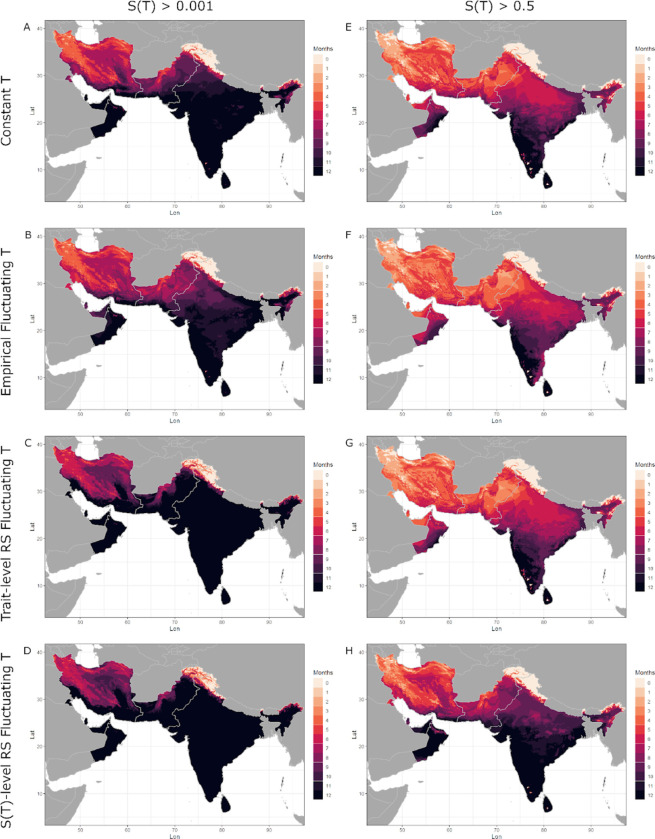
Temperature shapes the distribution, seasonality, and magnitude of mosquito-borne disease outbreaks. Mechanistic models predicting transmission often use mosquito and pathogen thermal responses from constant temperature experiments. However, mosquitoes live in fluctuating environments. Rate summation (nonlinear averaging) is a common approach to infer performance in fluctuating environments, but its accuracy is rarely validated. We measured three mosquito traits that impact transmission (bite rate, survival, fecundity) in a malaria mosquito () across temperature gradients with three diurnal temperature ranges (0, 9 and 12°C). We compared thermal suitability models with temperature-trait relationships observed under constant temperatures, fluctuating temperatures, and those predicted by rate summation. We mapped results across 's native Asian and invasive African ranges. We found: 1) daily temperature fluctuation significantly altered trait thermal responses; 2) rate summation partially captured decreases in performance near thermal optima, but also incorrectly predicted increases near thermal limits; and 3) while thermal suitability characterized across constant temperatures did not perfectly capture suitability in fluctuating environments, it was more accurate for estimating and mapping thermal limits than predictions from rate summation. Our study provides insight into methods for predicting mosquito-borne disease risk and emphasizes the need to improve understanding of organismal performance under fluctuating conditions.
温度塑造了蚊媒疾病暴发的分布、季节性和规模。预测传播的机制模型通常使用恒温实验中的蚊子和病原体热反应。然而,蚊子生活在波动的环境中。速率总和(非线性平均)是推断波动环境中表现的常用方法,但其准确性很少得到验证。我们在具有三种昼夜温度范围(0、9和12°C)的温度梯度下,测量了一种疟蚊(按蚊)影响传播的三个蚊子特征(叮咬率、存活率、繁殖力)。我们将热适应性模型与在恒温、波动温度下观察到的温度-特征关系以及速率总和预测的关系进行了比较。我们将结果绘制在按蚊的原生亚洲范围和入侵非洲范围上。我们发现:1)每日温度波动显著改变了特征热反应;2)速率总和部分捕捉到了接近热最适点时性能的下降,但也错误地预测了接近热极限时性能的增加;3)虽然在恒温条件下表征的热适应性不能完美地捕捉波动环境中的适应性,但它在估计和绘制热极限方面比速率总和的预测更准确。我们的研究为预测蚊媒疾病风险的方法提供了见解,并强调需要加强对波动条件下生物体性能的理解。