Department of Population, Family and Reproductive Health, School of Public Health, University of Ghana, Accra, Ghana.
Department of Epidemiology and Disease Control, School of Public Health, University of Ghana, Accra, Ghana.
PLoS One. 2018 Jul 19;13(7):e0200874. doi: 10.1371/journal.pone.0200874. eCollection 2018.
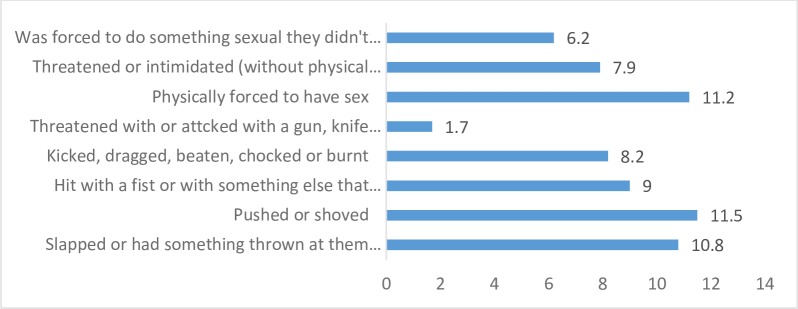
Intimate partner violence (IPV) is a significant global public health problem. Understanding risk factors is crucial for developing prevention programmes. Yet, little evidence exists on population-based prevalence and risk factors for IPV in West Africa. Our objective was to measure both lifetime and past year prevalence of IPV and to determine factors associated with past year physical or sexual IPV experience. This population-based survey involved 2000 randomly selected women aged 18 to 49 years living in 40 localities within four districts of the Central Region of Ghana. Questionnaires were interviewer-administered from February to May 2016. Respondents were currently or ever-partnered, and resident in study area ≥12months preceding the survey. Data collected included: socio-demographics; sexual behavior; mental health and substance use; employment status; 12-month and lifetime experience of violence; household food insecurity; gender norms/attitudes; partner characteristics and childhood trauma. Logistic regression modelling was used to determine factors associated with sexual or physical IPV, adjusting for age and survey design. About 34% of respondents had experienced IPV in the past year, with 21.4% reporting sexual and or physical forms. Past year experience of emotional and economic IPV were 24.6% and 7.4% respectively. Senior high school education or higher was protective of IPV (AOR = 0.51[0.30-0.86]). Depression (AOR = 1.06[1.04-1.08], disability (AOR = 2.30[1.57-3.35]), witnessing abuse of mother (AOR = 2.1.98[1.44-2.72]), experience of childhood sexual abuse (AOR = 1.46[1.07-1.99]), having had multiple sexual partners in past year (AOR = 2.60[1.49-4.53]), control by male partner (AOR = 1.03[1.00-1.06]), male partner alcohol use in past year (AOR = 2.65[2.12-3.31]) and male partner infidelity (AOR = 2.31[1.72-3.09]) were significantly associated with increased odds of past year physical or sexual IPV experience. Male perpetrated IPV remains a significant public health issue in Ghana. Evidence-based interventions targeting women's mental health, disabilities, exposure to violence in childhood, risky sexual behavior and unequal power in relationships will be critical in reducing IPV in this setting.
亲密伴侣暴力(IPV)是一个重大的全球公共卫生问题。了解风险因素对于制定预防计划至关重要。然而,在西非,关于 IPV 的基于人群的流行率和风险因素的证据很少。我们的目的是衡量终生和过去一年 IPV 的流行率,并确定与过去一年身体或性 IPV 经历相关的因素。这项基于人群的调查涉及加纳中部地区四个区的 40 个地方的 2000 名 18 至 49 岁的随机选择的女性。问卷于 2016 年 2 月至 5 月由访谈者管理。受访者目前或曾经与伴侣在一起,在调查前 12 个月居住在研究地区。收集的数据包括:社会人口统计学;性行为;心理健康和物质使用;就业状况;12 个月和终生的暴力经历;家庭粮食不安全;性别规范/态度;伴侣特征和童年创伤。使用逻辑回归模型确定与性或身体 IPV 相关的因素,同时调整年龄和调查设计。约 34%的受访者在过去一年中经历过 IPV,其中 21.4%报告了性和/或身体形式的暴力。过去一年的情绪和经济 IPV 分别为 24.6%和 7.4%。高中或以上教育对 IPV 具有保护作用(AOR=0.51[0.30-0.86])。抑郁(AOR=1.06[1.04-1.08])、残疾(AOR=2.30[1.57-3.35])、目睹母亲被虐待(AOR=2.1.98[1.44-2.72])、经历过童年性虐待(AOR=1.46[1.07-1.99])、过去一年有多个性伴侣(AOR=2.60[1.49-4.53])、男性伴侣控制(AOR=1.03[1.00-1.06])、男性伴侣过去一年饮酒(AOR=2.65[2.12-3.31])和男性伴侣不忠(AOR=2.31[1.72-3.09])与过去一年身体或性 IPV 经历的几率增加显著相关。男性实施的 IPV 仍然是加纳的一个重大公共卫生问题。针对妇女的心理健康、残疾、童年时期遭受暴力、危险性行为和不平等权力关系的循证干预措施对于减少这种环境中的 IPV 将至关重要。