Arthritis Research UK Primary Care Centre, Research Institute for Primary Care and Health Sciences, Keele University, Keele, Staffordshire, United Kingdom.
PLoS One. 2018 Jul 19;13(7):e0200879. doi: 10.1371/journal.pone.0200879. eCollection 2018.
Complementary and alternative medicine (CAM) is very popular with patients frequently combining it with orthodox health care. The high prevalence of CAM use and satisfaction with CAM reported by patients directly challenges an orthodox system that can only approve such use if it results from the application of biomedical concepts and science. Studies highlighting this as a cultural, sociological and historical phenomenon emphasise the value of choice for consumers of health care. Musculoskeletal conditions typify common problems for which the effectiveness of orthodox care is often unclear. We postulated that the reasons people give for using or not using CAM for musculoskeletal conditions, would therefore indicate the full range of expectations that people have of health care. Furthermore, these reasons would indicate how much people feel orthodox health care is or is not meeting their expectations. Therefore, this study aims to investigate people's reasons for choosing or avoiding CAM for non-traumatic musculoskeletal conditions.
A systematic search and narrative synthesis was conducted of published qualitative and quantitative studies related to CAM and non-traumatic musculoskeletal conditions.
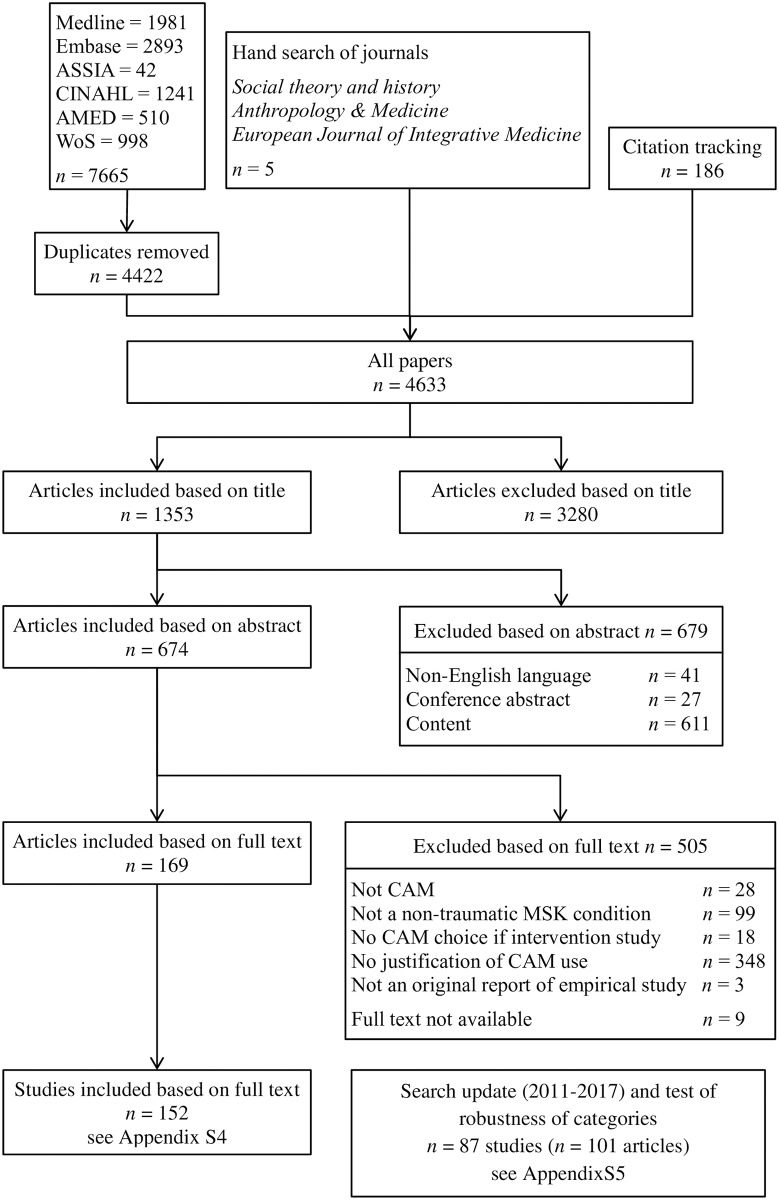
We identified 169 relevant papers detailing 152 separate studies, from which 1486 justifications were extracted concerning CAM use. Content analysis resulted in 11 distinct categories across four themes: practical aspects of care, clinical effectiveness, non-clinical outcomes of care, and a person's philosophy of illness and care. People provided similar rationales for both using and avoiding CAM, emphasising that, whilst CAM is perceived by many patients with musculoskeletal conditions to fill gaps in care (such as practitioner time or quality of the therapeutic relationship), orthodox care also seeks to deliver these aspects of care. However, people who used CAM also highlighted its alignment with their general philosophy and ideas about illness and health care, and often emphasised CAM's capacity to give them control over their condition and its treatment.
Currently, CAM appears to have a significant role for patients with common painful long-term conditions in providing choices to enable individual needs to be met.
补充和替代医学(CAM)在患者中非常受欢迎,他们经常将其与传统医疗相结合。患者报告的 CAM 使用的高流行率和对 CAM 的满意度直接挑战了一种只能批准基于生物医学概念和科学应用的使用的正统系统。强调这种现象是一种文化、社会学和历史现象的研究强调了医疗保健消费者选择的价值。肌肉骨骼疾病是常见问题,正统治疗的效果往往不明确。我们假设,人们使用或不使用 CAM 治疗肌肉骨骼疾病的原因,将表明人们对医疗保健的期望的全部范围。此外,这些原因将表明人们认为正统医疗保健在多大程度上满足或不满足他们的期望。因此,本研究旨在调查人们选择或避免使用 CAM 治疗非创伤性肌肉骨骼疾病的原因。
对与 CAM 和非创伤性肌肉骨骼疾病相关的已发表的定性和定量研究进行了系统搜索和叙述性综合分析。
我们确定了 169 篇相关论文,详细介绍了 152 项单独的研究,从中提取了 1486 个关于 CAM 使用的理由。内容分析产生了四个主题下的 11 个不同类别:护理的实际方面、临床效果、护理的非临床结果以及一个人的疾病和护理理念。人们为使用和避免 CAM 提供了类似的理由,强调虽然许多患有肌肉骨骼疾病的患者认为 CAM 填补了护理的空白(例如从业者时间或治疗关系的质量),但正统护理也试图提供这些方面的护理。然而,使用 CAM 的人还强调了它与他们对疾病和医疗保健的一般理念和观念的一致性,并且经常强调 CAM 有能力使他们控制自己的病情和治疗。
目前,CAM 似乎在满足患者个体需求方面为常见的慢性疼痛疾病患者提供了重要选择。