Shvedova Maria, Anfinogenova Yana, Atochina-Vasserman Elena N, Schepetkin Igor A, Atochin Dmitriy N
Cardiovascular Research Center, Cardiology Division, Massachusetts General Hospital, Harvard Medical School, Charlestown, MA, United States.
Cardiology Research Institute, Tomsk National Research Medical Center, Russian Academy of Sciences, Tomsk, Russia.
Front Pharmacol. 2018 Jul 5;9:715. doi: 10.3389/fphar.2018.00715. eCollection 2018.
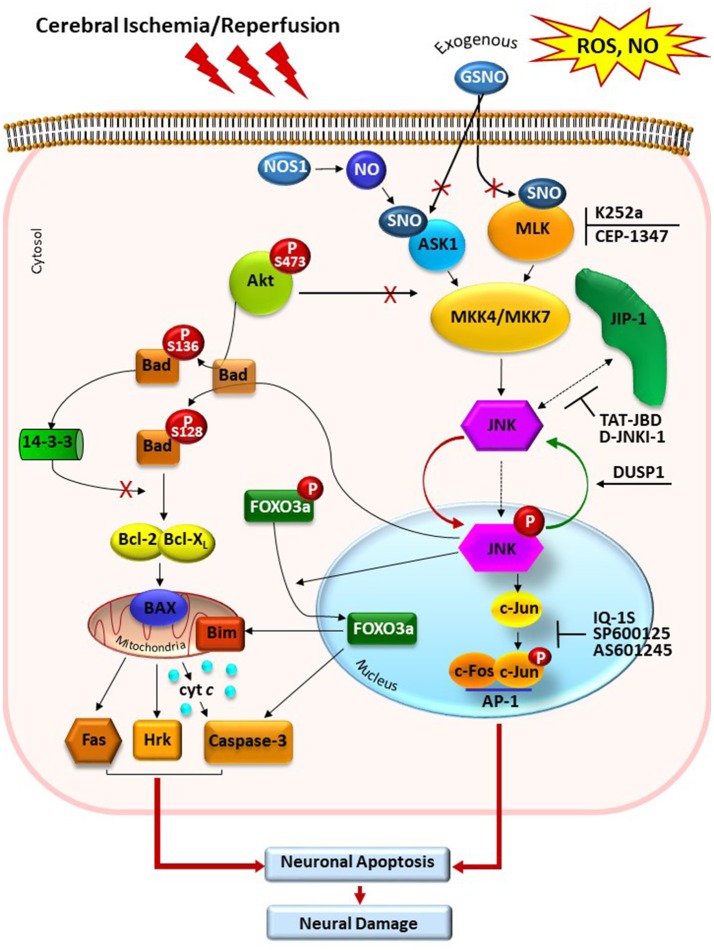
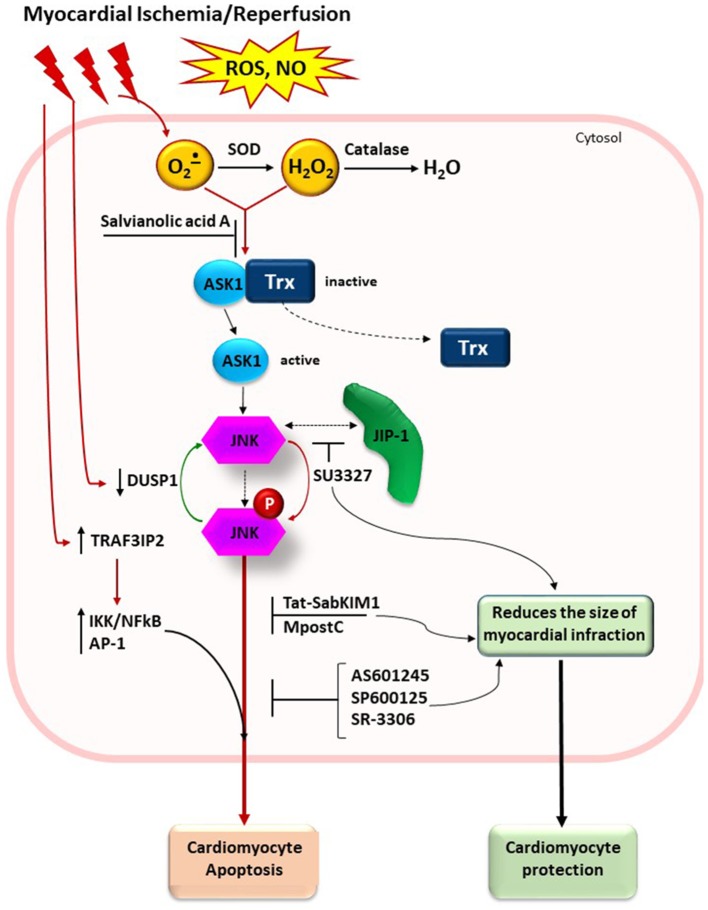
In this article, we review the literature regarding the role of c-Jun N-terminal kinases (JNKs) in cerebral and myocardial ischemia/reperfusion injury. Numerous studies demonstrate that JNK-mediated signaling pathways play an essential role in cerebral and myocardial ischemia/reperfusion injury. JNK-associated mechanisms are involved in preconditioning and post-conditioning of the heart and the brain. The literature and our own studies suggest that JNK inhibitors may exert cardioprotective and neuroprotective properties. The effects of modulating the JNK-depending pathways in the brain and the heart are reviewed. Cardioprotective and neuroprotective mechanisms of JNK inhibitors are discussed in detail including synthetic small molecule inhibitors (AS601245, SP600125, IQ-1S, and SR-3306), ion channel inhibitor GsMTx4, JNK-interacting proteins, inhibitors of mixed-lineage kinase (MLK) and MLK-interacting proteins, inhibitors of glutamate receptors, nitric oxide (NO) donors, and anesthetics. The role of JNKs in ischemia/reperfusion injury of the heart in diabetes mellitus is discussed in the context of comorbidities. According to reviewed literature, JNKs represent promising therapeutic targets for protection of the brain and the heart against ischemic stroke and myocardial infarction, respectively. However, different members of the JNK family exert diverse physiological properties which may not allow for systemic administration of non-specific JNK inhibitors for therapeutic purposes. Currently available candidate JNK inhibitors with high therapeutic potential are identified. The further search for selective JNK3 inhibitors remains an important task.
在本文中,我们综述了有关c-Jun氨基末端激酶(JNKs)在脑和心肌缺血/再灌注损伤中作用的文献。大量研究表明,JNK介导的信号通路在脑和心肌缺血/再灌注损伤中起重要作用。JNK相关机制参与心脏和大脑的预处理和后处理。文献及我们自己的研究表明,JNK抑制剂可能具有心脏保护和神经保护特性。本文综述了调节脑和心脏中依赖JNK的信号通路的作用。详细讨论了JNK抑制剂的心脏保护和神经保护机制,包括合成小分子抑制剂(AS601245、SP600125、IQ-1S和SR-3306)、离子通道抑制剂GsMTx4、JNK相互作用蛋白、混合谱系激酶(MLK)抑制剂和MLK相互作用蛋白、谷氨酸受体抑制剂、一氧化氮(NO)供体和麻醉剂。在合并症的背景下讨论了JNKs在糖尿病患者心脏缺血/再灌注损伤中的作用。根据综述文献,JNKs分别是保护大脑和心脏免受缺血性中风和心肌梗死的有前景的治疗靶点。然而,JNK家族的不同成员具有不同的生理特性,这可能不允许为治疗目的全身应用非特异性JNK抑制剂。确定了目前具有高治疗潜力的候选JNK抑制剂。进一步寻找选择性JNK3抑制剂仍然是一项重要任务。