Kang Zhenyu, Yang Mengling, Liu Yue, Gui Yang, Dong Yalan, Zhou Haifeng, Zhang Zili, Li Mingyue, Fan Heng, Li Zheng, Lu Junjie, Li Junyi, Zhu Rui, Yin Chengyu, Liu Boyi, Jiang Feng, Huang Kun, Sarapultsev Alexey, Li Fangfei, Zhang Ge, Zhao Ling, Wang Yanyi, Ning Yunjia, Cheng Xiang, Mohanta Sarajo K, Yin Changjun, Luo Shanshan, Habenicht Andreas J R, Hu Desheng
Department of Integrated Traditional Chinese and Western Medicine, Union Hospital, Tongji Medical College, Huazhong University of Science and Technology, Wuhan, China.
Cardiovascular Disease Center, Xiyuan Hospital of China academy of Chinese Medical Sciences, Beijing, China.
Nat Commun. 2025 Jun 2;16(1):5101. doi: 10.1038/s41467-025-60123-7.
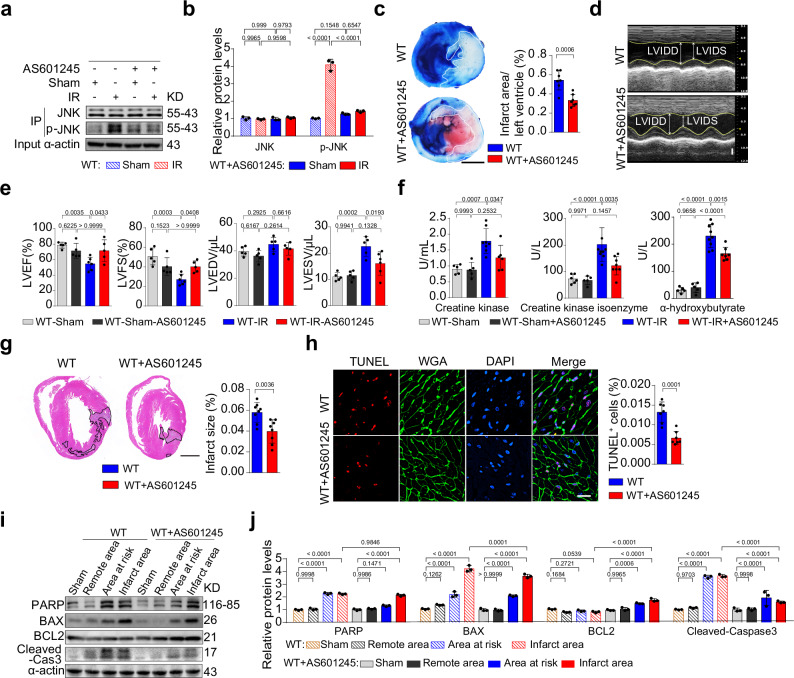
Myocardial ischemia-reperfusion injury (MIRI) is a life-threatening complication of myocardial infarcts, with inner mitochondrial membrane protein dysfunction involved in MIRI-induced heart injury. The role of outer mitochondrial membrane protein mitochondrial antiviral signaling protein (MAVS) is unknown. Here, we show that MAVS expression increases in infarcted myocardium of male wild-type mice. Global MAVS-knock-out or myocardial-specific MAVS knockdown protects male mice from acute and chronic MIRI. MIRI induces double-stranded RNA in affected myocardium, activating intracellular retinoic acid-inducible gene I (RIG-I) signaling, which leads to MAVS aggregation and subsequent non-canonical downstream signaling. MAVS aggregates recruit tumor necrosis factor-associated factor family 6 (TRAF6) and transforming growth factor-β-activated kinase 1 (TAK1), the activating mitogen-activated protein kinase (MAPK) pathway and apoptosis. MAVS-knock-out reduces c-jun-NH2 terminal kinase (JNK) phosphorylation and apoptosis. JNK inhibition protects against MIRI in wild-type male mice, whereas JNK agonist impairs protection in MAVS-knock-out male mice. MIRI activates RIG-I/MAVS pathway and subsequently triggers the TAK1/TRAF6 complex, leading to the activation of the MAPK/JNK signaling cascade. This sequential activation cascade may serve as a potential therapeutic target for MIRI.
心肌缺血再灌注损伤(MIRI)是心肌梗死的一种危及生命的并发症,线粒体内膜蛋白功能障碍参与了MIRI所致的心脏损伤。线粒体外膜蛋白线粒体抗病毒信号蛋白(MAVS)的作用尚不清楚。在此,我们发现雄性野生型小鼠梗死心肌中MAVS表达增加。全身性MAVS基因敲除或心肌特异性MAVS基因敲低可保护雄性小鼠免受急性和慢性MIRI的影响。MIRI在受影响的心肌中诱导双链RNA,激活细胞内视黄酸诱导基因I(RIG-I)信号通路,导致MAVS聚集及随后的非经典下游信号传导。MAVS聚集体募集肿瘤坏死因子相关因子家族6(TRAF6)和转化生长因子-β激活激酶1(TAK1),激活丝裂原活化蛋白激酶(MAPK)途径并引发凋亡。MAVS基因敲除可降低c-jun氨基末端激酶(JNK)磷酸化水平并减少凋亡。抑制JNK可保护野生型雄性小鼠免受MIRI的影响,而JNK激动剂则会削弱MAVS基因敲除雄性小鼠的保护作用。MIRI激活RIG-I/MAVS途径,随后触发TAK1/TRAF6复合物,导致MAPK/JNK信号级联反应的激活。这种顺序激活级联反应可能成为MIRI的一个潜在治疗靶点。