de Vries Stefan A H, van Doeselaar Marina, Meij Björn P, Tryfonidou Marianna A, Ito Keita
Orthopaedic Biomechanics, Department of Biomedical Engineering, Eindhoven University of Technology, P.O. Box 513, Eindhoven, the Netherlands.
Faculty of Veterinary Medicine, Department of Clinical Sciences of Companion Animals, Utrecht University, Utrecht, the Netherlands.
J Orthop Res. 2018 Dec;36(12):3188-3195. doi: 10.1002/jor.24114. Epub 2018 Aug 6.
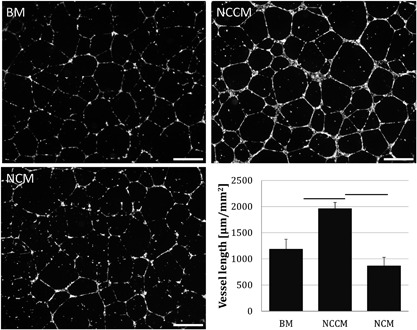
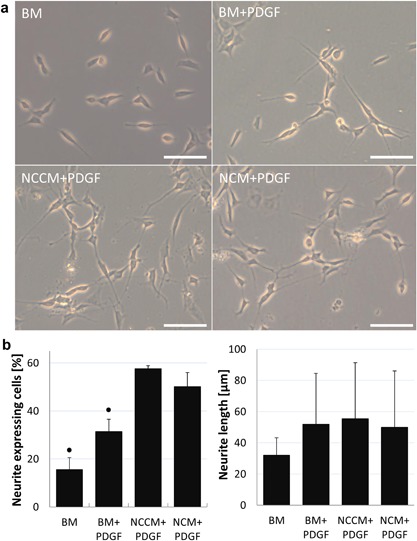
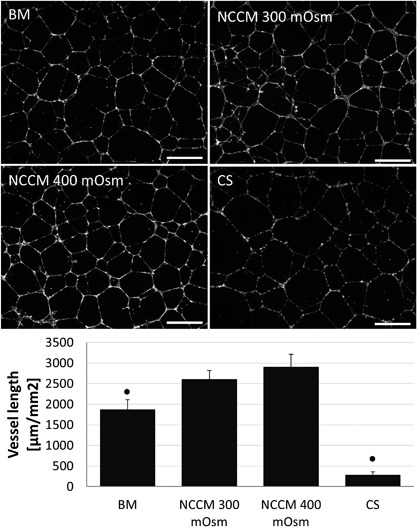
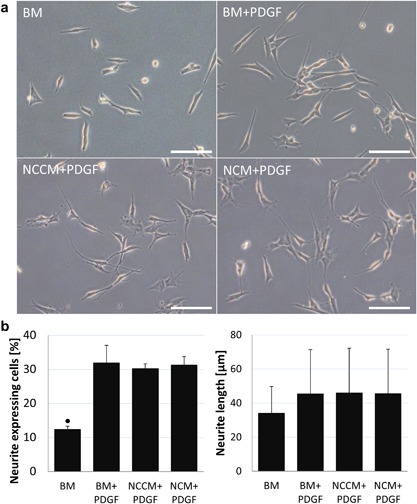
Blood vessel and neurite ingrowth into the degenerating intervertebral disc (IVD) are related to pain. In reported studies, notochordal cell (NC)-conditioned medium (NCCM) induced a regenerative response of nucleus pulposus (NP) cells, but also inhibition of neurite and vessel formation. NC matrix (NCM) derived from NC-rich NP tissue, induced even stronger anabolic effects than NCCM. Thus, the aim was to investigate whether NCM has similar anti-neurogenic and -angiogenic properties as NCCM. NCM and NCCM where produced from porcine NC-rich NP tissue. Human umbilical vein endothelial cells (HUVECs) were cultured in base medium (BM, 300 mOsm), NCCM (produced at 300 and 400 mOsm), NCM, or with chondroitin sulfate (CS, positive control) in angiogenesis-inducing medium, after which vessel length was measured. Although CS alone inhibited vessel growth, NCCM (both osmolarities) stimulated vessel formation by HUVECs. NCM did not affect vessel growth relative to BM. SH-SY5Y cells were cultured in BM, NCCM, and NCM on poly-D-lysine coated and polystyrene surfaces, and analyzed for neurite length and percentage of neurite expressing cells. On coated surfaces, neither NCCM nor NCM affected neurite growth. On a polystyrene surface, NCCM and NCM induced a higher number of neurite-expressing cells. NCCM's previously reported anti-angiogenic and -neurogenic effects were not observed in this study. Although addition of CS inhibited HUVEC vessel formation, other factors may be present in NCCM and NCM that affect neurite and vessel growth. Therefore, future studies testing an NC-based regenerative strategy should carefully assess the risk of such adverse effects in an in vivo setting. © 2018 The Authors. Journal of Orthopaedic Research® Published by Wiley Periodicals, Inc. J Orthop Res 36:3188-3195, 2018.
血管和神经纤维长入退变的椎间盘(IVD)与疼痛相关。在已报道的研究中,脊索细胞(NC)条件培养基(NCCM)可诱导髓核(NP)细胞产生再生反应,但同时也会抑制神经纤维和血管形成。源自富含NC的NP组织的NC基质(NCM),其合成代谢作用比NCCM更强。因此,本研究旨在探讨NCM是否具有与NCCM类似的抗神经生成和抗血管生成特性。NCM和NCCM均由猪富含NC的NP组织制备。人脐静脉内皮细胞(HUVECs)在基础培养基(BM,300 mOsm)、NCCM(分别在300和400 mOsm条件下制备)、NCM或硫酸软骨素(CS,阳性对照)中,于促血管生成培养基中培养,之后测量血管长度。尽管单独使用CS可抑制血管生长,但NCCM(两种渗透压条件下)均可刺激HUVECs形成血管。相对于BM,NCM对血管生长无影响。SH-SY5Y细胞在涂有聚-D-赖氨酸的聚苯乙烯表面上,于BM、NCCM和NCM中培养,并分析神经纤维长度和表达神经纤维的细胞百分比。在涂有聚-D-赖氨酸的表面上,NCCM和NCM均不影响神经纤维生长。在聚苯乙烯表面上,NCCM和NCM可诱导更多表达神经纤维的细胞。本研究未观察到NCCM先前报道的抗血管生成和抗神经生成作用。尽管添加CS可抑制HUVECs血管形成,但NCCM和NCM中可能存在其他影响神经纤维和血管生长的因素。因此,未来测试基于NC的再生策略的研究应在体内环境中仔细评估此类不良反应的风险。© 2018作者。《骨科研究杂志》®由威利期刊公司出版。《骨科研究杂志》36:3188 - 3195,2018年。