KU Leuven-University of Leuven, Department of Microbiology and Immunology, Rega Institute for Medical Research, Clinical and Epidemiological Virology, Leuven, Belgium.
Peter Medawar Building for Pathogen Research, Nuffield Department of Medicine, University of Oxford, Oxford, United Kingdom.
PLoS One. 2018 Jul 25;13(7):e0201268. doi: 10.1371/journal.pone.0201268. eCollection 2018.
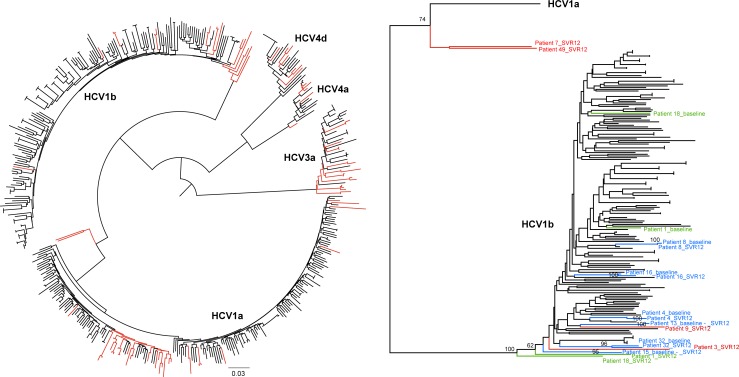
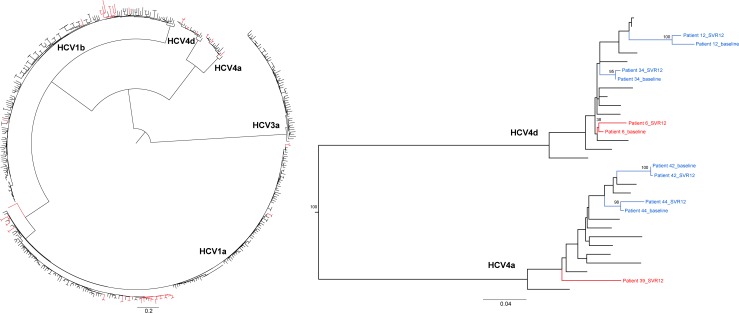
Despite high response rates associated to hepatitis C virus (HCV) treatment, no protective immunity is acquired, allowing for reinfection and continued infectiousness. Distinguishing between relapse and reinfection is crucial for patient counselling and to choose the most appropriate retreatment. Here, refined phylogenetic analysis using multiple genes served to assess genotype and reinfection for 53 patients for whom the virus was sampled before start of therapy and at time of sustained virological response evaluation at week 12. At baseline, genotypes were determined as HCV1a (41.5%), HCV1b (24.5%), HCV4 (18.9%) and HCV3a (15.1%), while six cases revealed to be discordantly assigned by phylogeny and commercial assays. Overall, 60.4% was co-infected with HIV. The large majority was classified as people who inject drugs (78.6%), often co-infected with HIV. Transmission was sexual in seven cases, of which five in HIV-positive men-who-have-sex-with-men. Overall, relapse was defined for 44 patients, while no conclusion was drawn for four patients. Five patients were reinfected with a different HCV strain, of which three with a different genotype, showing that phylogeny is needed not only to determine the genotype, but also to distinguish between relapse and intra-subtype reinfection. Of note, phylogenies are more reliable when longer fragments of the viral genome are being sequenced.
尽管丙型肝炎病毒 (HCV) 治疗后有很高的反应率,但并没有获得保护性免疫,从而允许再次感染和持续的传染性。区分复发和再感染对于患者咨询和选择最合适的再治疗至关重要。在这里,使用多个基因进行的精细系统发育分析用于评估 53 名患者的基因型和再感染情况,这些患者在开始治疗前和第 12 周持续病毒学应答评估时采集了病毒样本。在基线时,确定的基因型为 HCV1a(41.5%)、HCV1b(24.5%)、HCV4(18.9%)和 HCV3a(15.1%),而通过系统发育和商业检测发现有 6 例存在不一致的分配情况。总体而言,60.4%的患者同时感染了 HIV。绝大多数患者(78.6%)为静脉注射毒品者,通常同时感染 HIV。7 例为性传播,其中 5 例为 HIV 阳性的男男性接触者。总体而言,44 例患者被定义为复发,4 例患者则无定论。5 例患者感染了不同的 HCV 株,其中 3 例为不同基因型,表明系统发育不仅需要确定基因型,还需要区分复发和同型内再感染。值得注意的是,当对病毒基因组的较长片段进行测序时,系统发育更可靠。