Faculty of Life and Environmental Sciences, University of Tsukuba, 1-1-1 Tennodai, Tsukuba, Ibaraki, 305-8572, Japan.
College of Science and Engineering, Kanto Gakuin University, 1-50-1 Mutsuura-higashi, Kanazawa-ku, Yokohama, Kanagawa, 236-8501, Japan.
Sci Rep. 2018 Jul 25;8(1):11230. doi: 10.1038/s41598-018-29482-8.
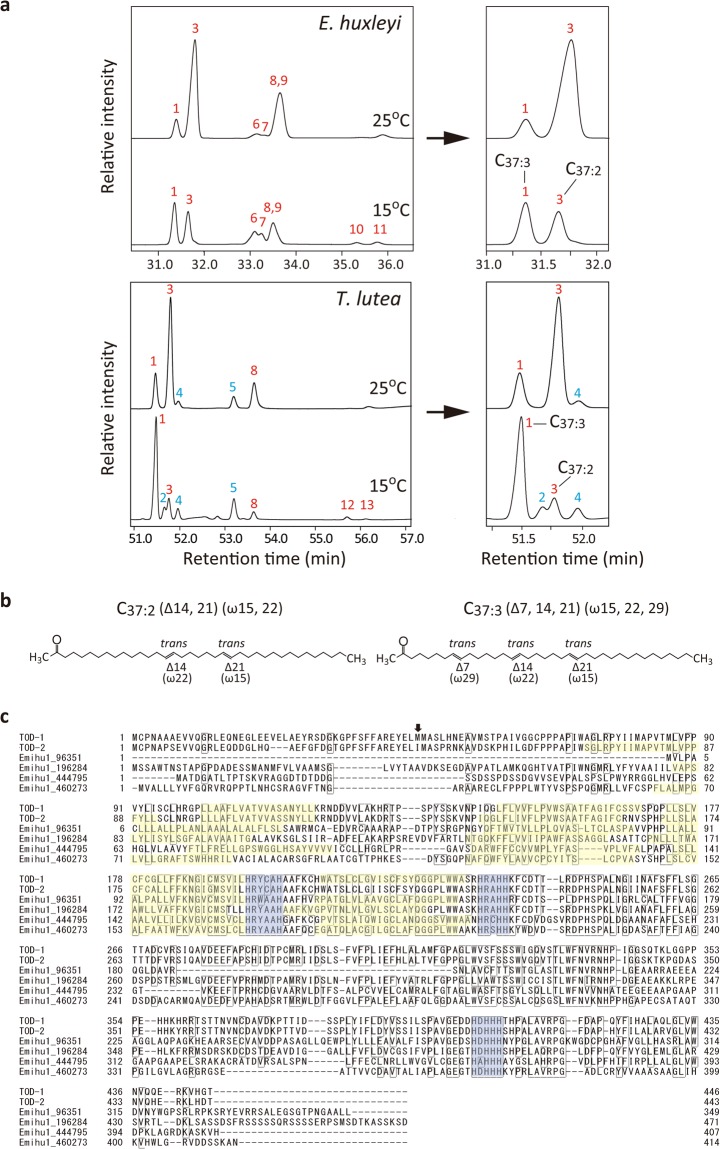
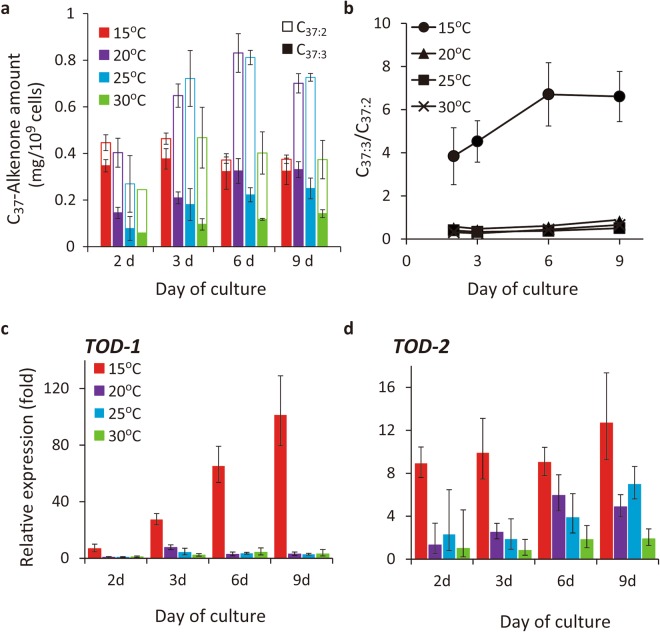
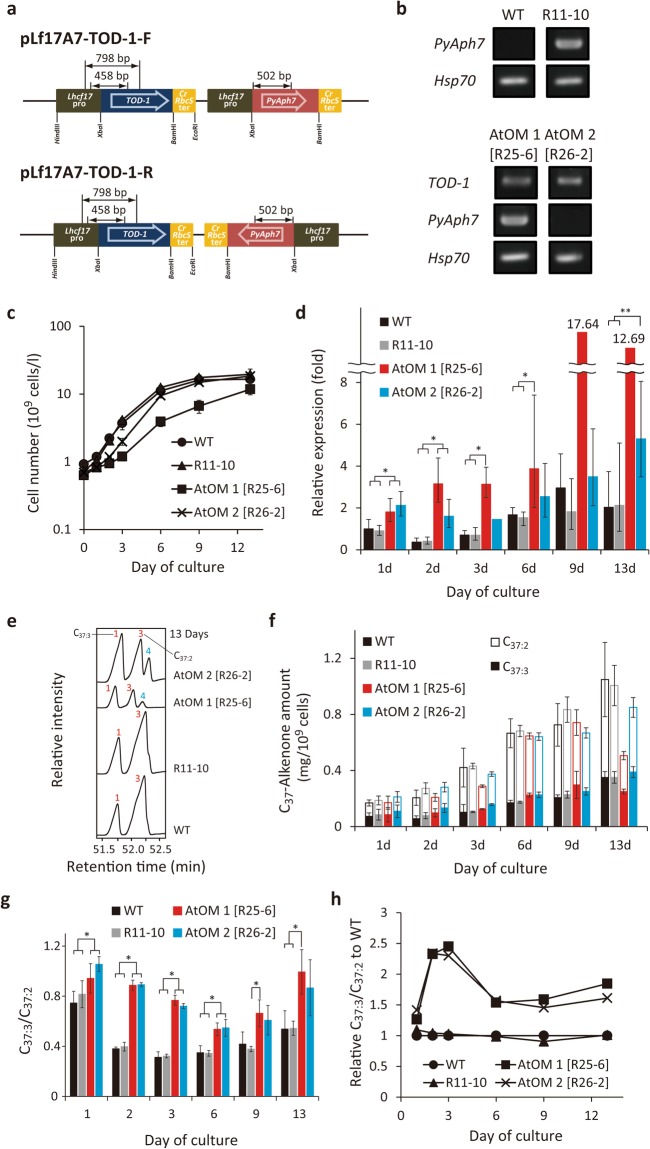
Alkenones are unusual long-chain neutral lipids that were first identified in oceanic sediments. Currently they are regarded as reliable palaeothermometers, since their unsaturation status changes depending on temperature. These molecules are synthesised by specific haptophyte algae and are stored in the lipid body as the main energy storage molecules. However, the molecular mechanisms that regulate the alkenone biosynthetic pathway, especially the low temperature-dependent desaturation reaction, have not been elucidated. Here, using an alkenone-producing haptophyte alga, Tisochrysis lutea, we show that the alkenone desaturation reaction is catalysed by a newly identified desaturase. We first isolated two candidate desaturase genes and found that one of these genes was drastically upregulated in response to cold stress. Gas chromatographic analysis revealed that the overexpression of this gene, named as Akd1 finally, increased the conversion of di-unsaturated C-alkenone to tri-unsaturated molecule by alkenone desaturation, even at a high temperature when endogenous desaturation is efficiently suppressed. We anticipate that the Akd1 gene will be of great help for elucidating more detailed mechanisms of temperature response of alkenone desaturation, and identification of active species contributing alkenone production in metagenomic and/or metatranscriptomic studies in the field of oceanic biogeochemistry.
烯酮是一种不寻常的长链中性脂质,最初在海洋沉积物中被发现。目前,它们被认为是可靠的古温度计,因为它们的不饱和状态随温度变化而变化。这些分子是由特定的甲藻合成的,并作为主要的能量储存分子储存在脂滴中。然而,调节烯酮生物合成途径的分子机制,特别是低温依赖的去饱和反应,尚未阐明。在这里,我们使用一种产生烯酮的甲藻,即 Tisochrysis lutea,表明烯酮的去饱和反应是由新鉴定的去饱和酶催化的。我们首先分离了两个候选的去饱和酶基因,并发现其中一个基因在冷胁迫下明显上调。气相色谱分析显示,该基因的过表达,最终命名为 Akd1,增加了烯酮去饱和作用中二不饱和 C-烯酮向三不饱和分子的转化,即使在高温下,内源性去饱和作用也被有效抑制。我们预计,Akd1 基因将有助于阐明烯酮去饱和对温度响应的更详细机制,并有助于在海洋生物地球化学领域的宏基因组和/或宏转录组研究中确定产生烯酮的活性物质。