Li Yan, Liu Liangang, Huang Lian, Wang Xiaomin, Hoffmann Matthew, Reyes Josephine, Palmisano Maria, Zhou Simon
Translational Development and Clinical Pharmacology,
Biometrics and Data Operations.
Clin Pharmacol. 2018 Jul 19;10:89-99. doi: 10.2147/CPAA.S171735. eCollection 2018.
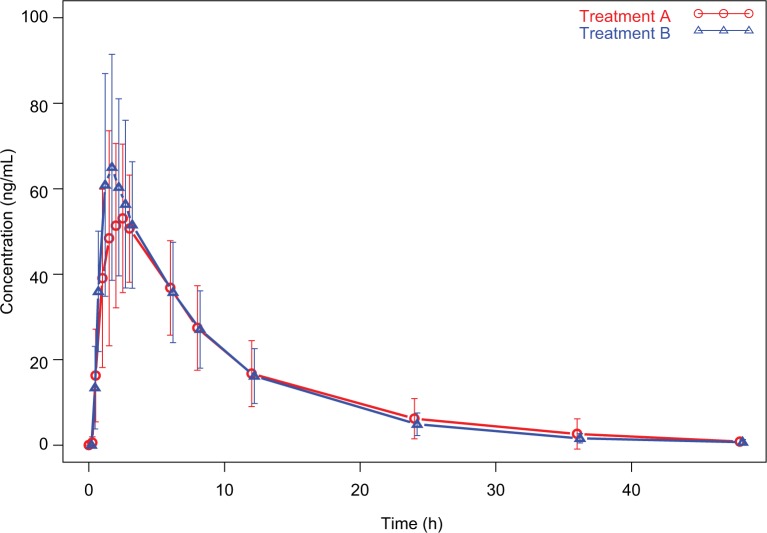
The aim of this study was to evaluate the bioavailability of a pomalidomide oral liquid suspension relative to the commercial capsule formulation and to assess the food effect on the pomalidomide oral liquid suspension when administered as a single 4 mg dose.
This was an open-label, randomized, three-period, two-sequence crossover study in healthy subjects consisting of a screening phase, a baseline assessment phase, a treatment phase with three periods, and a follow-up phone call phase. Blood samples for pharmacokinetics (PK) assessment were collected up to 48 h postdose during each treatment period. Safety was evaluated throughout the study.
Pomalidomide exposures were comparable in healthy subjects administered with a single oral 4 mg dose as the reference capsule or as the test liquid suspension formulations, demonstrated as the 90% confidence intervals of the geometric mean ratios for area under the plasma concentration-time curve calculated from time 0 to the last measurable concentration at time (AUC), area under the plasma concentration-time curve from time 0 to infinity (AUC), and peak (maximum) plasma drug concentration () were completely contained within the bioequivalence range of 80-125%. Administration of the pomalidomide liquid suspension with a high fat meal resulted in a 3.0 h delay in pomalidomide time to () and an ~ 34.5% reduction in . However, the AUCs were comparable after dose administration with and without food.
A single oral dose of 4 mg of liquid suspension was bioequivalent to a single oral dose of 4 mg of capsule formulation. There was no clinically relevant impact of food on pomalidomide liquid suspension. Single oral doses of 4 mg pomalidomide were safe and well tolerated when administered as a liquid suspension under fed and fasted conditions or as a capsule under fasted conditions.
本研究旨在评估泊马度胺口服液体混悬液相对于市售胶囊制剂的生物利用度,并评估单次服用4mg剂量时食物对泊马度胺口服液体混悬液的影响。
这是一项在健康受试者中进行的开放标签、随机、三周期、两序列交叉研究,包括筛选阶段、基线评估阶段、三个周期的治疗阶段和随访电话阶段。在每个治疗周期内,给药后长达48小时采集血样进行药代动力学(PK)评估。在整个研究过程中评估安全性。
在给予单次口服4mg剂量作为参比胶囊或受试液体混悬液制剂的健康受试者中,泊马度胺的暴露量相当,从时间0至最后可测量浓度时血浆浓度-时间曲线下面积(AUC)、从时间0至无穷大时血浆浓度-时间曲线下面积(AUC)以及血浆药物峰(最大)浓度()的几何平均比值的90%置信区间完全包含在80%-125%的生物等效性范围内。高脂餐服用泊马度胺液体混悬液导致泊马度胺达峰时间()延迟3.0小时,峰浓度()降低约34.5%。然而,给药后进食和未进食时的AUC相当。
单次口服4mg液体混悬液与单次口服4mg胶囊制剂生物等效。食物对泊马度胺液体混悬液无临床相关影响。单次口服4mg泊马度胺作为液体混悬液在进食和空腹条件下给药或作为胶囊在空腹条件下给药时安全且耐受性良好。