Epidemiology Group, School of Medicine, Medical Sciences and Nutrition, Aberdeen, UK.
Aberdeen Centre for Arthritis and Musculoskeletal Health, University of Aberdeen, Aberdeen, UK.
Rheumatology (Oxford). 2018 Nov 1;57(11):1982-1990. doi: 10.1093/rheumatology/key206.
To quantify the extent to which co-morbid FM is associated with higher disease activity, worse quality of life (QoL) and poorer response to TNF inhibitors (TNFis) in patients with axial SpA.
A prospective study recruiting across 83 centres in the UK. Clinical information and patient-reported measures were available, including 2011 criteria for FM. Multivariable linear regression was used to model the effect of meeting the FM criteria on disease activity, QoL and response to TNFis.
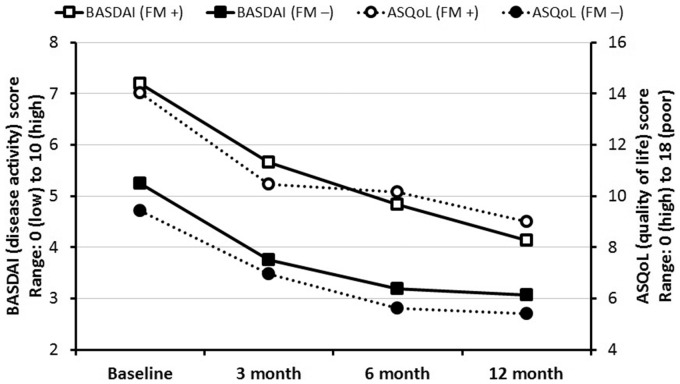
A total of 1757 participants were eligible for analyses, of whom 22.1% met criteria for FM. Those with co-morbid FM criteria had higher disease activity [BASDAI average difference FM+ - FM- 1.04 (95% CI 0.75, 1.33)] and worse QoL [Ankylosing Spondylitis Quality of Life score difference 1.42 (95% CI 0.88, 1.96)] after adjusting for demographic, clinical and lifestyle factors. Among 291 participants who commenced biologic therapy, BASDAI scores in those with co-morbid FM were 2.0 higher at baseline but decreased to 1.1 higher at 12 months. There was no significant difference in the likelihood of meeting Assessment of SpondyloArthritis international Society 20 criteria at 12 months. Less improvement in disease activity and QoL over 3 months of TNFi therapy was most strongly related to high scores on the FM criteria symptom severity scale component.
Fulfilling criteria for FM has a modest impact on the assessment of axial SpA disease activity and QoL and does not significantly influence response to biologic therapy. Those with a high symptom severity scale on FM assessment may benefit from additional specific management for FM.
定量评估合并纤维肌痛(FM)与更高疾病活动度、更差的生活质量(QoL)以及对肿瘤坏死因子抑制剂(TNFis)反应较差在中轴型脊柱关节炎(SpA)患者中的关联程度。
一项在英国 83 个中心开展的前瞻性研究,获取了临床信息和患者报告的测量结果,包括 FM 的 2011 标准。采用多变量线性回归模型,对符合 FM 标准对疾病活动度、QoL 和 TNFis 反应的影响进行建模。
共有 1757 名符合分析条件的参与者,其中 22.1%符合 FM 标准。在调整人口统计学、临床和生活方式因素后,符合 FM 标准的患者疾病活动度更高[BASDAI 平均差值 FM+ - FM- 1.04(95%CI 0.75,1.33)],生活质量更差[强直性脊柱炎生活质量评分差值 1.42(95%CI 0.88,1.96)]。在 291 名开始接受生物治疗的参与者中,基线时合并 FM 的患者 BASDAI 评分高 2.0,但在 12 个月时降低至高 1.1。在 12 个月时,符合国际脊柱关节炎评估协会 20 标准的可能性没有显著差异。在 3 个月 TNFis 治疗期间,疾病活动度和 QoL 的改善程度较低,与 FM 标准症状严重程度量表成分的高分最相关。
符合 FM 标准对中轴型 SpA 疾病活动度和 QoL 的评估有一定影响,但对生物治疗的反应没有显著影响。在 FM 评估中具有较高症状严重程度量表评分的患者可能受益于针对 FM 的额外特定管理。