Thoracic and Oncologic Surgery Branch, National Cancer Institute, National Institutes of Health, Bethesda, MD, USA.
Biostatistics and Data Management Section, Center for Cancer Research, National Cancer Institute, National Institutes of Health, Bethesda, MD, USA.
Ann Surg Oncol. 2018 Nov;25(12):3436-3442. doi: 10.1245/s10434-018-6674-4. Epub 2018 Jul 27.
The demand for training in complex general surgical oncology (CGSO) fellowships currently exceeds the number of positions offered; however, there are scarce data defining the applicant pool or characteristics associated with successful matriculation. Our study described the applicant population and to determine factors associated with acceptance into the fellowship.
Data were extracted from the Electronic Residency Application System for applicants in 2015 and 2016 and stratified based on matriculation status. Applicant demographics, including medical education, residency, and research achievements, were analyzed. Academic productivity was quantified using the number of peer-reviewed publications as well as the journal with the highest impact factor in which an applicant's work was published.
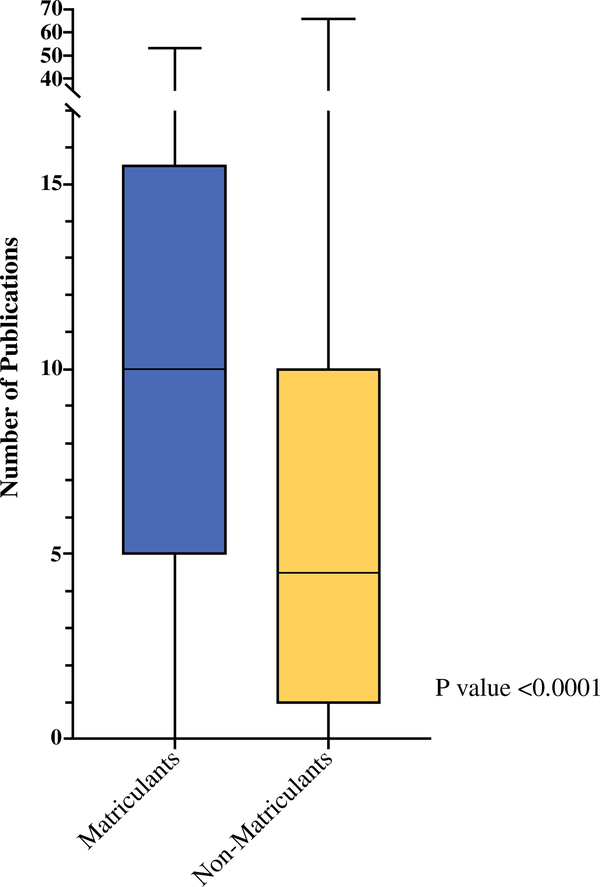
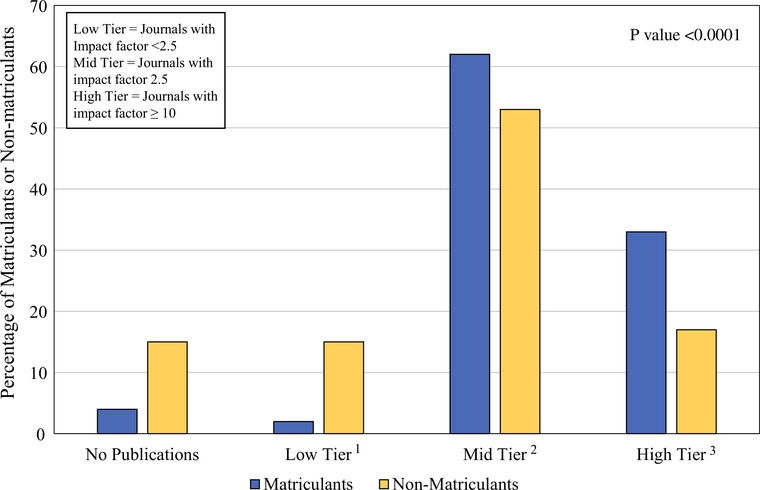
Data were gathered on a total of 283 applicants, of which 105 matriculated. The overall population was primarily male (63.2%), Caucasian (40.6%), educated at a U.S. allopathic medical school (53.4%), and trained at a university-based General Surgery residency (55.5%). Education at a U.S. allopathic school (OR = 5.63, p < 0.0001), university-based classification of the applicant's surgical residency (OR = 4.20, p < 0.0001), and a residency affiliation with a CGSO fellowship (OR = 2.61, p = 0.004) or National Cancer Institute designated Comprehensive Cancer Center (OR = 3.16, p < 0.001) were found to be associated with matriculation. Matriculants published a higher number of manuscripts than nonmatriculants (median of 10 vs. 4.5, p < 0.0001) and more frequently achieved publication in journals with higher impact factors (p < 0.0001).
This study represents the first objective description of the CGSO fellowship applicant pool. Applicants' medical school, residency, and research data points correlated with successful matriculation.
目前,复杂普通外科肿瘤学(CGSO)培训 fellowship的需求超过了提供的职位数量;然而,关于申请人群体或与成功入学相关的特征的数据却很少。我们的研究描述了申请人群体,并确定了与 fellowship 入学相关的因素。
从 2015 年和 2016 年的电子住院医师申请系统中提取数据,并根据入学情况进行分层。分析了申请人的人口统计学特征,包括医学教育、住院医师培训和研究成果。学术成果通过同行评议出版物的数量以及申请人工作发表的影响因子最高的期刊来量化。
共收集了 283 名申请人的数据,其中 105 人入学。总体人群主要为男性(63.2%)、白种人(40.6%)、在美国接受全科学医学教育(53.4%),并在大学附属普通外科住院医师培训(55.5%)。在美国接受全科学医学教育(OR=5.63,p<0.0001)、申请人的外科住院医师培训的大学分类(OR=4.20,p<0.0001)、与 CGSO 奖学金(OR=2.61,p=0.004)或国家癌症研究所指定的综合癌症中心(OR=3.16,p<0.001)的附属关系与入学相关。入学者发表的论文数量多于未入学者(中位数分别为 10 篇和 4.5 篇,p<0.0001),并且更频繁地在影响因子较高的期刊上发表文章(p<0.0001)。
这项研究代表了对 CGSO 奖学金申请人群体的首次客观描述。申请人的医学院、住院医师培训和研究数据点与成功入学相关。