Department of Medical Oncology, Dana-Farber Cancer Institute, Boston, United States.
Harvard Medical School, Boston, United States.
Elife. 2018 Jul 30;7:e37184. doi: 10.7554/eLife.37184.
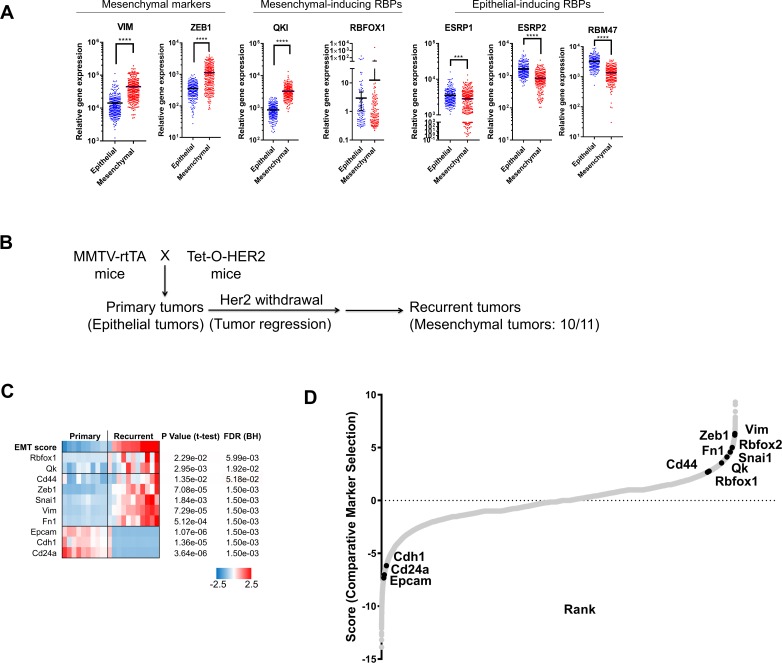
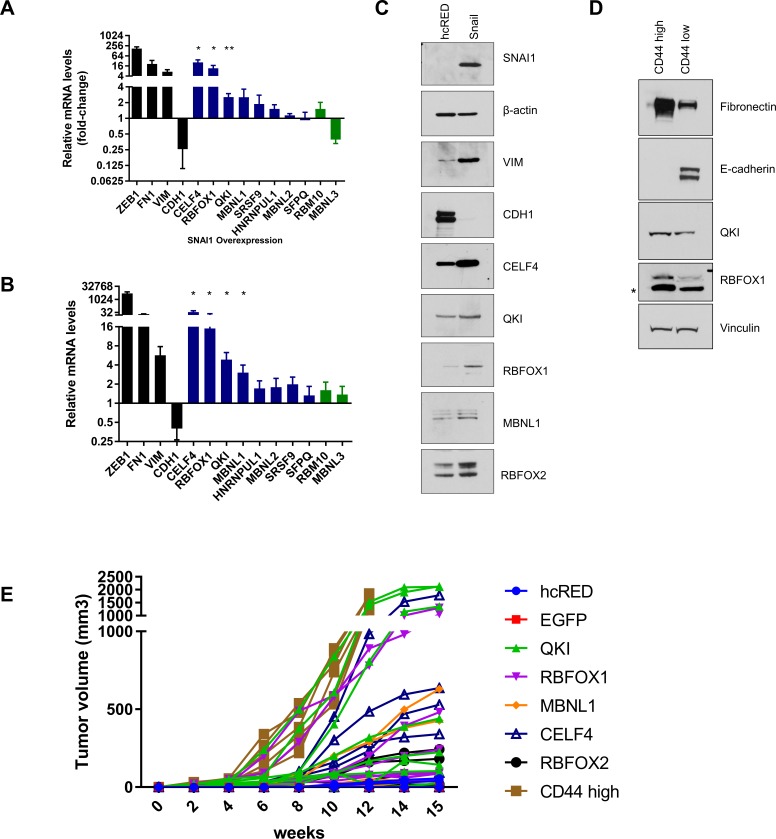
Alternative splicing of mRNA precursors represents a key gene expression regulatory step and permits the generation of distinct protein products with diverse functions. In a genome-scale expression screen for inducers of the epithelial-to-mesenchymal transition (EMT), we found a striking enrichment of RNA-binding proteins. We validated that QKI and RBFOX1 were necessary and sufficient to induce an intermediate mesenchymal cell state and increased tumorigenicity. Using RNA-seq and eCLIP analysis, we found that QKI and RBFOX1 coordinately regulated the splicing and function of the actin-binding protein FLNB, which plays a causal role in the regulation of EMT. Specifically, the skipping of FLNB exon 30 induced EMT by releasing the FOXC1 transcription factor. Moreover, skipping of FLNB exon 30 is strongly associated with EMT gene signatures in basal-like breast cancer patient samples. These observations identify a specific dysregulation of splicing, which regulates tumor cell plasticity and is frequently observed in human cancer.
mRNA 前体的可变剪接代表了一个关键的基因表达调控步骤,并允许产生具有不同功能的不同蛋白质产物。在一个大规模的上皮-间充质转化 (EMT) 诱导物的基因组规模表达筛选中,我们发现 RNA 结合蛋白明显富集。我们验证了 QKI 和 RBFOX1 是诱导中间间充质细胞状态和增加肿瘤发生所必需的和充分的。使用 RNA-seq 和 eCLIP 分析,我们发现 QKI 和 RBFOX1 协调调节肌动蛋白结合蛋白 FLNB 的剪接和功能,FLNB 在 EMT 的调控中起着因果关系。具体来说,FLNB 外显子 30 的跳跃通过释放 FOXC1 转录因子诱导 EMT。此外,FLNB 外显子 30 的跳跃与基底样乳腺癌患者样本中的 EMT 基因特征强烈相关。这些观察结果确定了一种特定的剪接失调,它调节肿瘤细胞的可塑性,并且在人类癌症中经常观察到。