Nutrition Research Institute, UNC Chapel Hill, Kannapolis, NC, United States.
Nutrition Research Institute, UNC Chapel Hill, Kannapolis, NC, United States; Department of Nutrition, UNC Chapel Hill, Chapel Hill, NC, United States.
Adv Cancer Res. 2018;140:191-215. doi: 10.1016/bs.acr.2018.04.011. Epub 2018 Jun 1.
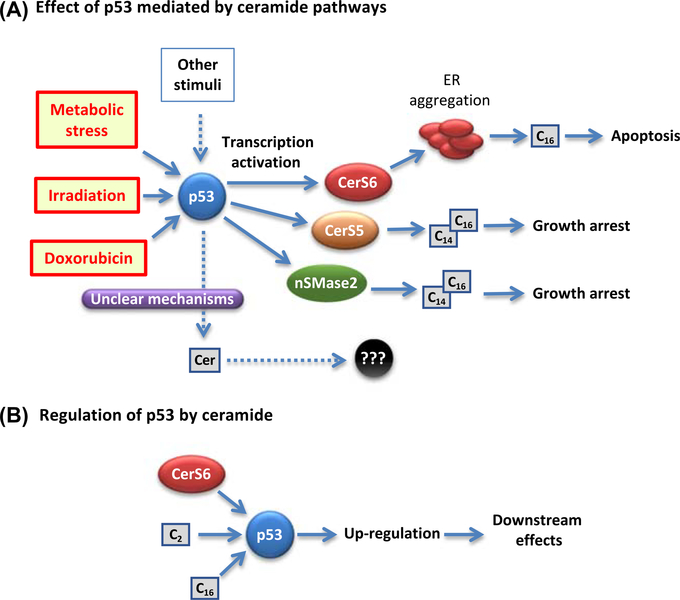
Ceramides, important players in signal transduction, interact with multiple cellular pathways, including p53 pathways. However, the relationship between ceramide and p53 is very complex, and mechanisms underlying their coregulation are diverse and not fully characterized. The role of p53, an important cellular regulator and a transcription factor, is linked to its tumor suppressor function. Ceramides are involved in the regulation of fundamental processes in cancer cells including cell death, proliferation, autophagy, and drug resistance. This regulation, however, can be pro-death or pro-survival depending on cancer type, the balance between ceramide species, the rate of their synthesis and utilization, and the availability of a specific array of downstream targets. This chapter highlights the central role of ceramide in sphingolipid metabolism, its role in cancer, specific effectors in ceramide pathways controlled by p53, and coregulation of ceramide and p53 signaling. We discuss the recent studies, which underscore the function of p53 in the regulation of ceramide pathways and the reciprocal regulation of p53 by ceramide. This complex relationship is based on several molecular mechanisms including the p53-dependent transcriptional regulation of enzymes in sphingolipid pathways, the activation of mutant p53 through ceramide-mediated alternative splicing, as well as modulation of the p53 function through direct and indirect effects on p53 coregulators and downstream targets. Further insight into the connections between ceramide and p53 will allow simultaneous targeting of the two pathways with a potential to yield more efficient anticancer therapeutics.
神经酰胺是信号转导中的重要参与者,与包括 p53 途径在内的多种细胞途径相互作用。然而,神经酰胺与 p53 之间的关系非常复杂,它们的核心调控机制多种多样,尚未完全阐明。p53 作为一种重要的细胞调节因子和转录因子,其作用与其肿瘤抑制功能有关。神经酰胺参与调节癌细胞的基本过程,包括细胞死亡、增殖、自噬和耐药性。然而,这种调节可以是促进死亡或促进生存,具体取决于癌症类型、神经酰胺种类之间的平衡、它们合成和利用的速度以及特定下游靶标的可用性。本章重点介绍神经酰胺在鞘脂代谢中的核心作用、它在癌症中的作用、p53 控制的神经酰胺途径中的特定效应物以及神经酰胺和 p53 信号的核心调控。我们讨论了最近的研究,这些研究强调了 p53 在调节神经酰胺途径中的功能以及神经酰胺对 p53 的反向调节。这种复杂的关系基于几种分子机制,包括鞘脂途径中酶的 p53 依赖性转录调节、通过神经酰胺介导的选择性剪接激活突变型 p53 ,以及通过直接和间接影响 p53 共激活因子和下游靶标来调节 p53 功能。进一步深入了解神经酰胺和 p53 之间的联系将允许同时靶向这两个途径,有可能产生更有效的抗癌治疗方法。